
How to Read Bitcoin Market Cycles: Complete Guide
How to Read Bitcoin Market Cycles: Complete Guide
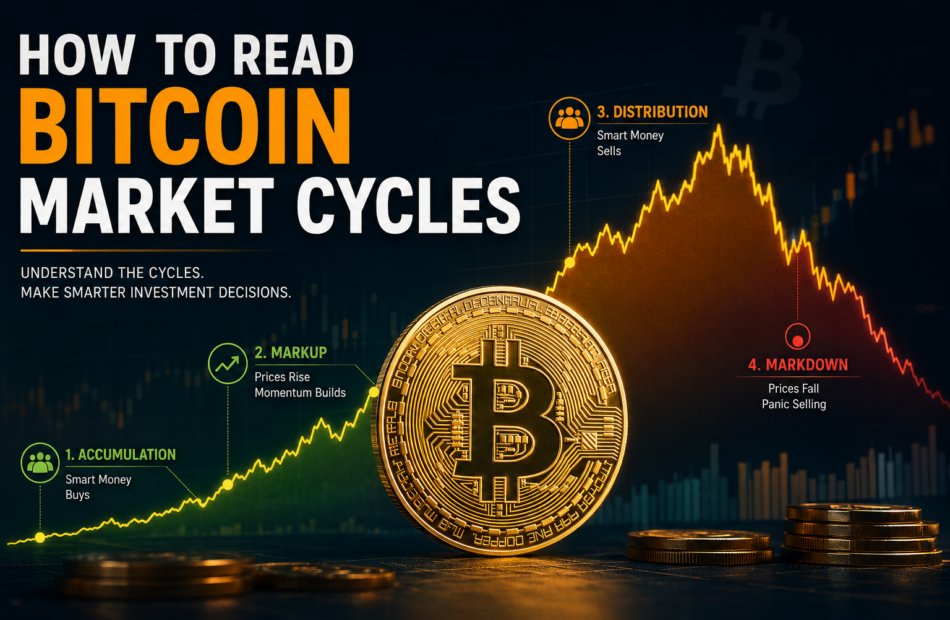
Learning how to read Bitcoin market cycles involves understanding the recurring phases of accumulation, markup, distribution, and markdown. By analyzing these stages alongside market indicators and investor sentiment, you can make more informed cryptocurrency investment decisions.
Quick Summary
Bitcoin does not move in a straight line. Instead, it follows cycles influenced by supply and demand, investor psychology, macroeconomic factors, and Bitcoin halving events. Understanding these cycles can help investors manage risk and identify potential opportunities.
Key Takeaways
- Bitcoin market cycles generally consist of four phases.
- Investor emotions often drive price movements.
- Halving events can significantly impact market trends.
- On-chain metrics provide valuable market insights.
- Long-term strategies typically outperform emotional decisions.
What Are Bitcoin Market Cycles?
Bitcoin market cycles refer to the recurring patterns of price growth and decline that occur over time. These cycles reflect changing investor sentiment, market conditions, and Bitcoin’s supply dynamics.
While no cycle is identical, understanding past patterns can help investors better interpret current market behavior.
Why Do Bitcoin Market Cycles Occur?
Several factors contribute to Bitcoin’s cyclical nature:
- Investor psychology.
- Bitcoin halving events.
- Market liquidity.
- Institutional participation.
- Global economic conditions.
- Media coverage and public sentiment.
These forces interact to create periods of optimism and pessimism.
The Four Phases of Bitcoin Market Cycles
Understanding these phases is essential if you want to know how to read Bitcoin market cycles effectively.
1. Accumulation Phase
The accumulation phase typically occurs after a prolonged market decline.
Characteristics:
- Prices stabilize.
- Market sentiment remains negative.
- Experienced investors gradually accumulate Bitcoin.
- Trading volumes are relatively low.
Many long-term investors view this phase as an opportunity.
2. Markup Phase
The markup phase marks the beginning of a sustained upward trend.
Characteristics:
- Higher highs and higher lows emerge.
- Positive sentiment increases.
- Media attention grows.
- New investors enter the market.
Historically, this phase has generated substantial returns.
3. Distribution Phase
During distribution, early investors begin taking profits.
Characteristics:
- Prices become highly volatile.
- Market enthusiasm peaks.
- Valuation concerns increase.
- Institutional selling may occur.
This phase often signals that the market is approaching a turning point.
4. Markdown Phase
The markdown phase represents a broader market correction.
Characteristics:
- Prices decline significantly.
- Investor confidence weakens.
- Fear dominates decision-making.
- Trading activity decreases.
Although challenging emotionally, this phase lays the foundation for future accumulation.
How to Read Bitcoin Market Cycles Using Key Indicators
Bitcoin Halving Events
Bitcoin halvings reduce the rate at which new Bitcoin enters circulation.
Historically, halvings have influenced long-term price trends by affecting supply dynamics. While past performance does not guarantee future outcomes, many investors monitor these events closely.
On-Chain Metrics
On-chain data can provide valuable insights into market conditions.
Common metrics include:
- Long-term holder behavior.
- Exchange inflows and outflows.
- Realized profit and loss indicators.
- Network activity trends.
These metrics help investors assess underlying market strength.
Technical Analysis Indicators
Technical tools may assist in identifying broader trends.
Popular indicators include:
- Moving averages.
- Relative Strength Index (RSI).
- Volume analysis.
- Support and resistance levels.
These indicators should complement—not replace—fundamental analysis.
Market Sentiment
Investor sentiment frequently influences Bitcoin price movements.
Signs of extreme optimism or excessive fear can sometimes indicate potential market turning points.
Common Mistakes Investors Make
Chasing Market Hype
Entering positions solely because others are buying often leads to poor outcomes.
Panic Selling
Short-term volatility may trigger emotional decisions that conflict with long-term objectives.
Ignoring Risk Management
Every investment strategy should include clear risk parameters.
Expecting Perfect Predictions
No indicator can consistently predict market tops and bottoms with certainty.
Practical Tips for Navigating Bitcoin Market Cycles
- Focus on long-term goals.
- Develop a disciplined investment plan.
- Avoid making decisions based solely on emotions.
- Diversify your overall portfolio.
- Continue educating yourself about market developments.
- Review your investment strategy periodically.
Consistency often proves more effective than attempting to time every market movement.
Frequently Asked Questions
1. What are Bitcoin market cycles?
Bitcoin market cycles are recurring periods of growth and decline influenced by supply, demand, and investor behavior.
2. How long do Bitcoin market cycles last?
Cycle durations vary, although many investors reference Bitcoin’s historical four-year pattern linked to halving events.
3. What is the accumulation phase?
The accumulation phase occurs after market declines when experienced investors gradually build positions.
4. How do halving events affect Bitcoin?
Halvings reduce new Bitcoin supply, which may influence long-term market dynamics.
5. Can technical analysis predict Bitcoin cycles?
Technical analysis can identify trends but cannot predict future outcomes with certainty.
6. Is investor psychology important?
Yes. Fear and greed often contribute significantly to market movements.
7. Should beginners study Bitcoin cycles?
Understanding market cycles can help beginners develop realistic expectations and stronger investment discipline.
8. Are Bitcoin cycles guaranteed to repeat?
No. Historical patterns offer insights, but future market conditions may differ.
9. Can market cycles help reduce investment risk?
Recognizing different phases may improve decision-making and support better risk management practices.
10. What is the best way to learn Bitcoin market cycles?
Combining historical analysis, educational resources, and ongoing market observation can strengthen understanding over time.
Conclusion
Understanding how to read Bitcoin market cycles can help investors navigate volatility with greater confidence. By recognizing the phases of accumulation, markup, distribution, and markdown, investors can develop more disciplined strategies and avoid emotional decision-making.
At The Crypto Investors, we aim to provide reliable cryptocurrency education, market insights, and practical investment knowledge to help readers make informed decisions in the ever-evolving digital asset landscape.
Disclaimer: This content is intended for educational purposes only and should not be considered financial advice. Always conduct independent research before making investment decisions.