

Using a Bitcoin Macro Risk Framework to Navigate Uncertain Markets
The Irony of Bitcoin Investing: More News, Worse Decisions
The more Bitcoin news you consume, the more anxious you tend to become.
That sounds backward. Most investors assume that staying informed leads to better outcomes. Yet in Bitcoin, the opposite is often true.
Every day brings a new headline. A government announcement. An ETF rumor. A regulatory scare. A macroeconomic prediction. A social media debate. A price target from someone who claims to know exactly where Bitcoin is headed next.
The result?
Most Bitcoin holders become trapped in a cycle of constant reaction. They feel informed, but their decision-making deteriorates.
The best Bitcoin investors often read surprisingly little news.
That isn’t because they are uninformed. It’s because they understand a simple truth:
News operates on a 24-hour cycle. Bitcoin operates on a multi-year cycle.
The mismatch creates one of the worst signal-to-noise environments in modern investing.
Instead of reacting to headlines, sophisticated investors rely on a structured framework that filters noise and focuses on the few variables that actually matter.
That framework is what we call a Bitcoin Macro Risk Framework.
What Is a Bitcoin Macro Risk Framework?
A Bitcoin Macro Risk Framework is a structured process for evaluating the major forces influencing Bitcoin’s long-term risk and opportunity profile.
Rather than focusing on daily price predictions, the framework tracks:
- Global liquidity conditions
- Central bank policy
- Market cycle positioning
- Institutional participation
- On-chain activity
- Investor sentiment
- Market structure
The goal is not to predict every price movement.
The goal is to make better decisions under uncertainty.
This distinction is critical.
Successful Bitcoin investing isn’t about forecasting every move. It’s about understanding probabilities and managing risk appropriately as conditions change.
Why Most Bitcoin News Is Financial Entertainment
Financial media has a business model.
Attention.
That means headlines are optimized for engagement rather than investment outcomes.
Every market move must have an explanation.
Every pullback becomes a crisis.
Every rally becomes the start of a new paradigm.
But Bitcoin doesn’t care about today’s headline cycle.
Bitcoin’s major bull and bear markets are driven by deeper forces that unfold over months and years.
For example:
- Global liquidity expansions
- Monetary policy shifts
- Bitcoin halving cycles
- Institutional adoption trends
- Capital market conditions
These developments rarely change overnight.
Yet they are responsible for the majority of Bitcoin’s long-term price movements.
For investors trying to build wealth, obsessing over daily news often becomes a distraction from the variables that actually matter.
The Three Signals That Matter Most
1. Global Liquidity
Liquidity is arguably the most important macro variable for Bitcoin.
When central banks expand liquidity and financial conditions loosen, risk assets generally benefit.
When liquidity contracts, speculative assets face greater pressure.
Bitcoin has increasingly become sensitive to global liquidity trends.
This is why understanding money supply growth, central bank balance sheets, and financial conditions often provides more insight than reading dozens of daily crypto articles.
For a deeper analysis, read our guide on:
How Global Liquidity Impacts Bitcoin Prices
2. Market Structure
Market structure reveals who is buying and selling.
Questions worth asking include:
- Are institutions accumulating?
- Are long-term holders distributing?
- Is leverage increasing?
- Are ETFs seeing sustained inflows?
- Is participation broadening or narrowing?
These structural changes often occur gradually and provide valuable clues about market direction.
3. On-Chain Metrics
Bitcoin offers something unique among major asset classes.
Its blockchain creates unprecedented transparency.
Investors can analyze:
- Long-term holder behavior
- Exchange balances
- Realized profits and losses
- Network activity
- Capital flows
These metrics frequently reveal investor behavior long before it becomes obvious in traditional news coverage.
Why Macro Matters More Than Ever
Bitcoin has matured significantly.
A decade ago, Bitcoin primarily traded as an isolated asset.
Today it exists within the global financial system.
Institutional investors participate through ETFs.
Corporate treasuries hold Bitcoin.
Governments discuss Bitcoin policy.
Macroeconomic developments increasingly influence capital flows into and out of digital assets.
This means Bitcoin investors who ignore macro conditions may be missing critical information.
Understanding interest rates, liquidity cycles, inflation trends, and credit conditions has become increasingly important.
The future of Bitcoin investing belongs to investors who combine on-chain intelligence with macro awareness.
The Problem With Emotional Bitcoin Investing
Emotional investing feels productive.
Checking prices every hour.
Reading endless Twitter threads.
Following every breaking story.
Reacting to every market move.
Unfortunately, these behaviors often lead to:
- Buying near market tops
- Selling near market bottoms
- Excessive trading
- Increased tax liabilities
- Poor risk management
- Higher stress levels
Most investment mistakes occur when emotions override process.
A macro risk framework provides structure.
Structure creates discipline.
Discipline improves outcomes.
Understanding Bitcoin Through Market Cycles
Bitcoin does not move randomly.
It tends to follow recognizable market cycles.
While no cycle repeats perfectly, recurring patterns continue to emerge around liquidity conditions, investor psychology, and supply dynamics.
Understanding where Bitcoin sits within a broader cycle can dramatically improve decision-making.
Read:
Where We Are in the Bitcoin Market Cycle
Investors who understand cycles often avoid the extremes of fear and euphoria that drive poor decisions.
The Components of TCI’s Bitcoin Macro Risk Framework
At The Crypto Investors, we developed our framework to simplify complex market information.
The objective is straightforward:
Filter out noise. Focus on signal.
Weekly Research Summaries
Most investors don’t need more information.
They need better information.
Our weekly research summaries distill dozens of market variables into actionable insights.
Instead of spending hours consuming news, members receive focused analysis highlighting meaningful developments.
Bitcoin Cycle Gauge
The Bitcoin Cycle Gauge tracks the broader position of Bitcoin within its market cycle.
Rather than relying on emotion or media narratives, investors gain a structured perspective on current conditions.
This helps answer critical questions:
- Are risks increasing?
- Are opportunities improving?
- Is market sentiment becoming excessive?
- Is caution warranted?
Macro Dashboard
The Macro Dashboard monitors key indicators influencing Bitcoin.
These include:
- Global liquidity
- Monetary policy
- Financial conditions
- Risk appetite
- Capital flows
The objective is not prediction.
The objective is preparedness.
Risk Management Is More Important Than Price Prediction
Most Bitcoin content focuses on price targets.
Few discussions focus on risk.
This is a mistake.
Professional investors understand that long-term success depends more on risk management than forecasting.
Consider reading:
Risk Management Frameworks for Large Bitcoin Positions
Investors who survive volatility remain positioned to benefit from long-term growth.
Investors who suffer catastrophic losses rarely recover.
How High-Net-Worth Investors Approach Bitcoin
Sophisticated investors rarely view Bitcoin as an all-or-nothing bet.
Instead, they focus on:
- Portfolio construction
- Position sizing
- Tax efficiency
- Hedging strategies
- Risk-adjusted returns
Additional resources:
Bitcoin Allocation Strategy for a $10M Portfolio
How Institutional Investors Manage Bitcoin Volatility
Bitcoin Portfolio Hedging Strategies
Tax Optimization Strategies for Significant Bitcoin Gains
Why Passive Bitcoin Investing Can Still Be Risky
Many investors assume that simply buying Bitcoin and holding forever eliminates risk.
Reality is more nuanced.
Passive investing without a framework can expose investors to:
- Concentration risk
- Tax inefficiencies
- Liquidity concerns
- Behavioral mistakes
- Opportunity costs
Learn more:
Why Passive Bitcoin Investing May Increase Portfolio Risk
Building a Better Bitcoin Decision-Making Process
The most successful investors don’t rely on certainty.
They rely on process.
A robust Bitcoin Macro Risk Framework creates a repeatable approach that reduces emotional decision-making.
The framework should answer:
- What is happening with liquidity?
- Where are we in the market cycle?
- What do on-chain metrics suggest?
- Is risk increasing or decreasing?
- Does portfolio exposure remain appropriate?
These questions matter far more than the latest social media debate.
The Future of Bitcoin Investing
Bitcoin continues evolving.
Institutional participation is increasing.
Capital markets are integrating Bitcoin exposure.
Macro conditions play a larger role than ever before.
As Bitcoin matures, successful investors will likely look less like traders and more like risk managers.
The edge will not come from consuming more information.
The edge will come from filtering information effectively.
That is precisely what a Bitcoin Macro Risk Framework is designed to accomplish.
Frequently Asked Questions
What is a Bitcoin Macro Risk Framework?
A Bitcoin Macro Risk Framework is a structured approach that evaluates macroeconomic conditions, liquidity trends, market cycles, and on-chain indicators to improve investment decisions and risk management.
Why is macro analysis important for Bitcoin?
Bitcoin increasingly responds to global liquidity conditions, interest rates, institutional capital flows, and broader financial market trends, making macro analysis increasingly valuable.
Are on-chain metrics better than news headlines?
In many cases, yes. On-chain data often reveals investor behavior and capital flows before these trends become widely discussed in the media.
Can a Bitcoin Macro Risk Framework predict prices?
No framework can consistently predict short-term prices. The goal is to improve probability-based decision-making and risk management.
Who benefits most from a Bitcoin Macro Risk Framework?
Long-term Bitcoin investors, high-net-worth individuals, family offices, and self-directed investors seeking a disciplined investment process can benefit significantly.
Final Thoughts
The Bitcoin market rewards patience, discipline, and structured thinking.
Unfortunately, most market participants are encouraged to do the opposite.
They consume more news.
They react more frequently.
They become more emotional.
A Bitcoin Macro Risk Framework offers a different path.
Instead of chasing headlines, focus on liquidity, market structure, and on-chain signals.
Instead of reacting, build a process.
Instead of trying to predict every move, learn to manage risk intelligently.
That’s how sophisticated Bitcoin investors navigate uncertain markets.
Subscribe to TCI’s Free Weekly Research
If you’re tired of information overload and want a smarter framework for understanding Bitcoin, subscribe to The Crypto Investors’ free weekly research.
Each week you’ll receive:
- Market cycle analysis
- Macro liquidity updates
- Risk framework insights
- Institutional-level Bitcoin research
- Actionable market intelligence
Explore more resources:
Contact The Crypto Investors
For additional institutional Bitcoin research and advisory perspectives, visit:

Free Bitcoin Sentiment Analysis Tools Every Investor Should Know
There is a profound psychological paradox that governs the modern digital asset market: the more Bitcoin news you read, the worse your investment performance tends to be. The human brain is hardwired to seek safety in consensus, leading investors to consume an endless stream of breaking news alerts, analytical commentaries, and social media feeds under the illusion that they are gaining an edge.
Yet, the historical record tells a completely different story. The most successful capital allocators in this space—those who consistently preserve and grow generational wealth across multi-year intervals—tend to operate in near-total isolation from the daily financial media apparatus. They understand that mainstream reporting does not provide clarity; it manufactures reactive anxiety.
When the media space screams of an impending collapse, retail holders panic and liquidate their positions at the absolute bottom. When headlines project multi-million-dollar price targets over the weekend, the same investors over-leverage themselves at the local peak. To stop being a victim of this emotional cycle, you must learn to read the market’s psychological state objectively. You don’t need more opinions; you need data-driven, quantifiable instrumentation. Specifically, you need to understand the absolute best free Bitcoin sentiment analysis tools every investor should know to filter out the noise and identify true systemic inflection points.
The Temporal Mismatch: Managing a 4-Year Asset with a 24-Hour Information Diet
The primary reason self-directed allocators consistently make poor strategic choices is a deep mismatch in time horizons. Modern financial media operates on a strict 24-hour revenue loop. News organizations are incentivized to frame every single price deviation—no matter how mathematically insignificant—as a history-altering crisis or an unmissable triumph. If Bitcoin declines by 3% on a Tuesday, an arbitrary narrative must be constructed to explain it. If it rebounds on Wednesday, a completely contradictory story is quickly formatted.
Bitcoin, however, does not care about the daily news cycle. It operates on a slow, programmatic, architectural 4-year macro cycle determined by its immutable code. Its structural trends are governed by halving mechanics, monetary supply limits, and massive macroeconomic liquidity sweeps. When you try to guide a multi-year portfolio using information designed to expire in twenty-four hours, the resulting signal-to-noise ratio is structurally catastrophic.
By consuming high-frequency media noise, you voluntarily subject yourself to systemic psychological manipulation. This manipulation causes investors to abandon their multi-cycle holding plans in favor of short-term market timing. The antidote to this trap is to recognize that crowd psychology is highly predictable, cyclical, and deeply quantifiable. Instead of reading what an anchor thinks about the market, you should look directly at tools that measure exactly how the market is behaving.
The Structural Reality: Tracking Slow Signals in a Fast World
The core macroeconomic variables that dictate Bitcoin’s long-term price action move with the deliberate speed of tectonic plates. These factors include on-chain capital concentration, global monetary debasement metrics, and derivative leverage ratios. Because these fundamental parameters do not change erratically from hour to hour, they are essentially ignored by popular media outlets.
To master this asset class, an investor must look closely at three pillars of information:
- Crowd Behavioral Metrics: Quantitative gauges that look at the aggregate emotional state of retail and institutional participants.
- Derivatives Microstructure: Real-time pricing models that expose leverage imbalances, funding rates, and forced liquidation zones.
- Macro Liquidity Trends: The systemic expansion and contraction of central bank balance sheets globally.
By shifting your cognitive focus to these slow-moving structural gauges, you stop guessing what the market will do next and start understanding where the market currently sits. You transition from a reactive spectator into a highly disciplined, systematic capital allocator. To build this foundation correctly, a clear and fundamental mastery of what is Bitcoin and how does it work from a decentralized network perspective is non-negotiable.
The Core Free Bitcoin Sentiment Analysis Tools
Sentiment analysis is not about following the crowd. It is about measuring the crowd’s positioning so you can position yourself ahead of them. At market extremes, mass sentiment is almost always structurally wrong. Therefore, the highest-quality sentiment tools are fundamentally contrarian indicators. When used correctly, they tell you exactly when the market is running out of buyers or when it has completely run out of sellers.
1. The Crypto Fear & Greed Index
The Crypto Fear & Greed Index is perhaps the most well-known free sentiment tool in the digital asset space, yet it remains widely misunderstood and poorly executed by the average retail participant. The index aggregates data from multiple distinct vectors—including current volatility, trading volume momentum, social media text mining, and Google search dominance trends—to output a single, consolidated score ranging from 0 to 100.
The mistake most self-directed investors make is using this index as a momentum signal. When the index reads 85 (Extreme Greed), they feel comfortable buying because everyone else is excited. When it drops to 12 (Extreme Fear), they panic and sell. An institutional-quality approach dictates the exact opposite response. Extreme greed indicates that the vast majority of market participants have already deployed their capital, meaning the buyer pool is exhausted and the local market cycle is highly extended. Extreme fear indicates that capitulation has occurred, weak hands have exited, and the asset is resting in strong historical accumulation zones.
2. Derivatives Funding Rates and Open Interest
To understand the immediate structural risk within the market, you must look at perpetual swap funding rates across major crypto exchanges. In the decentralized derivatives market, funding rates are a periodic rebalancing mechanism that forces the price of perpetual futures contracts to track the actual underlying spot index price.
When the funding rate is significantly positive, long-position traders are paying a premium to short traders to keep their leveraged bets open. This signals that the market is excessively greedy and over-leveraged on the upside. When a market becomes heavily tilted toward leveraged longs, even a minor downward price move can trigger a cascade of automated margin calls and forced liquidations, resulting in a sudden, sharp price drop. Conversely, deeply negative funding rates show that short sellers are dominating the leverage space, often creating the perfect structural backdrop for an explosive upward move known as a short squeeze. Monitoring these metrics allows you to pinpoint local extremes regardless of what the news media claims.
3. Social Volume and Search Dominance Metrics
Free macro analytics suites provide real-time tracking of social volume trends across platforms like X (formerly Twitter), Reddit, and Telegram. By tracking the frequency of specific keywords (e.g., “Bitcoin crash,” “buy the dip,” or “hyperinflation”), these tools map retail psychology with incredible precision.
A sudden, parabolic spike in social media mentions accompanied by highly optimistic phrases is a classic sign of retail euphoria. Historically, these spikes occur within days of cyclical local tops. On the other hand, when search dominance and social volume drop to multi-year lows, it indicates complete retail disinterest. For the long-term accumulator, this quiet despondency is the ultimate signal that asset prices are bottoming out and preparing for the next major structural trend upward.
Integrating Sentiment with Market Cycle Metrics
Sentiment tools are highly effective for identifying short- to medium-term market extensions, but their analytical power multiplies exponentially when paired with macro cyclical indicators. You must learn to distinguish between a minor wave of social panic and a major, multi-year trend shift.
Tracking Cyclical Inflection Points
To achieve true structural clarity, an allocator must overlay short-term emotional sentiment against the asset’s broader historical position. Utilizing sophisticated analytical frameworks lets you determine exactly where we are in the Bitcoin market cycle.
For instance, if the Fear & Greed Index registers extreme fear during a structural secular bull market, it represents a highly profitable, low-risk buying opportunity. However, if extreme fear occurs at the beginning of a multi-year cyclical macro correction, it requires a completely different capital deployment strategy. To anchor your asset thesis over multi-year horizons, examining a comprehensive Bitcoin price prediction: what to expect in the coming years provides the long-term context necessary to withstand short-term sentiment swings.
The Macro Liquidity Connection
Retail sentiment does not change randomly. It is driven by asset price movements, which are themselves driven by the global supply of fiat currency. To truly master market cycles, an investor must study the core drivers of capital flow. Understanding how global liquidity impacts Bitcoin prices reveals that retail euphoria is simply a late-stage lagging reaction to the expansion of central bank balance sheets.
To contextualize Bitcoin’s growth and capital migration within the broader global economic landscape, smart investors use free institutional databases like Market Cap Group to observe macro shifts across equities, gold, and real estate. When global fiat liquidity increases, capital eventually trickles down into digital assets, triggering price gains that ignite mass retail enthusiasm.
Advanced Capital Allocation and Risk Mitigation Architecture
An accurate read on market sentiment is completely useless if your internal portfolio architecture is poorly constructed. The ultimate purpose of using sentiment analysis tools is to inform your risk management and execution frameworks, protecting you from forced liquidations during sudden market shakeouts.
Position Sizing and Allocation Models
When sentiment reaches states of extreme, unmitigated greed, the temptation to overallocate capital to risk assets can become overwhelming. To counter this psychological vulnerability, disciplined investors adhere to strict, mathematically validated Bitcoin allocation models for long-term wealth preservation.
These models define exact portfolio boundaries based on capital scale and liquidity needs. For example, managing institutional or family-office scale wealth requires a dedicated, unemotional Bitcoin allocation strategy for a $10M portfolio. By establishing clear upper and lower exposure limits before emotional cycles take over, you ensure that your portfolio rebalances systematically when the crowd enters dangerous extremes.
Volatility Management and Hedging Infrastructure
Bitcoin’s structural volatility is an essential characteristic of its monetization process. Rather than fearing this volatility, sophisticated capital allocators use sentiment data to deploy active risk mitigation tools. Learning how institutional investors manage Bitcoin volatility shows that large desks use periods of high sentiment euphoria to systematically reduce leverage or execute hedging plays.
By implementing calculated Bitcoin portfolio hedging strategies—such as utilizing options contracts or accumulating defensive cash reserves during times of extreme market greed—investors can dramatically reduce drawdowns, keeping their core holdings safe throughout the entire cycle.
The Sovereign Execution Layer: Wallets, Custody, and Structural Security
Even the most brilliant analytical insight will fail if your custody architecture contains a single point of failure. Many self-directed investors spend years mastering market sentiment, only to lose their life savings because they left their assets sitting on an unsecured centralized platform.
Securing Your Asset Base
When market sentiment collapses into extreme fear, centralized exchanges often face immense liquidity pressures, internal panics, or technical outages. True portfolio security requires migrating your core generational wealth into a self-sovereign custody environment. Understanding the operational realities of a crypto exchange vs wallet is a critical piece of operational knowledge for anyone holding digital assets.
To eliminate counterparty risk entirely, investors must look to the best Bitcoin wallets to use in 2025. Transitioning cold storage assets into hardened, offline hardware infrastructures guarantees that regardless of what happens to exchange liquidity during a market crisis, your private keys remain exclusively in your possession.
Institutional Risk and Wealth Preservation Frameworks
For individuals managing significant net worth, standard retail custody solutions are insufficient. Large allocations require deploying specialized, rigorous risk management frameworks for large Bitcoin positions. These institutional architectures cover everything from multi-signature spending policies to secure geographic distribution of access phrases.
Furthermore, navigating multi-cycle wealth preservation demands proactive, long-term fiscal planning. Implementing advanced tax optimization strategies for significant Bitcoin gains ensures that you retain capital efficiency and avoid forced liquidations to cover tax obligations during sudden market shifts.
A Comparative Matrix of Key Sentiment and Cycle Instruments
To help you reorganize your analytical routine, here is a concise breakdown of how free sentiment tracking tools compare to broader macroeconomic indicators across your portfolio workflow.
| Analytical Tool Category | Data Sources Looked At | Primary Metric Extracted | Optimal Portfolio Action |
|---|---|---|---|
| Retail Sentiment Indices | Social volume, search data, volatility trackers | Crowd emotional extremes (Fear / Greed) | Execute contrarian accumulation or capital preservation sweeps |
| Derivatives Leverage Gauges | Perpetual funding rates, open interest trends | Systemic leverage imbalances and liquidation risk | Reduce risk or deploy hedging strategies during leverage extensions |
| On-Chain Supply Indicators | HODL waves, active ledger addresses | Movement of capital from retail to long-term holders | Align core holdings with institutional accumulation patterns |
| Macro Liquidity Metrics | Global M2 supply, central bank balance sheets | Fiat currency debasement and baseline capital flows | Determine multi-year portfolio exposure levels |
The True Risk: The Cost of a Misunderstood Strategy
Legacy financial planners and media commentators frequently warn that the main danger of digital assets is their day-to-day price volatility. This perspective misses the point entirely. Volatility is simply the natural price discovery mechanism of an immutable, globally open monetary network scaling toward global prominence in real time.
The real, long-term threat to your net worth is not volatility; it is the systemic, ongoing debasement of fiat currency. When analyzed objectively, the real risk of having zero Bitcoin exposure stands out clearly. In an era of structural debt expansion, choosing to hold no hard assets is an explicit, high-risk bet on the permanent stability of central bank policies.
Regrettably, standard asset managers are structurally unable to guide you through this transition. Their educational backgrounds and regulatory structures are tied to old financial models that assume fiat money is a stable store of value. This deep blindspot explains exactly why most wealth advisors still misunderstand Bitcoin, often leading them to advise clients to sell their strongest-performing assets during temporary market drawdowns.
Additionally, taking a completely unmanaged, index-only approach can introduce subtle vulnerabilities into your portfolio. This is precisely why passive Bitcoin investing may increase portfolio risk if your asset allocations are not systematically adjusted against major macroeconomic shifts and structural liquidity trends. To successfully compound your capital across multiple market cycles, you must actively take command of your own data infrastructure.
The Solution: Filter the Media Noise. Focus on the Core Signals.
You do not need to consume more financial commentary. You need a much higher-quality analytical filter.
At The Crypto Investors (TCI), we do not publish daily price updates, we do not write dramatic clickbait articles about minor market fluctuations, and we do not participate in the endless chatter of the financial media space.
Instead, we serve as an independent, institutional-grade research house built explicitly for self-directed, long-term holders. We analyze the foundational, slow-moving metrics that truly matter: global macro liquidity expansions, derivatives market architecture, on-chain holder concentration, and historical cycle patterns. We filter out the noise and deliver these insights in a clean, actionable format once a week.
Our comprehensive weekly research package provides members with:
- The Macro Liquidity Dashboard: A direct, clear assessment of global M2 money supply trends and central bank balance sheet movements.
- The Sentiment & Leverage Gauge: Real-time tracking of funding rates, crowd emotion indices, and derivatives risk vectors.
- Cyclical Allocation Frameworks: Data-driven rebalancing strategies to protect your capital and manage volatility calmly across cycles.
Stop allowing the frantic 24-hour news loop to derail your long-term investment strategy. Shift your approach from reactive emotional decisions to disciplined, data-driven execution.
Subscribe to The Crypto Investors’ Free Weekly Research today, and join a select network of self-directed investors who have learned to ignore the noise and master the macro cycle.
Frequently Asked Questions
How do free Bitcoin sentiment analysis tools differ from technical analysis?
Technical analysis looks at historical price charts and volume patterns to forecast future price moves. Sentiment analysis tracks the underlying emotional state and leverage positioning of market participants, providing a psychological context that explains *why* those price moves happen.
Can sentiment indicators be used to accurately day-trade Bitcoin?
No. Sentiment indicators are highly effective for identifying structural market extremes over weeks, months, or years. Attempting to use macro sentiment indicators for high-frequency day trading introduces a severe mismatch in timeframes and typically results in poor performance.
Why do derivatives funding rates offer a reliable view of market sentiment?
Funding rates reflect actual capital commitments. While social media comments can easily be manipulated or faked by automated bots, funding rates show exactly how much real capital traders are willing to pay to maintain their leveraged positions, offering an authentic measure of market greed or fear.
Where can I discover more about your specific investment frameworks?
You can review our research philosophy, team background, and long-term asset allocation models by visiting our About Us page, or contact our team directly via our official Contact Page.
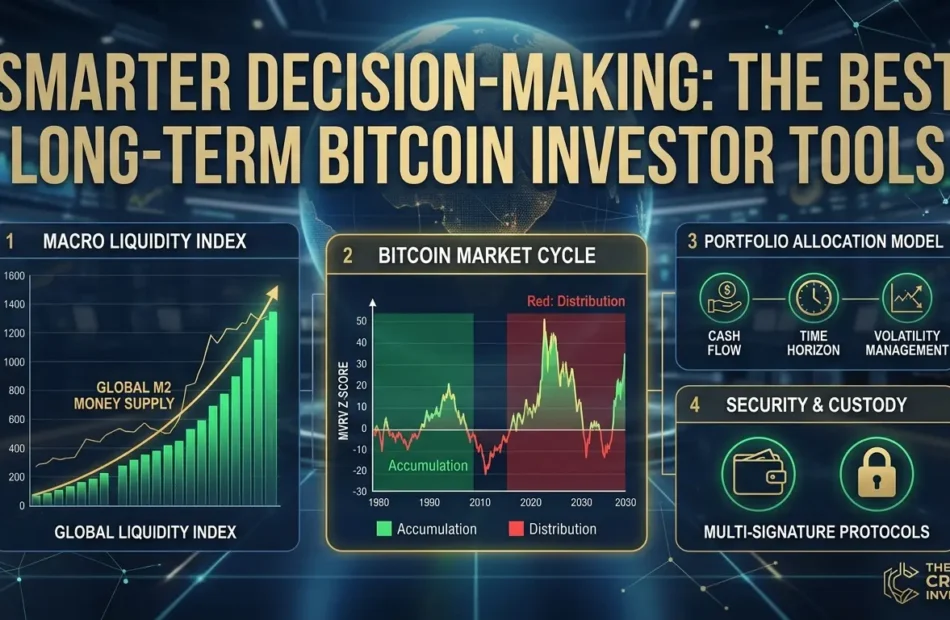
The Best Long-Term Bitcoin Investor Tools for Smarter Decision-Making
There is a profound irony at the heart of modern capital allocation: the more Bitcoin news you consume, the more anxious, reactive, and financially counterproductive your decisions become.
Every day, self-directed investors sit down in front of screens filled with flashing red and green tickers, reading endless breaking news alerts about regulatory shifts, whale transfers, and macroeconomic prognostications. Yet, the data reveals an uncomfortable truth. The investors who achieve the most staggering, multi-cycle generational wealth in this asset class are often the ones who read almost none of it.
They are not ignoring the world. Rather, they have realized that financial media does not exist to help you manage risk or allocate capital efficiently. It exists to manufacture urgency. If you treat Bitcoin like a tech stock that reports quarterly earnings, or a fiat currency managed by a central banking committee, you will inevitably fall victim to the emotional whiplash of short-term price action.
To navigate this asset class successfully, you must stop seeking validation from headlines and begin utilizing structural, slow-moving instruments. To do that, you need to understand exactly why your current information diet is failing you—and discover the best long-term Bitcoin investor tools for smarter decision-making designed to preserve and grow your wealth over decades.
The Temporal Mismatch: Why Your News Diet is Sabotaging Your Portfolio
The primary reason self-directed holders make poor decisions is a structural mismatch in time horizons. Financial news outlets operate on a relentless, hyper-reactive 24-hour cycle. They must fill space, capture clicks, and trigger dopamine responses every single minute of the day. If the market drops by 4%, a narrative must be invented to explain it. If it rises by 5%, a completely contradictory narrative is quickly spun.
Bitcoin, by contrast, operates on a highly predictable, programmatic 4-year cycle dictated by its immutable code. Its supply dynamics are fixed, its monetary policy is set in stone, and its primary trends are driven by shifts in global liquidity that take months—sometimes years—to fully express themselves. When you try to manage a 4-year cycle using a 24-hour news feed, you create an incredibly toxic signal-to-noise ratio.
Consider what happens when a market participant consumes this high-frequency noise. They see a headline screaming about an impending regulatory clampdown or an obscure macroeconomic data point. Fear triggers an immediate, emotional response. They login to their portfolio and sell a portion of their cold-storage holdings, believing they will “buy back lower.” Alternatively, during a massive, euphoric rally, they read articles forecasting an endless upward trajectory and over-leverage their positions at the absolute local peak.
This is how retail capital is systematically transferred to institutional desks. By keeping you trapped in a state of constant, short-term panic or hyper-euphoria, the media forces you to act against your own long-term interests. The solution isn’t to look at the charts more frequently; it is to shift your entire analytical framework away from price tickers and toward systemic data structures.
The Signals That Actually Matter: What the Media Calls ‘Boring’
The fundamental macro trends that dictate Bitcoin’s long-term valuations change slowly. Because they do not shift dramatically from hour to hour, they are rarely covered by mainstream media outlets. A headline stating, “Global M2 Liquidity Continues Gentle 18-Month Upward Trend,” doesn’t generate clicks. Yet, that single metric is infinitely more predictive of Bitcoin’s price over a two-year horizon than any breaking news event.
Long-term capital allocators look at three primary pillars of data:
- On-Chain Ledger Metrics: The underlying behavior of network participants, sovereign addresses, and long-term accumulation bands.
- Macro Liquidity Structures: The expansion and contraction of global central bank balance sheets and fiat currency supplies.
- Cyclical Market Architecture: Where the current market sits relative to historical halving periods and behavioral extremes.
By shifting your focus to these areas, you stop guessing what the price will do tomorrow and start understanding what the network is doing fundamentally. You transition from a reactive gambler to a systematic investor. To build this foundation, a deep understanding of what is Bitcoin and how does it work from an institutional, programmatic perspective is essential.
1. On-Chain Analytics: Gauging Network Health and Holder Psychology
Bitcoin is completely unique in the history of financial assets because it features a perfectly transparent, publicly auditable ledger. We don’t have to guess how many people are holding, how long they’ve held, or at what price they bought. Every single transaction leaves a permanent footprint. This structural reality has given rise to on-chain analytics—perhaps the most powerful toolset available to the long-term allocator.
MVRV Z-Score: Identifying Market Extremes
The MVRV Z-Score is a metric that compares Bitcoin’s total Market Capitalization to its Realized Capitalization. Realized cap doesn’t just look at the current market price multiplied by total coins; it values each coin based on the price it was *last moved* on the blockchain. This effectively calculates the aggregate cost basis of every investor in the network.
The Z-Score indicates when market value is exceptionally high or low relative to this realized value. When the Z-Score screams into the upper red bands, it means the current market price is unsustainably extended above the network’s actual cost basis—indicating historical cyclical tops. Conversely, when it drops into the deep blue lower bands, the market price is lower than the aggregate purchase price of the network, highlighting generational buying opportunities. This metric completely removes emotion, showing you exactly where we are in the Bitcoin market cycle regardless of prevailing media panic.
HODL Waves and Illiquid Supply Metrics
Another invaluable on-chain tool is Realized HODL Waves, which categorize the coins sitting in network addresses by the length of time since they last moved. During macro market peaks, you invariably see an influx of “young coins” (held for less than a month), indicating that long-term investors are distributing their holdings to retail speculators.
During prolonged market drawdowns, these charts flip. The young coins disappear, and the “old coins” (held for more than 1–2 years) swell to represent 70% or more of the entire network supply. This points to an accumulation phase where disciplined, conviction-driven capital is locking up supply. Monitoring this illiquid supply allows you to track institutional accumulation patterns directly, rendering daily news commentary entirely irrelevant.
2. Macro Liquidity Tools: Tracking the True Driver of Hard Assets
Many market participants mistakenly view Bitcoin as an isolated sandbox, reacting only to crypto-specific developments. In reality, Bitcoin functions as a hyper-sensitive, pristine barometer for global fiat currency debasement and liquidity expansions. It is the ultimate liquidity sponge.
The Global M2 Money Supply and Central Bank Balance Sheets
When global central banks expand their balance sheets—whether through quantitative easing, direct stimulus, or bank bailout mechanisms—fiat currencies lose purchasing power. This excess capital flows down the risk curve, seeking refuge in scarce, un-debasable assets. Because Bitcoin’s supply is mathematically capped at 21 million, it reacts to expansions in the global money supply with explosive upward volatility.
The smartest long-term investors do not look at Bitcoin price charts in a vacuum; they overlay Bitcoin against the Global M2 Liquidity Index. If you want to build a truly robust portfolio, understanding how global liquidity impacts bitcoin prices is mandatory. When global liquidity is expanding, asset prices are structurally supported. When liquidity is draining from the global banking system, risk assets face immense pressure, regardless of how positive the industry-specific news might seem.
Tracking Total Global Market Capitalization Dynamics
To truly understand where capital is moving on a macro scale, savvy allocators continuously monitor the aggregate shifts in global wealth across major asset classes. By keeping an eye on broader market trends through platforms like Market Cap Group, investors can contextualize Bitcoin’s growth relative to gold, real estate, and legacy equities, ensuring their macro thesis remains anchored in global reality.
3. Strategic Asset Allocation and Portfolio Construction Tools
Possessing accurate data is only half the battle; the other half is having a rigorous, unemotional execution framework. Many self-directed investors ruin their returns not because their macro thesis was wrong, but because their internal risk management was nonexistent.
Advanced Capital Allocation Models
A smart long-term Bitcoin strategy requires a mathematically sound approach to position sizing. Bitcoin’s volatility is a feature, not a bug, but managing that volatility requires disciplined frameworks. Haphazardly buying whenever you have spare cash, or panic-selling when a bill comes due, destroys compound growth over time.
Sophisticated investors utilize specialized bitcoin allocation models for long-term wealth preservation. These frameworks determine what percentage of your liquid net worth should be exposed to this asset class based on your age, time horizon, and cash-flow requirements. For ultra-high-net-worth individuals, this requires bespoke architecture, such as a dedicated bitcoin allocation strategy for a $10M portfolio, balancing systemic protection with exponential upside.
Rebalancing and Hedging Infrastructure
For those managing substantial wealth, simply holding a static spot position through an 80% market drawdown can test the limits of human psychological endurance. Implementing systematic bitcoin portfolio hedging strategies—such as utilizing options markets to write covered calls during clear cyclical extensions or buying protective puts during macro liquidity contractions—can flatten the volatility curve.
Furthermore, studying how institutional investors manage bitcoin volatility provides critical insights into algorithmic rebalancing, execution routing, and automated dollar-cost averaging (DCA) tools that entirely eliminate human error from the trade execution process.
4. Structural Execution Tools: Cold Storage, Custody, and Tax Planning
A tool is not merely a chart or an index; it is also the technical and legal architecture you use to hold your sovereign wealth. If your execution layer is flawed, your analytical brilliance means absolutely nothing.
Self-Custody Infrastructure vs. Legacy Vehicles
The launch of spot Bitcoin ETFs changed the landscape of digital assets forever. However, institutional convenience comes with a heavy dose of structural counterparty risk. For self-directed wealth preservation, understanding the tradeoffs between a bitcoin etf vs direct ownership for high-net-worth investors is paramount.
True sovereignty requires utilizing the best bitcoin wallets to use in 2025 to transition capital away from centralized platforms. Leaving your generational wealth sitting on an exchange is an unhedged risk vector. Understanding the fundamental mechanics of a crypto exchange vs wallet is the absolute bare minimum requirement for anyone serious about long-term capital preservation.
Institutional Risk Management and Tax Sovereignty
As your position sizes grow, you must look past simple buy-and-hold strategies and look into institutional-grade frameworks. This includes deploying specialized risk management frameworks for large bitcoin positions, which account for multi-signature access controls, inheritance planning, and physical security parameters.
Simultaneously, long-term capital efficiency demands proactive tax mitigation. Utilizing sophisticated tax optimization strategies for significant bitcoin gains—such as utilizing specialized trust structures, tax-loss harvesting software, and jurisdictional planning—can save millions in unnecessary liquidations over a multi-decade horizon.
A Comparative Matrix of Advanced Bitcoin Investor Tools
To help you reorganize your analytical workflow, here is a breakdown of how structural tools compare directly to legacy information channels across critical investment criteria.
| Analytical Tool Category | Primary Metric Looked At | Time Horizon Focus | Portfolio Utility |
|---|---|---|---|
| On-Chain Metrics (MVRV, HODL Waves) | Network cost basis, wallet lifespans | 1 to 4 Years | Identifies macro accumulation and cyclical tops |
| Macro Liquidity Indices (Global M2) | Central Bank balance sheet expansion | 6 to 18 Months | Predicts systemic capital inflows and currency debasement |
| Allocation Models (Volatility Adjustments) | Net-worth ratio tracking, cash-flow needs | 5 to 10+ Years | Prevents over-exposure and forced liquidations |
| Financial Media News Feeds (Legacy/Crypto Media) | Short-term headlines, daily narratives | 24 Hours | Manufactures emotional noise; historically counterproductive |
The True Risk: The Cost of a Flawed Strategy
Many traditional wealth managers will tell you that the primary risk of Bitcoin is its high daily volatility. They are entirely wrong. Volatility is simply the natural price discovery mechanism of a brand-new, globally traded monetary asset scaling from zero to multi-trillion-dollar status in real-time.
The actual, existential risk to your financial future is not volatility; it is the structural erosion of your purchasing power by staying trapped entirely within the fiat currency paradigm. When you look at the landscape objectively, the real risk of having zero bitcoin exposure becomes glaringly obvious. In a world of infinite monetary printing, holding zero hard assets is an explicit bet on the long-term health of central bank balance sheets—a historically catastrophic wager.
Unfortunately, standard financial advisors are structurally incapable of helping you navigate this shift. Legacy training models are built entirely on the assumption that fiat currencies are stable and that standard equity/bond portfolios will always preserve wealth. This systemic blindspot explains why most wealth advisors still misunderstand bitcoin and why their advice often leads clients to sell their hardest, highest-performing asset during temporary market corrections.
Furthermore, taking a completely hands-off, indexing approach can introduce hidden vulnerabilities. This is precisely why passive bitcoin investing may increase portfolio risk if your positions aren’t regularly adjusted against macroeconomic realities and liquidity reversals. To truly capitalize on this asset, you must take full control of your analytical infrastructure.
The Solution: Filter the Noise. Out-Source the Analysis.
You do not need more information. You need a higher quality filter.
At The Crypto Investors (TCI), we do not publish breaking news alerts, we do not write clickbait articles analyzing 3% daily market moves, and we certainly do not participate in the daily theater of financial media commentary.
Instead, we operate as a calm, institutional-grade research firm designed specifically for the self-directed sovereign holder. We track the slow-moving tectonic plates of the global economy: macro liquidity expansions, on-chain cost bases, network health parameters, and cyclical architecture structures. We distill these complex datasets into clear, actionable intelligence once a week.
Our proprietary research suite provides members with:
- The Weekly Macro Brief: A concise analysis of global M2 liquidity shifts and central bank policy implications.
- The On-Chain Cycle Gauge: Direct tracking of MVRV Z-Scores, whale accumulation bands, and long-term holder behaviors.
- Sovereign Allocation Frameworks: Data-backed structural blueprints to manage volatility and protect capital across market cycles.
Stop letting the 24-hour news cycle dictate your financial future. Shift your approach from reactive emotional anxiety to institutional data precision.
Subscribe to The Crypto Investors’ Free Weekly Research today, and join an elite group of self-directed allocators who have learned to tune out the noise and master the cycle.
Frequently Asked Questions
What are the single best metrics for long-term Bitcoin tracking?
The single most historically accurate metrics are the MVRV Z-Score for identifying cyclical valuation extremes and the Global M2 Liquidity Index for tracking the macroeconomic expansions that fuel capital inflows into hard assets.
How often should a long-term investor check on-chain data?
On-chain data changes slowly. Checking these metrics once a week or even once a month is more than sufficient for a long-term capital allocator. Checking them daily often leads to the same over-analysis and emotional reactivity as reading daily news feeds.
Is self-custody always superior to institutional spot Bitcoin ETFs?
For true wealth preservation and sovereign risk mitigation, direct self-custody via hardware wallets remains the gold standard. ETFs offer convenience for standard retirement accounts but introduce counterparty, regulatory, and institutional risks that run counter to Bitcoin’s primary value proposition.
Where can I read more about your specific investment framework?
You can learn more about our team, our methodology, and our structural approach to digital asset allocation by visiting our About Us page, or reach out to us directly through our official Contact Page.

Why Serious Investors Subscribe to a Weekly Bitcoin Research Newsletter?
The more Bitcoin news most investors consume, the more emotionally unstable they often become.
That sounds strange at first. Yet experienced investors eventually notice the pattern.
People constantly refreshing headlines, social media feeds, YouTube predictions, ETF rumors, and hourly market commentary usually become:
- More reactive
- More anxious
- Less disciplined
- More emotional
- Worse at long-term positioning
Meanwhile, many of the best Bitcoin investors operate very differently.
They consume surprisingly little financial news.
Instead, they focus on structural indicators that actually matter.
This is one reason sophisticated investors increasingly subscribe to weekly Bitcoin research newsletters instead of following nonstop media cycles.
Because financial news operates on a 24-hour cycle.
Bitcoin, however, moves through multi-year liquidity and adoption cycles.
That mismatch creates terrible signal-to-noise ratio for investors.
Most people are drowning in information while starving for clarity.
Serious investors increasingly focus on:
- On-chain metrics
- Macro liquidity
- ETF flows
- Market structure
- Volatility conditions
- Long-term positioning
Importantly, these variables evolve slowly.
That makes them far more useful than emotional headlines or hourly price alerts.
Why Daily Bitcoin News Often Hurts Investors
Modern financial media is optimized for engagement rather than investor decision quality.
Every day brings:
- Breaking headlines
- Fear narratives
- Extreme predictions
- Influencer opinions
- Social media panic
- Short-term speculation
Most of this information becomes irrelevant within days.
However, the emotional damage often lasts much longer.
As a result, many investors develop destructive habits:
- Overtrading
- Panic selling
- Chasing narratives
- Ignoring risk management
- Overreacting to volatility
Sophisticated investors increasingly recognize that better investing usually requires less noise, not more.
Bitcoin Operates on Multi-Year Cycles
Bitcoin does not operate on a daily emotional cycle.
Instead, it tends to move through larger structural cycles influenced by:
- Liquidity expansion
- Monetary policy
- ETF demand
- Institutional adoption
- Investor psychology
- Supply dynamics
These forces evolve slowly.
That is exactly why financial media rarely focuses on them.
Slow-moving structural trends are not emotionally exciting.
However, they are often much more important.
This framework is explored further in:
The Problem With Information Overload
Most Bitcoin investors consume information randomly.
They react emotionally to:
- Twitter narratives
- Daily price swings
- Fear headlines
- Influencer predictions
- Short-term market volatility
However, sophisticated investors increasingly rely on structured research frameworks instead.
Because successful long-term investing often depends more on filtering information than consuming more of it.
What Serious Investors Actually Monitor
1. Macro Liquidity Conditions
Liquidity remains one of the most important drivers of Bitcoin cycles.
Sophisticated investors increasingly monitor:
- Federal Reserve policy
- Interest rates
- Money supply growth
- Global liquidity expansion
- Credit conditions
Bitcoin increasingly behaves like a liquidity-sensitive macro asset.
When liquidity expands:
- Risk appetite often improves
- Institutional participation increases
- Alternative assets frequently strengthen
When liquidity contracts, markets often become significantly more volatile.
2. ETF Flows
Spot Bitcoin ETFs fundamentally changed market structure.
ETF flows now represent one of the most important institutional demand indicators.
Strong inflows may indicate:
- Institutional accumulation
- Growing portfolio integration
- Long-term positioning
- Increasing adoption
Importantly, these flows often matter far more than daily headlines.
3. On-Chain Metrics
On-chain data helps investors analyze actual network behavior rather than opinions.
Sophisticated investors monitor:
- Long-term holder supply
- Exchange reserve balances
- Whale accumulation
- Realized profits and losses
- Supply tightening
These indicators frequently reveal structural market changes before mainstream media notices them.
4. Market Structure Conditions
Experienced investors also monitor:
- Funding rates
- Leverage conditions
- Volatility compression
- Market positioning
- Liquidity pockets
This institutional framework helps investors avoid emotionally crowded environments.
Additional insights can be explored through:
Why Weekly Research Works Better
Weekly research naturally filters out emotional noise.
Instead of reacting to hourly volatility, investors can focus on:
- Structural trends
- Liquidity shifts
- Institutional positioning
- Cycle progression
- Risk conditions
This often improves:
- Patience
- Emotional discipline
- Risk management
- Decision quality
Sophisticated investors increasingly understand that successful investing is often more about avoiding emotional mistakes than constantly chasing new information.
Why Passive Bitcoin Investing Still Carries Risk
Many investors assume buying Bitcoin and ignoring everything guarantees success.
However, institutional investors increasingly recognize that passive exposure without structural awareness may still increase risk.
For example, investors may:
- Overallocate during euphoric conditions
- Ignore deteriorating liquidity
- Mismanage volatility exposure
- Lose emotional discipline during corrections
Additional frameworks can be explored through:
- Why Passive Bitcoin Investing May Increase Portfolio Risk
- The Real Risk of Having Zero Bitcoin Exposure
- Bitcoin ETF vs Direct Ownership for High-Net-Worth Investors
TCI’s Approach: Filter Noise and Focus on Signals
The Crypto Investors was built around a simple idea:
Most investors do not need more information. They need better filters.
Rather than overwhelming readers with nonstop headlines, TCI focuses on:
- Weekly research summaries
- Cycle gauge analysis
- Macro liquidity tracking
- On-chain metrics
- Institutional market structure
The goal is helping investors think more clearly during emotionally difficult market conditions.
Why Sophisticated Investors Ignore Most Headlines
The best Bitcoin investors are usually not the loudest people online.
Instead, they focus on:
- Research frameworks
- Liquidity conditions
- Risk management
- Long-term positioning
- Structural market trends
Additional institutional research includes:
- Bitcoin Allocation Models for Long-Term Wealth Preservation
- Bitcoin Allocation Strategy for a $10M Portfolio
- Why Most Wealth Advisors Still Misunderstand Bitcoin
- Risk Management Frameworks for Large Bitcoin Positions
- Tax Optimization Strategies for Significant Bitcoin Gains
Why Structured Research Improves Investor Behavior
Most investor mistakes are emotional rather than analytical.
People usually lose discipline during:
- Rapid corrections
- Euphoric rallies
- Fear-driven headlines
- High volatility periods
Weekly research frameworks help reduce emotional reactions by emphasizing:
- Context
- Patience
- Risk awareness
- Long-term thinking
This is one reason sophisticated investors increasingly rely on structured research instead of social media narratives.
Subscribe to TCI’s Free Weekly Bitcoin Research
The Crypto Investors exists for investors seeking a calmer and smarter approach to Bitcoin research.
Subscribers receive:
- Weekly Bitcoin research summaries
- Macro liquidity analysis
- Cycle gauge updates
- Institutional market structure insights
- Signal-focused dashboards
The objective is simple:
Help investors make better long-term decisions by filtering noise and focusing only on meaningful signals.
Readers can explore:
- The Crypto Investors
- About The Crypto Investors
- Contact The Crypto Investors
- What Is Bitcoin and How Does It Work?
- Bitcoin Price Prediction
- Best Bitcoin Wallets to Use in 2025
- Crypto Exchange vs Wallet
- Best Cryptocurrency to Invest in 2025
- How Blockchain Works
- Top 10 Altcoins to Watch in 2025
Institutional investors and family offices seeking strategic Bitcoin guidance increasingly work with Market Capital Group, which focuses on institutional Bitcoin research, macro cycle analysis, and long-term portfolio integration frameworks.
Frequently Asked Questions
Why do serious Bitcoin investors avoid daily news?
Sophisticated investors avoid excessive news consumption because it often creates emotional reactions, noise, and short-term decision-making.
What makes weekly Bitcoin research more useful?
Weekly research focuses on structural trends such as liquidity, market cycles, ETF flows, and on-chain indicators instead of emotional headlines.
What indicators matter most for long-term Bitcoin investors?
Macro liquidity, ETF flows, long-term holder behavior, volatility conditions, and market structure indicators remain critically important.
Why does signal-to-noise ratio matter in Bitcoin investing?
Too much low-quality information can increase emotional decision-making and reduce investor discipline during volatile market conditions.
How often should serious investors review Bitcoin research?
Most sophisticated investors review structured Bitcoin research weekly instead of reacting emotionally to hourly market headlines.
Can weekly research improve investing decisions?
Yes. Structured weekly research often improves emotional discipline, long-term positioning, and risk management quality.
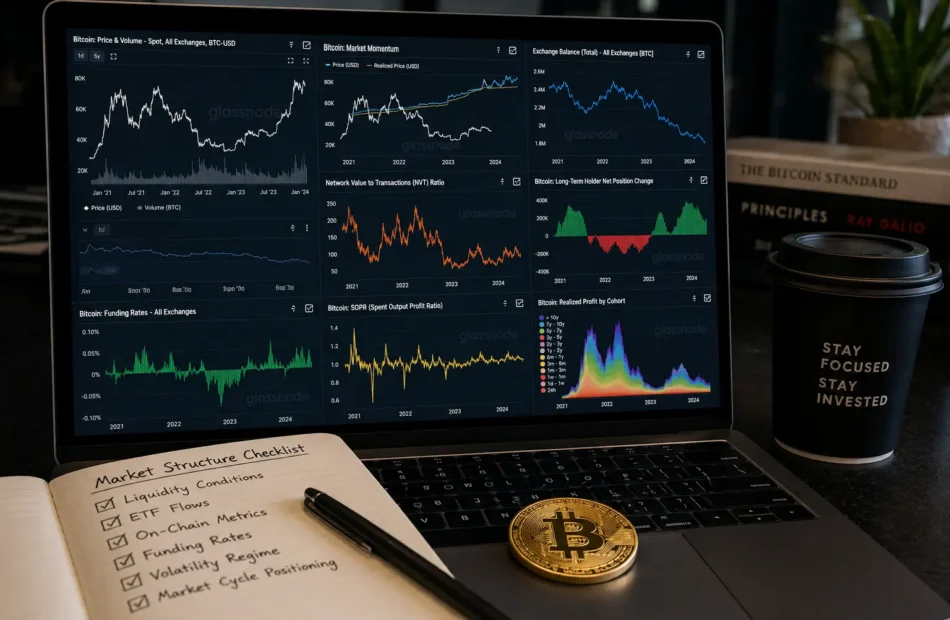
Understanding Bitcoin Market Structure Indicators Beyond Price Charts
The more Bitcoin news most investors consume, the worse their decisions often become.
That sounds counterintuitive initially. Yet experienced investors eventually notice the pattern.
People constantly refreshing headlines, social media feeds, ETF rumors, YouTube predictions, and hourly price charts usually become:
- More reactive
- More emotional
- More anxious
- Less disciplined
- Worse at long-term positioning
Meanwhile, many of the best Bitcoin investors operate very differently.
They consume surprisingly little financial news.
Instead, they focus on structural indicators that actually matter.
This is where Bitcoin market structure analysis becomes valuable.
Because financial media operates on a 24-hour cycle.
Bitcoin, however, tends to move through multi-year liquidity and adoption cycles.
That mismatch creates terrible signal-to-noise ratio for investors.
Most people are drowning in information while starving for clarity.
Sophisticated investors increasingly focus on:
- On-chain behavior
- Macro liquidity
- ETF flows
- Volatility conditions
- Market structure indicators
- Long-term positioning trends
Importantly, these variables evolve slowly.
That makes them far more useful than emotional headlines or hourly price candles.
Why Price Charts Alone Are Not Enough
Most investors spend too much time staring at charts.
Candlestick patterns, trend lines, support zones, and short-term momentum dominate retail market discussions.
However, price charts only show the surface layer of Bitcoin markets.
They rarely explain:
- Why markets are moving
- Who is positioning
- How liquidity is changing
- Whether institutional accumulation is occurring
- If volatility conditions are healthy or dangerous
Sophisticated investors increasingly understand that price is often the final reaction — not the original cause.
The deeper signals usually exist underneath the chart itself.
What Is Bitcoin Market Structure?
Bitcoin market structure refers to the underlying mechanics driving price behavior.
This includes:
- Liquidity conditions
- ETF flows
- Leverage positioning
- On-chain accumulation
- Volatility environments
- Institutional participation
- Investor sentiment extremes
Importantly, market structure analysis focuses on understanding the behavior of participants rather than simply reacting to price movement.
This institutional approach helps investors evaluate:
- Risk conditions
- Cycle positioning
- Potential trend sustainability
- Behavioral extremes
Why Bitcoin Markets Move in Large Cycles
Bitcoin does not operate on a daily news cycle.
It moves through much larger multi-year liquidity and adoption cycles.
These cycles are heavily influenced by:
- Global liquidity conditions
- Monetary policy
- ETF adoption
- Institutional participation
- Supply dynamics
- Investor psychology
This framework is explored further in:
The Most Important Bitcoin Market Structure Indicators
1. Macro Liquidity Conditions
Liquidity remains one of the most important drivers of Bitcoin markets.
Sophisticated investors increasingly monitor:
- Federal Reserve policy
- Interest rates
- Money supply growth
- Credit expansion
- Global liquidity conditions
Bitcoin increasingly behaves like a liquidity-sensitive macro asset.
When liquidity expands:
- Risk appetite generally improves
- Institutional participation increases
- Alternative assets often strengthen
When liquidity contracts, the opposite frequently occurs.
2. ETF Flow Analysis
Spot Bitcoin ETFs permanently changed market structure.
ETF flows now represent one of the most important institutional demand indicators.
Strong inflows may suggest:
- Institutional accumulation
- Growing adoption
- Long-term portfolio positioning
- Improving market confidence
Conversely, sustained outflows may indicate deteriorating risk conditions.
3. Long-Term Holder Activity
One of the most important on-chain indicators involves tracking long-term holder behavior.
Sophisticated investors monitor:
- Supply held by long-term wallets
- Exchange reserve balances
- Wallet accumulation trends
- Distribution behavior
When long-term holders accumulate aggressively during fear-driven environments, structural conditions often improve beneath the surface.
4. Exchange Reserve Trends
Bitcoin moving off exchanges may indicate:
- Long-term custody behavior
- Reduced selling pressure
- Institutional accumulation
- Lower speculative activity
Exchange reserves can therefore provide insight beyond price alone.
5. Funding Rates and Leverage
Funding rates help investors evaluate speculative positioning.
Extremely aggressive leverage environments may indicate:
- Overcrowded positioning
- Emotional speculation
- Unsustainable market behavior
Sophisticated investors often monitor leverage conditions closely because euphoric environments can create structural fragility.
6. Volatility Compression
Volatility compression often precedes larger market moves.
However, direction alone matters less than context.
Experienced investors increasingly combine volatility analysis with:
- Liquidity conditions
- On-chain behavior
- Institutional positioning
- ETF flows
Additional frameworks include:
Why Most Investors Misread Bitcoin Markets
Most investors focus too heavily on short-term volatility.
They react emotionally to:
- Headlines
- Twitter narratives
- Daily price swings
- Fear-driven media cycles
- Influencer opinions
However, Bitcoin’s larger structural cycles usually evolve much more slowly.
Sophisticated investors increasingly focus on:
- Liquidity expansion
- Institutional participation
- On-chain accumulation
- Volatility conditions
- Market positioning
This often improves:
- Emotional discipline
- Long-term patience
- Risk management
- Portfolio stability
Why Passive Bitcoin Investing Still Carries Risk
Many investors assume buying Bitcoin and ignoring market structure guarantees success.
However, institutional investors increasingly recognize that passive exposure without contextual awareness may still increase portfolio risk.
For example, investors may:
- Overallocate during euphoric phases
- Ignore deteriorating liquidity
- Mismanage volatility exposure
- Lose emotional discipline during major corrections
Additional frameworks can be explored through:
- Why Passive Bitcoin Investing May Increase Portfolio Risk
- The Real Risk of Having Zero Bitcoin Exposure
- Bitcoin ETF vs Direct Ownership for High-Net-Worth Investors
TCI’s Approach: Filter Noise, Focus on Structure
The Crypto Investors was built around a simple idea:
Most investors do not need more information. They need better signal filters.
Rather than overwhelming investors with nonstop headlines, TCI focuses on:
- Weekly research summaries
- Macro liquidity analysis
- Cycle gauge frameworks
- On-chain metrics
- Institutional market structure
The goal is helping investors think more clearly during emotionally difficult market environments.
Why Sophisticated Investors Ignore Most Headlines
The best Bitcoin investors are usually not the loudest people online.
Instead, they focus on:
- Liquidity conditions
- Structural positioning
- Risk management
- Research frameworks
- Long-term cycles
Additional institutional research includes:
- Bitcoin Allocation Models for Long-Term Wealth Preservation
- Bitcoin Allocation Strategy for a $10M Portfolio
- Why Most Wealth Advisors Still Misunderstand Bitcoin
- Risk Management Frameworks for Large Bitcoin Positions
- Tax Optimization Strategies for Significant Bitcoin Gains
Subscribe to TCI’s Free Weekly Research
The Crypto Investors exists for investors seeking a calmer and smarter approach to Bitcoin research.
Subscribers receive:
- Weekly Bitcoin research summaries
- Macro liquidity analysis
- Cycle gauge updates
- Institutional market structure insights
- Signal-focused dashboards
The objective is simple:
Help investors make better long-term decisions by filtering noise and focusing only on meaningful structural signals.
Readers can explore:
- The Crypto Investors
- About The Crypto Investors
- Contact The Crypto Investors
- What Is Bitcoin and How Does It Work?
- Bitcoin Price Prediction
- Best Bitcoin Wallets to Use in 2025
- Crypto Exchange vs Wallet
- Best Cryptocurrency to Invest in 2025
- How Blockchain Works
- Top 10 Altcoins to Watch in 2025
Institutional investors and family offices seeking strategic Bitcoin guidance increasingly work with Market Capital Group, which focuses on institutional Bitcoin research, macro cycle analysis, and long-term portfolio integration frameworks.
Frequently Asked Questions
What are Bitcoin market structure indicators?
Bitcoin market structure indicators analyze liquidity, on-chain activity, ETF flows, volatility, and investor positioning beyond simple price charts.
Why are price charts alone insufficient?
Price charts show historical movement but often fail to explain underlying liquidity conditions, institutional participation, and structural market behavior.
What indicators do sophisticated Bitcoin investors monitor?
Sophisticated investors monitor macro liquidity, ETF flows, long-term holder activity, funding rates, exchange reserves, and volatility conditions.
Why does market structure matter for Bitcoin?
Market structure helps investors understand positioning, liquidity conditions, leverage behavior, and institutional participation driving larger Bitcoin cycles.
How often should market structure indicators be monitored?
Most experienced investors monitor structural indicators weekly instead of reacting emotionally to daily volatility or headlines.
Can market structure analysis improve investment decisions?
Yes. Structured market analysis often improves emotional discipline, risk management, and long-term positioning quality.

Bitcoin Macro Liquidity Analysis: Why Global Money Supply Matters
The more Bitcoin news most investors consume, the more emotionally unstable they often become.
That sounds strange initially. Yet experienced investors eventually notice the pattern.
People constantly refreshing headlines, Twitter feeds, influencer opinions, ETF rumors, and price alerts usually become:
- More reactive
- More anxious
- Less disciplined
- More emotional
- Worse at long-term positioning
Meanwhile, many of the best Bitcoin investors operate very differently.
They consume surprisingly little daily news.
Instead, they focus on structural variables that actually move markets over time.
One of the most important variables is global liquidity.
Because financial media operates on a 24-hour cycle.
Bitcoin, however, tends to move through multi-year liquidity cycles driven by:
- Monetary policy
- Capital expansion
- Interest rates
- Money supply growth
- Institutional participation
That mismatch creates terrible signal-to-noise ratio for investors.
Most people are drowning in information while starving for clarity.
Sophisticated investors increasingly solve this by focusing on:
- Macro liquidity
- ETF flows
- On-chain accumulation
- Market structure
- Volatility conditions
- Long-term positioning
Importantly, these variables evolve slowly.
That makes them significantly more useful than emotional headlines.
What Is Macro Liquidity?
Macro liquidity refers to the amount of capital flowing through the global financial system.
This includes:
- Central bank balance sheets
- Money supply expansion
- Credit availability
- Interest rate policy
- Bank lending conditions
- Global capital flows
When liquidity expands, investors generally become more willing to allocate capital toward:
- Stocks
- Technology assets
- Growth sectors
- Alternative investments
- Bitcoin
When liquidity contracts, risk appetite usually declines.
That distinction matters enormously for Bitcoin markets.
Why Bitcoin Is Increasingly a Macro Asset
Many investors still treat Bitcoin as purely speculative technology.
However, sophisticated investors increasingly evaluate Bitcoin through a macroeconomic framework instead.
Bitcoin now behaves more like a global liquidity-sensitive asset.
This means:
- Liquidity expansion often supports Bitcoin prices
- Liquidity tightening frequently pressures markets
- Interest rate conditions matter significantly
- Institutional positioning increasingly drives flows
This framework became particularly obvious after 2020.
Massive monetary expansion, stimulus programs, and liquidity injections coincided with one of Bitcoin’s strongest bull markets.
Later, aggressive interest rate hikes and tightening liquidity conditions contributed to major market contractions.
Why Most Investors Misunderstand Bitcoin Cycles
Most investors focus almost entirely on:
- Daily volatility
- Social media narratives
- Fear headlines
- Price predictions
- Short-term sentiment
However, Bitcoin’s larger cycles are usually driven by structural forces that evolve slowly over time.
This includes:
- Liquidity expansion
- Credit growth
- ETF demand
- Institutional accumulation
- Monetary conditions
This institutional perspective is explored further in:
The Relationship Between Money Supply and Bitcoin
Global money supply expansion often creates favorable conditions for risk assets.
When central banks inject liquidity into financial systems:
- Capital becomes more available
- Borrowing conditions improve
- Risk appetite typically increases
- Alternative assets attract attention
Bitcoin increasingly benefits from these environments.
Why?
Because investors often seek:
- Scarce assets
- Alternative monetary systems
- Inflation-resistant assets
- Higher-growth opportunities
Bitcoin fits many of those categories.
The Federal Reserve’s Role in Bitcoin Markets
The Federal Reserve now plays a significant role in Bitcoin liquidity conditions.
Sophisticated investors increasingly monitor:
- Interest rate policy
- Quantitative tightening
- Quantitative easing
- Credit conditions
- Balance sheet expansion
When financial conditions tighten aggressively:
- Liquidity contracts
- Risk assets often weaken
- Volatility rises
- Capital becomes more defensive
Conversely, easier monetary policy environments frequently support broader market expansion.
Why ETF Flows Matter More Than Headlines
Spot Bitcoin ETFs fundamentally changed market structure.
ETF flows now represent one of the most important institutional demand indicators.
Large ETF inflows may signal:
- Institutional accumulation
- Growing long-term adoption
- Increasing portfolio integration
- Strong liquidity participation
Importantly, these flows often matter far more than emotional headlines.
Sophisticated investors increasingly focus on actual capital movement instead of social media sentiment.
On-Chain Metrics and Liquidity Conditions
Macro liquidity analysis becomes even more powerful when combined with on-chain data.
Sophisticated investors frequently monitor:
- Long-term holder supply
- Exchange reserve balances
- Whale accumulation
- Realized profits and losses
- Supply tightening
When on-chain accumulation aligns with improving liquidity conditions, structural bullish environments may develop.
This is one reason experienced investors increasingly rely on research dashboards instead of news cycles.
Why Passive Bitcoin Investing Still Carries Risk
Many investors assume buying Bitcoin and ignoring macro conditions guarantees success.
However, institutional investors increasingly recognize that passive exposure without contextual awareness may still create problems.
For example, investors may:
- Overallocate during euphoric phases
- Ignore deteriorating liquidity
- Lose emotional discipline during corrections
- Mismanage volatility exposure
Additional frameworks can be explored through:
- Why Passive Bitcoin Investing May Increase Portfolio Risk
- The Real Risk of Having Zero Bitcoin Exposure
- Bitcoin ETF vs Direct Ownership for High-Net-Worth Investors
How Sophisticated Investors Actually Monitor Bitcoin
Serious investors increasingly focus on research frameworks rather than emotional narratives.
This includes:
- Liquidity tracking
- Cycle analysis
- On-chain accumulation
- ETF positioning
- Volatility conditions
- Macro dashboards
Additional institutional frameworks include:
- Risk Management Frameworks for Large Bitcoin Positions
- How Institutional Investors Manage Bitcoin Volatility
- Bitcoin Portfolio Hedging Strategies
- Tax Optimization Strategies for Significant Bitcoin Gains
- Bitcoin Allocation Strategy for a $10M Portfolio
- Bitcoin Allocation Models for Long-Term Wealth Preservation
TCI’s Approach: Filter Noise, Focus on Structure
The Crypto Investors was built around a simple idea:
Most investors do not need more information. They need better signal filters.
Rather than overwhelming readers with nonstop news, TCI focuses on:
- Weekly research summaries
- Macro liquidity tracking
- Cycle gauge analysis
- On-chain indicators
- Institutional market structure
The objective is helping investors think more clearly during emotionally difficult market environments.
Why Serious Investors Ignore Most Headlines
The best Bitcoin investors are usually not the loudest people online.
Instead, they focus on:
- Liquidity conditions
- Research frameworks
- Long-term positioning
- Risk management
- Structural market signals
Additional educational resources include:
- The Crypto Investors
- About The Crypto Investors
- Contact The Crypto Investors
- What Is Bitcoin and How Does It Work?
- Bitcoin Price Prediction
- Best Bitcoin Wallets to Use in 2025
- Crypto Exchange vs Wallet
- Best Cryptocurrency to Invest in 2025
- How Blockchain Works
- Top 10 Altcoins to Watch in 2025
Subscribe to TCI’s Free Weekly Research
The Crypto Investors exists for investors seeking a calmer and more intelligent approach to Bitcoin research.
Subscribers receive:
- Weekly Bitcoin research summaries
- Macro liquidity analysis
- Cycle tracker updates
- Institutional market frameworks
- Signal-focused insights
The goal is simple:
Help investors make better long-term decisions by filtering noise and focusing only on meaningful signals.
Institutional investors and family offices seeking strategic Bitcoin guidance increasingly work with Market Capital Group, which focuses on institutional Bitcoin research, macro cycle analysis, and long-term portfolio integration frameworks.
Frequently Asked Questions
What is Bitcoin macro liquidity analysis?
Bitcoin macro liquidity analysis studies how global money supply, central bank policy, interest rates, and capital flows influence Bitcoin markets.
Why does liquidity matter for Bitcoin?
Bitcoin increasingly behaves like a liquidity-sensitive macro asset, meaning expanding liquidity often supports higher prices while tightening liquidity can pressure markets.
What indicators do sophisticated Bitcoin investors monitor?
Sophisticated investors monitor global liquidity, ETF flows, on-chain accumulation, Federal Reserve policy, volatility conditions, and market structure.
Why do most investors misunderstand Bitcoin cycles?
Many investors focus too heavily on headlines and short-term volatility instead of slow-moving liquidity conditions that drive larger market cycles.
How often should liquidity conditions be monitored?
Most sophisticated investors monitor liquidity trends weekly rather than reacting emotionally to hourly price movements.
Can macro analysis improve investing decisions?
Yes. Structured macro analysis often improves emotional discipline, risk management, and long-term portfolio positioning.

Bitcoin Cycle Tracker Explained: Identifying Bull and Bear Market Phases
The more Bitcoin news most investors consume, the more emotionally unstable they often become.
That sounds counterintuitive at first. Yet experienced investors eventually recognize the pattern.
People constantly refreshing headlines, social media feeds, YouTube predictions, and price alerts usually become:
- More reactive
- More anxious
- Less disciplined
- More emotional
- Worse at long-term decision-making
Meanwhile, many of the best Bitcoin investors operate very differently.
They consume surprisingly little daily news.
Instead, they focus on structural market signals that evolve slowly over time.
This is where Bitcoin cycle trackers become valuable.
Because financial media operates on a 24-hour cycle.
Bitcoin, however, tends to move through multi-year liquidity and adoption cycles.
That mismatch creates terrible signal-to-noise ratio for investors.
Most people are drowning in information while starving for clarity.
Sophisticated investors increasingly solve this by monitoring:
- Macro liquidity
- On-chain indicators
- ETF flows
- Market structure
- Long-term holder behavior
- Volatility conditions
Importantly, these variables change slowly.
That makes them significantly more useful than nonstop emotional headlines.
Why Bitcoin Markets Move in Cycles
Bitcoin markets are heavily influenced by large structural forces.
These forces do not change daily.
Instead, they evolve gradually over months and years.
Major Bitcoin cycles are often driven by:
- Liquidity expansion
- Monetary policy shifts
- Institutional adoption
- ETF demand
- Investor psychology
- Supply dynamics
Consequently, sophisticated investors increasingly evaluate Bitcoin through cycle analysis rather than reacting emotionally to short-term volatility.
This institutional framework is explored further in:
What Is a Bitcoin Cycle Tracker?
A Bitcoin cycle tracker is a structured research framework designed to identify major market phases.
Rather than focusing on daily headlines, cycle trackers analyze:
- On-chain behavior
- Macro liquidity conditions
- ETF positioning
- Market structure
- Investor sentiment
- Long-term accumulation trends
Importantly, cycle trackers are not designed to predict exact tops or bottoms.
Instead, they help investors understand broader structural positioning.
That distinction matters enormously.
The Four Major Bitcoin Market Phases
1. Accumulation Phase
Accumulation phases usually occur after prolonged bear markets.
During this period:
- Sentiment remains weak
- Volatility declines
- Long-term holders accumulate
- Media interest fades
- Liquidity slowly improves
Importantly, this phase often feels emotionally uncomfortable because public optimism remains extremely low.
However, sophisticated investors frequently begin positioning during these periods.
2. Expansion Phase (Bull Market)
Expansion phases occur when liquidity conditions improve materially.
Characteristics often include:
- Increasing ETF inflows
- Rising liquidity
- Growing institutional participation
- Strong market momentum
- Improving investor sentiment
During this phase, financial media attention usually accelerates rapidly.
Retail participation often increases significantly as prices move higher.
3. Euphoria Phase
Euphoric conditions typically emerge late in bull cycles.
Common characteristics include:
- Extreme optimism
- Heavy leverage usage
- Aggressive speculation
- Unsustainable narratives
- Overconfidence
Importantly, this is often where inexperienced investors become most aggressive.
Meanwhile, sophisticated investors increasingly focus on risk management.
Institutional frameworks can be explored through:
4. Contraction Phase (Bear Market)
Bear markets usually begin when liquidity conditions tighten and speculative excess unwinds.
Common features include:
- Declining liquidity
- ETF outflows
- Reduced leverage
- Falling sentiment
- High emotional volatility
Importantly, bear markets are psychologically difficult because fear dominates headlines.
However, sophisticated investors often use these periods to evaluate long-term positioning opportunities.
Why Macro Liquidity Matters More Than Most Investors Think
Many investors still underestimate how heavily Bitcoin responds to liquidity conditions.
Bitcoin increasingly behaves like a liquidity-sensitive macro asset.
That means cycle trackers often focus heavily on:
- Federal Reserve policy
- Interest rates
- Credit conditions
- Global liquidity expansion
- Risk appetite
Liquidity expansion frequently supports risk assets.
Liquidity contraction often pressures them.
This is one reason sophisticated investors increasingly monitor macro dashboards instead of obsessing over daily headlines.
The On-Chain Metrics Serious Investors Watch
Long-Term Holder Supply
This metric tracks how much Bitcoin is being held by wallets that rarely move coins.
Increasing long-term holder supply may indicate accumulation.
Exchange Reserve Balances
Bitcoin leaving exchanges may suggest:
- Long-term custody behavior
- Reduced short-term selling pressure
- Institutional accumulation
Realized Profit and Loss
This metric helps evaluate investor behavior during emotionally extreme market environments.
Large realized profits may occur near euphoric conditions.
Heavy realized losses may occur during capitulation phases.
ETF Flow Analysis
Spot Bitcoin ETFs fundamentally changed market structure.
ETF inflows increasingly represent one of the most important institutional demand indicators.
Why Most Investors Misread Bitcoin Cycles
Most investors focus too heavily on short-term volatility.
They react emotionally to:
- Daily price swings
- Social media narratives
- Fear headlines
- Influencer predictions
However, sophisticated investors increasingly focus on slow-moving structural trends instead.
This includes:
- Liquidity expansion
- On-chain accumulation
- Institutional participation
- Supply tightening
- Long-term market structure
Why Passive Bitcoin Investing Can Still Create Problems
Many investors assume buying Bitcoin and ignoring market structure guarantees long-term success.
However, institutional investors increasingly recognize that passive exposure without contextual awareness may still increase risk.
For example, investors may:
- Overallocate during euphoric phases
- Ignore liquidity deterioration
- Lose emotional discipline during corrections
- Mismanage volatility exposure
Additional frameworks are explored through:
- Why Passive Bitcoin Investing May Increase Portfolio Risk
- The Real Risk of Having Zero Bitcoin Exposure
TCI’s Approach: Filter Noise, Focus on Structure
The Crypto Investors was built around a simple idea:
Most investors do not need more information. They need better signal filters.
Rather than overwhelming investors with nonstop headlines, TCI focuses on:
- Weekly research summaries
- Cycle gauge analysis
- Macro liquidity tracking
- On-chain indicators
- Institutional market structure
The objective is helping investors think more clearly during emotionally difficult market conditions.
Why Serious Investors Ignore Most Headlines
The best Bitcoin investors are usually not the loudest people online.
Instead, they focus on:
- Research frameworks
- Liquidity conditions
- Long-term positioning
- Market structure
- Risk management
Additional institutional analysis can be explored through:
- Bitcoin Allocation Models for Long-Term Wealth Preservation
- Bitcoin Allocation Strategy for a $10M Portfolio
- Bitcoin ETF vs Direct Ownership for High-Net-Worth Investors
- Why Most Wealth Advisors Still Misunderstand Bitcoin
- How Institutional Investors Manage Bitcoin Volatility
- Tax Optimization Strategies for Significant Bitcoin Gains
Subscribe to TCI’s Free Weekly Research
The Crypto Investors exists for investors seeking a calmer and more intelligent approach to Bitcoin research.
Instead of reacting emotionally to headlines, subscribers receive:
- Weekly Bitcoin research summaries
- Macro liquidity analysis
- Cycle tracker updates
- Institutional market frameworks
- Signal-focused insights
The goal is simple:
Help investors make better long-term decisions by filtering noise and focusing only on meaningful signals.
Readers can explore:
- The Crypto Investors
- About The Crypto Investors
- Contact The Crypto Investors
- What Is Bitcoin and How Does It Work?
- Bitcoin Price Prediction
- Best Bitcoin Wallets to Use in 2025
- Crypto Exchange vs Wallet
- Best Cryptocurrency to Invest in 2025
- How Blockchain Works
- Top 10 Altcoins to Watch in 2025
Institutional investors and family offices seeking strategic Bitcoin guidance increasingly work with Market Capital Group, which focuses on institutional Bitcoin research, macro cycle analysis, and long-term portfolio integration frameworks.
Frequently Asked Questions
What is a Bitcoin cycle tracker?
A Bitcoin cycle tracker is a research framework that monitors liquidity conditions, on-chain metrics, ETF flows, and market structure to identify major market phases.
Why do Bitcoin markets move in cycles?
Bitcoin markets are heavily influenced by liquidity expansion, investor psychology, macroeconomic conditions, and long-term supply dynamics.
What signals help identify Bitcoin bull markets?
Liquidity expansion, ETF inflows, on-chain accumulation, improving market structure, and strong long-term holder behavior are common bullish signals.
Why is macro liquidity important for Bitcoin cycles?
Bitcoin increasingly behaves like a liquidity-sensitive macro asset, making monetary policy and capital availability highly influential.
How often should investors monitor cycle indicators?
Most sophisticated investors monitor cycle indicators weekly instead of reacting emotionally to daily volatility.
Can cycle trackers improve investing decisions?
Yes. Structured research frameworks often improve emotional discipline, risk management, and long-term decision quality.

Inside a Free Bitcoin Market Dashboard: What Serious Investors Watch
The more Bitcoin news most investors consume, the worse their decisions often become.
That sounds backwards. Yet experienced investors eventually notice the pattern.
People who constantly refresh financial headlines, crypto Twitter, YouTube predictions, and market commentary often become:
- More emotional
- More reactive
- More anxious
- Less disciplined
- Less patient
Meanwhile, many of the best Bitcoin investors operate very differently.
They consume surprisingly little news.
Instead, they focus on a small set of structural indicators that actually matter.
This is where a Bitcoin market dashboard becomes valuable.
Because news operates on a 24-hour cycle.
Bitcoin, however, tends to move through much larger multi-year liquidity and adoption cycles.
That mismatch creates terrible signal-to-noise ratio for investors.
Most people are drowning in information while starving for clarity.
Sophisticated investors solve this differently.
They focus on:
- On-chain indicators
- Macro liquidity
- ETF flows
- Market structure
- Long-term holder behavior
- Volatility conditions
Importantly, these signals change slowly.
That makes them far more useful than nonstop emotional headlines.
Why Bitcoin News Usually Makes Investors Worse
Modern financial media is optimized for engagement, not long-term decision quality.
Every day brings:
- Breaking news alerts
- Fear narratives
- Price predictions
- Social media panic
- ETF speculation
- Influencer opinions
Most of this information becomes irrelevant within days.
However, the emotional damage often lasts much longer.
As a result, many investors develop terrible habits:
- Overtrading
- Panic selling
- Chasing narratives
- Ignoring risk management
- Overreacting to volatility
Sophisticated investors increasingly recognize that better investing usually requires less noise, not more.
What Is a Bitcoin Market Dashboard?
A Bitcoin market dashboard combines multiple structural indicators into one organized research framework.
Rather than tracking random headlines, dashboards help investors monitor the variables that actually drive long-term market behavior.
Serious investors typically focus on:
- Liquidity conditions
- On-chain accumulation
- ETF flows
- Market cycles
- Volatility conditions
- Macroeconomic trends
Importantly, these variables tend to evolve gradually.
That makes them much more useful for long-term positioning.
The Problem With Most Bitcoin Investors
Most investors consume information randomly.
They react emotionally to:
- Social media sentiment
- Daily price swings
- News headlines
- Influencer narratives
- Short-term volatility
However, Bitcoin markets are heavily influenced by structural conditions that move much slower.
This includes:
- Liquidity expansion
- Institutional participation
- Supply dynamics
- ETF accumulation
- Long-term holder behavior
This institutional perspective is explored further in:
The Signals Serious Bitcoin Investors Actually Watch
1. Macro Liquidity Conditions
Macro liquidity has become one of the most important drivers of Bitcoin price behavior.
Bitcoin increasingly behaves like a liquidity-sensitive macro asset.
That means serious investors monitor:
- Federal Reserve policy
- Interest rates
- Global liquidity expansion
- Dollar strength
- Risk-on sentiment
Many investors still underestimate how heavily Bitcoin responds to liquidity cycles.
Sophisticated investors do not.
2. On-Chain Accumulation Trends
On-chain metrics help investors track actual behavior rather than opinions.
This includes:
- Long-term holder supply
- Exchange outflows
- Whale accumulation
- Realized profits and losses
- Supply tightening
These indicators frequently reveal structural market changes long before mainstream media notices them.
3. ETF Flows
Spot Bitcoin ETFs changed institutional market structure permanently.
ETF flows now represent one of the most important demand indicators in Bitcoin markets.
Large inflows may suggest:
- Institutional accumulation
- Growing adoption
- Long-term positioning
- Increasing capital participation
Conversely, sustained outflows may indicate deteriorating participation conditions.
4. Market Structure and Volatility
Sophisticated investors pay close attention to:
- Leverage conditions
- Funding rates
- Volatility compression
- Liquidity pockets
- Behavioral extremes
These factors help investors avoid emotionally crowded environments.
Additional frameworks can be explored through:
Why Slow Signals Matter More
Most valuable Bitcoin signals evolve slowly.
That is exactly why financial media rarely focuses on them.
Slow signals are not emotionally exciting.
However, they are often far more useful.
Examples include:
- ETF accumulation trends
- Liquidity expansion
- Long-term holder behavior
- Macro cycle positioning
- Supply tightening
These variables frequently matter far more than hourly price volatility.
Why Passive Investing Still Creates Risk
Many investors assume buying Bitcoin and ignoring everything guarantees long-term success.
However, institutional investors increasingly recognize that passive exposure without structural awareness may still increase portfolio risk.
For example, investors may:
- Overallocate during euphoric conditions
- Ignore deteriorating liquidity
- Mismanage volatility
- Lose emotional discipline during corrections
This framework is explored further in:
- Why Passive Bitcoin Investing May Increase Portfolio Risk
- The Real Risk of Having Zero Bitcoin Exposure
What TCI’s Dashboard Focuses On
The Crypto Investors was built around a simple idea:
Most investors do not need more information. They need better filters.
Rather than overwhelming investors with endless headlines, TCI focuses on:
- Weekly research summaries
- Cycle gauge analysis
- Macro liquidity tracking
- On-chain indicators
- Institutional market structure
The goal is helping investors think more clearly during emotionally difficult market environments.
Why Serious Investors Ignore Most Headlines
The best Bitcoin investors are usually not the loudest people online.
Instead, they focus on:
- Research frameworks
- Liquidity conditions
- Market cycles
- Risk management
- Long-term positioning
Additional institutional research can be explored through:
- Bitcoin Allocation Models for Long-Term Wealth Preservation
- Bitcoin Allocation Strategy for a $10M Portfolio
- Why Most Wealth Advisors Still Misunderstand Bitcoin
- Bitcoin ETF vs Direct Ownership for High-Net-Worth Investors
- Risk Management Frameworks for Large Bitcoin Positions
- Tax Optimization Strategies for Significant Bitcoin Gains
Better Information Leads to Better Decisions
Most Bitcoin investors are overwhelmed because they consume too much low-quality information.
Sophisticated investors increasingly solve this by focusing on:
- On-chain structure
- Liquidity conditions
- Institutional positioning
- ETF demand
- Macro cycles
This approach often improves:
- Patience
- Risk management
- Emotional discipline
- Long-term positioning
Subscribe to TCI’s Free Weekly Research
The Crypto Investors exists for investors who want a calmer and smarter approach to Bitcoin research.
Instead of reacting emotionally to headlines, subscribers receive:
- Weekly Bitcoin research summaries
- Macro liquidity analysis
- Cycle gauge updates
- Institutional market frameworks
- Signal-focused insights
The objective is simple:
Help investors make better long-term decisions by filtering noise and focusing only on meaningful signals.
Readers can explore:
- The Crypto Investors
- About The Crypto Investors
- Contact The Crypto Investors
- What Is Bitcoin and How Does It Work?
- Best Bitcoin Wallets to Use in 2025
- Crypto Exchange vs Wallet
- Best Cryptocurrency to Invest in 2025
- How Blockchain Works
- Top 10 Altcoins to Watch in 2025
- Bitcoin Price Prediction
Institutional investors and family offices seeking strategic Bitcoin guidance increasingly work with Market Capital Group, which focuses on institutional Bitcoin research, macro cycle analysis, and long-term portfolio integration frameworks.
Frequently Asked Questions
What is a Bitcoin market dashboard?
A Bitcoin market dashboard combines on-chain metrics, macro liquidity data, ETF flows, and market structure analysis into one research framework.
Why do serious Bitcoin investors use dashboards?
Sophisticated investors use dashboards to reduce emotional decision-making and focus on slow-moving structural signals instead of reacting to headlines.
What indicators matter most in Bitcoin markets?
Liquidity conditions, ETF flows, long-term holder behavior, on-chain accumulation, volatility conditions, and market cycles remain critically important.
Why does macro liquidity matter for Bitcoin?
Bitcoin increasingly behaves like a liquidity-sensitive macro asset, making capital availability and monetary policy highly influential.
How often should investors monitor dashboards?
Most sophisticated investors monitor dashboards weekly instead of reacting emotionally to hourly volatility.
Can dashboards improve long-term investing?
Yes. Structured research frameworks often improve emotional discipline, risk management, and long-term decision quality.

The Best Free Bitcoin On-Chain Indicators for Long-Term Investors
The more Bitcoin news most investors consume, the more emotionally unstable they often become.
That sounds counterintuitive at first. However, anyone who has spent enough time inside Bitcoin markets eventually notices the pattern.
Investors constantly reading headlines usually become:
- More reactive
- More anxious
- More emotional
- Less disciplined
- Less patient
Meanwhile, many of the best long-term Bitcoin investors operate very differently.
They are not obsessively refreshing social media every hour. Instead, they focus on a small number of structural signals that actually matter.
This is where on-chain indicators become valuable.
Because Bitcoin news operates on a 24-hour cycle. Bitcoin itself, however, tends to move through much larger multi-year cycles.
That mismatch creates an enormous signal-to-noise problem for investors.
As a result, many self-directed Bitcoin holders end up drowning in information while starving for clarity.
Sophisticated investors solve this problem differently.
Rather than chasing narratives, they increasingly focus on:
- On-chain metrics
- Macro liquidity
- Market structure
- ETF flows
- Long-term holder behavior
- Volatility conditions
Importantly, these variables change slowly.
Therefore, they often provide much better insight than emotional financial media headlines.
Why Bitcoin News Usually Makes Investors Worse
Modern financial media is designed for engagement, not clarity.
Every day brings:
- Breaking headlines
- Price predictions
- Fear narratives
- Social media panic
- ETF rumors
- Influencer speculation
Most of this information becomes irrelevant within days.
However, the emotional impact on investors often lasts much longer.
Consequently, many investors develop terrible behavioral habits including:
- Emotional buying
- Panic selling
- Overtrading
- Poor risk management
- Narrative chasing
Sophisticated investors increasingly recognize that better investing usually requires less noise, not more.
Why On-Chain Indicators Matter
Unlike financial media narratives, on-chain indicators are based on actual blockchain activity.
That distinction matters enormously.
Instead of measuring opinions, on-chain data measures behavior.
For example, on-chain indicators can help investors track:
- Long-term holder accumulation
- Exchange inflows and outflows
- Supply distribution
- Network activity
- Profit realization
- Capital movement
These metrics often reveal structural shifts long before mainstream narratives catch up.
As a result, institutional investors increasingly rely on on-chain analysis alongside macro liquidity frameworks.
The Best Bitcoin Investors Usually Ignore Most Headlines
One of the strangest realities in Bitcoin markets is that the investors who appear most informed are often the least informed structurally.
Why?
Because nonstop information consumption creates emotional confusion.
Meanwhile, sophisticated investors increasingly focus on slow-moving structural data instead.
This includes:
- Liquidity conditions
- ETF accumulation
- Supply tightening
- Market cycle positioning
- Behavioral extremes
Frameworks such as Where We Are in the Bitcoin Market Cycle and How Global Liquidity Impacts Bitcoin Prices focus on these larger structural drivers.
1. Long-Term Holder Supply
Long-term holder supply is one of the most important Bitcoin indicators institutional investors monitor.
This metric tracks how much Bitcoin is being held by wallets that have not moved coins for extended periods.
Generally speaking:
- Increasing long-term holder supply may indicate accumulation
- Falling long-term holder supply may suggest distribution
Importantly, this metric often changes gradually.
Therefore, it provides much better long-term insight than emotionally driven news cycles.
2. Exchange Reserve Balances
Exchange reserves track how much Bitcoin remains on centralized exchanges.
This matters because Bitcoin leaving exchanges may indicate:
- Long-term custody behavior
- Reduced short-term selling pressure
- Institutional accumulation
Conversely, rising exchange balances may suggest increasing liquidity available for selling activity.
Sophisticated investors often monitor this indicator together with broader liquidity conditions.
3. Realized Profit and Loss
Realized profit and loss metrics help investors understand when market participants are aggressively taking profits or realizing losses.
This often becomes useful during emotionally extreme market environments.
For example:
- Massive profit realization may occur during euphoric tops
- Heavy realized losses may occur during capitulation phases
Consequently, these metrics may help investors evaluate broader market psychology.
4. MVRV Z-Score
The MVRV Z-Score is widely used to evaluate Bitcoin valuation relative to historical market behavior.
While no single indicator should be treated as perfect, MVRV frameworks may help investors identify:
- Overheated conditions
- Undervalued periods
- Behavioral extremes
Importantly, sophisticated investors rarely use this metric in isolation.
Instead, it is usually combined with:
- Liquidity analysis
- Market structure
- ETF flows
- Macro conditions
5. Stablecoin Liquidity Trends
Stablecoin liquidity has become increasingly important in modern crypto market structure.
Rising stablecoin balances may indicate:
- Growing liquidity availability
- Potential buying power
- Increasing market participation
Meanwhile, declining liquidity conditions may create structural pressure across risk assets.
This is one reason sophisticated investors increasingly monitor macro liquidity instead of obsessing over daily headlines.
6. ETF Flow Data
Spot Bitcoin ETFs materially changed institutional market structure.
ETF flows now represent one of the most important structural demand indicators in Bitcoin markets.
Large inflows may suggest:
- Institutional participation
- Capital rotation
- Growing long-term demand
Conversely, sustained outflows may indicate weakening participation conditions.
Sophisticated investors increasingly combine ETF analysis with on-chain metrics and liquidity frameworks.
7. Funding Rates and Leverage Conditions
Leverage often becomes dangerous near euphoric market conditions.
Funding rates help investors understand how aggressively traders are positioned.
Excessively positive funding rates may indicate:
- Overconfidence
- Speculative excess
- Crowded positioning
Meanwhile, negative funding environments may sometimes reflect excessive fear.
Institutional investors frequently monitor leverage conditions to avoid emotionally crowded markets.
Why Macro Liquidity Matters More Than Most Investors Think
Bitcoin is increasingly behaving like a liquidity-sensitive macro asset.
That means:
- Central bank policy matters
- Capital availability matters
- Credit conditions matter
- Global liquidity matters
Many investors still underestimate how heavily Bitcoin responds to liquidity expansion and contraction cycles.
As a result, macro dashboards are becoming increasingly important for long-term investors.
Why Sophisticated Investors Focus on Slow Signals
Most valuable Bitcoin signals evolve slowly.
That is precisely why financial media rarely focuses on them.
Slow signals are not emotionally exciting.
However, they are often far more useful.
Examples include:
- Long-term holder accumulation
- ETF positioning
- Supply tightening
- Macro liquidity expansion
- Market structure stabilization
These variables frequently matter far more than hourly price volatility.
Why Passive Bitcoin Investing Can Still Create Problems
Many investors assume that buying Bitcoin and ignoring all market conditions guarantees strong long-term outcomes.
However, institutional investors increasingly recognize that passive exposure without contextual awareness may still increase risk.
For example, investors may:
- Overallocate during euphoric conditions
- Ignore liquidity deterioration
- Lose emotional discipline during corrections
- Mismanage volatility exposure
Consequently, sophisticated investors increasingly combine long-term conviction with disciplined portfolio frameworks.
This institutional perspective is explored further in:
- Why Passive Bitcoin Investing May Increase Portfolio Risk
- How Institutional Investors Manage Bitcoin Volatility
Why Long-Term Investors Need Better Filters
Most Bitcoin investors are overwhelmed because they consume too much low-quality information.
Sophisticated investors solve this differently.
Instead of chasing every narrative, they focus on:
- Cycle analysis
- Liquidity frameworks
- On-chain indicators
- Market structure
- Behavioral extremes
Importantly, this approach tends to improve emotional discipline and long-term consistency.
TCI’s Approach: Filter Noise, Focus on Structure
The Crypto Investors was built around a simple idea:
Most investors do not need more information. They need better signal filters.
Rather than overwhelming investors with nonstop headlines, TCI focuses on:
- Weekly research summaries
- Bitcoin cycle analysis
- Macro liquidity tracking
- On-chain frameworks
- Institutional market structure
The objective is helping investors think more clearly during emotionally difficult market environments.
This framework aligns far more closely with how sophisticated investors increasingly approach Bitcoin research.
Institutional Research Matters More Than Constant News Consumption
The investors who navigate Bitcoin cycles most effectively are rarely the loudest people online.
Instead, they are usually investors with:
- Clear frameworks
- Strong emotional discipline
- Macro awareness
- Long-term positioning strategies
- Risk management systems
Additional institutional frameworks can be explored through:
- Bitcoin Allocation Models for Long-Term Wealth Preservation
- The Real Risk of Having Zero Bitcoin Exposure
- Why Most Wealth Advisors Still Misunderstand Bitcoin
- Bitcoin Portfolio Hedging Strategies
- Risk Management Frameworks for Large Bitcoin Positions
- Bitcoin ETF vs Direct Ownership for High-Net-Worth Investors
Subscribe to TCI’s Free Weekly Research
The Crypto Investors exists for investors who want a calmer and smarter approach to Bitcoin research.
Instead of reacting emotionally to headlines, subscribers receive:
- Weekly Bitcoin research summaries
- Macro liquidity analysis
- Cycle gauge updates
- Institutional market frameworks
- Signal-focused insights
The goal is simple:
Help investors make better long-term decisions by filtering noise and focusing only on meaningful signals.
Readers can explore:
Institutional investors and family offices seeking strategic Bitcoin guidance increasingly work with Market Capital Group, which focuses on institutional Bitcoin research, macro cycle analysis, and long-term portfolio integration frameworks.
Frequently Asked Questions
What are Bitcoin on-chain indicators?
Bitcoin on-chain indicators are blockchain-based metrics that track investor behavior, liquidity conditions, wallet activity, and market structure trends.
Why do long-term Bitcoin investors use on-chain data?
Long-term investors use on-chain data because it often provides better structural insight than short-term financial news or emotional narratives.
What is the most important Bitcoin on-chain metric?
There is no single perfect metric. Sophisticated investors usually combine liquidity analysis, ETF flows, long-term holder behavior, and market structure together.
Are free Bitcoin on-chain indicators reliable?
Many free on-chain indicators provide highly valuable market insight when interpreted correctly within broader macro and cycle frameworks.
How often should investors monitor on-chain indicators?
Most institutional investors monitor on-chain frameworks weekly rather than reacting emotionally to daily volatility.
Why does macro liquidity matter for Bitcoin?
Bitcoin remains highly sensitive to global liquidity conditions, monetary policy shifts, and capital availability, making macro analysis increasingly important for sophisticated investors.

Bitcoin Cycle Gauge: How Smart Investors Track Market Phases
# Bitcoin Cycle Gauge: How Smart Investors Track Market Phases “`htmlThe more Bitcoin news most investors consume, the more anxious they become.
That sounds backward at first. However, it becomes obvious once you spend enough time watching how financial media operates.
Most Bitcoin headlines are designed to trigger emotional reactions, not improve investor decision-making. As a result, many self-directed investors end up overwhelmed, reactive, and mentally exhausted.
Meanwhile, the best Bitcoin investors often behave very differently.
They are not checking prices every hour. They are not reacting emotionally to every ETF rumor or social media prediction. Instead, they focus on understanding where Bitcoin sits inside a larger market cycle.
That distinction matters because Bitcoin does not move according to the daily news cycle.
Instead, Bitcoin tends to move according to larger structural forces including liquidity conditions, capital flows, market psychology, macroeconomic policy, and long-duration adoption trends.
Consequently, sophisticated investors increasingly rely on cycle-based frameworks rather than emotionally driven narratives.
This is exactly why the concept of a Bitcoin cycle gauge is becoming increasingly important.
The Problem With Constant Bitcoin News Consumption
Financial media operates on a 24-hour engagement cycle. Bitcoin, on the other hand, typically moves through multi-year market phases.
That mismatch creates a terrible signal-to-noise ratio.
Every day investors are bombarded with:
- Price predictions
- Breaking news alerts
- Exchange rumors
- Federal Reserve speculation
- Social media panic
- Extreme bullish forecasts
- Fear-driven headlines
Most of these narratives disappear within days. However, the emotional impact on investors often remains much longer.
As a result, many investors become trapped in reactive behavior.
They buy emotionally during euphoric periods. Then, they panic during volatility spikes. Eventually, they lose confidence in their long-term framework entirely.
In contrast, sophisticated investors focus on slow-moving structural signals.
Bitcoin Operates on Long-Term Cycles
Institutional investors increasingly understand that Bitcoin behaves more like a macro-sensitive long-duration asset than a short-term speculative instrument.
Therefore, understanding Bitcoin requires analyzing broader market conditions instead of reacting emotionally to short-term headlines.
Historically, Bitcoin cycles have been heavily influenced by:
- Global liquidity expansion
- Monetary policy changes
- Capital rotation trends
- ETF inflows
- Investor positioning
- Leverage conditions
- Institutional adoption
These variables evolve slowly over time.
Consequently, investors who constantly react to daily noise often miss the larger structural picture entirely.
Sophisticated frameworks such as How Global Liquidity Impacts Bitcoin Prices and Where We Are in the Bitcoin Market Cycle focus on these broader dynamics.
What Smart Investors Actually Track
Most retail investors focus on headlines because headlines are easy to consume.
Institutional investors, however, usually focus on signals that evolve quietly in the background.
These include:
- Liquidity conditions
- On-chain accumulation trends
- ETF flow behavior
- Long-term holder activity
- Volatility structure
- Leverage conditions
- Market breadth
- Macro positioning
Importantly, none of these variables change dramatically every few hours.
Instead, they usually develop gradually across weeks or months.
That is why sophisticated investors often consume far less Bitcoin news than retail participants.
What a Bitcoin Cycle Gauge Really Does
A Bitcoin cycle gauge is not designed to predict tomorrow’s price.
Instead, it is designed to identify the broader environment Bitcoin is currently operating within.
For example, a cycle framework may help investors evaluate whether markets are:
- Overheated
- Undervalued
- Liquidity-supported
- Leverage-heavy
- Structurally weakening
- Recovering from contraction
This type of framework helps investors reduce emotional decision-making.
More importantly, it encourages disciplined long-term thinking.
The Four Core Bitcoin Market Phases
1. Accumulation Phase
Accumulation phases are usually emotionally uncomfortable.
During these periods, sentiment is weak, media attention fades, and investors lose interest.
However, long-term capital often begins positioning quietly during this stage.
Typical signals include:
- Low public enthusiasm
- Reduced leverage
- Long-term holder accumulation
- Stabilizing market structure
2. Expansion Phase
Expansion phases typically emerge when liquidity conditions improve and capital flows increase.
At the same time, institutional participation often accelerates.
This phase may include:
- Growing ETF inflows
- Improving sentiment
- Higher trading activity
- Strengthening trend structure
3. Euphoria Phase
This is often the most emotionally dangerous phase.
During euphoric conditions, financial media becomes aggressively bullish while investors begin assuming prices can only move higher.
Consequently, risk discipline often disappears.
Typical signs include:
- Extreme optimism
- Heavy leverage
- Social media mania
- Retail speculation
- Emotionally driven narratives
4. Contraction Phase
Contraction phases usually follow excessive leverage and speculative excess.
During these periods, markets often reset structurally.
This may include:
- Liquidity tightening
- Volatility spikes
- Sentiment collapse
- Capital rotation outflows
Why On-Chain Metrics Matter More Than Headlines
Most financial media focuses on narratives because narratives generate engagement.
On-chain metrics, however, often provide far more useful long-term information.
Sophisticated investors increasingly analyze:
- Long-term holder behavior
- Supply distribution
- Exchange balances
- Realized profit and loss
- Capital flow dynamics
- Network activity
Importantly, these metrics often reveal structural shifts before mainstream media narratives change.
Therefore, serious investors increasingly prioritize data over emotional commentary.
Why Macro Liquidity Is Critical
Bitcoin is increasingly functioning as a liquidity-sensitive macro asset.
As a result, global liquidity conditions matter enormously.
Sophisticated investors now monitor:
- Central bank policy
- Interest rate expectations
- Dollar liquidity conditions
- Credit market stress
- Capital availability
When liquidity expands, Bitcoin often benefits.
Conversely, tightening conditions frequently create volatility pressure.
This is why macro dashboards are becoming increasingly valuable for Bitcoin investors.
Why Passive Bitcoin Investing Can Still Create Risk
Many investors assume that simply buying Bitcoin and ignoring market structure guarantees strong outcomes.
However, institutional investors increasingly recognize that passive exposure without risk management may still create unnecessary portfolio stress.
For example, investors may:
- Overallocate during euphoric periods
- Ignore liquidity conditions
- Mismanage volatility exposure
- Lose emotional discipline during corrections
Consequently, sophisticated investors often combine long-term conviction with disciplined allocation frameworks.
This institutional perspective is discussed further in Why Passive Bitcoin Investing May Increase Portfolio Risk.
Institutional Investors Think in Probabilities
Retail investors often search for certainty.
Institutional investors, by contrast, focus on probabilities.
That distinction changes how sophisticated investors approach Bitcoin entirely.
Rather than attempting to predict exact prices, institutional frameworks evaluate:
- Risk conditions
- Market structure
- Liquidity trends
- Behavioral extremes
- Volatility environments
This probabilistic mindset helps investors remain emotionally stable during difficult market environments.
Why Signal Filtering Is Becoming Essential
The Bitcoin information environment is becoming increasingly noisy.
Every day investors encounter:
- Extreme predictions
- Fear narratives
- Market panic
- Influencer opinions
- Engagement-driven headlines
Most of this information does not improve decision quality.
Instead, it usually increases emotional instability.
Therefore, sophisticated investors increasingly prioritize:
- Research quality
- Cycle awareness
- Macro understanding
- Risk management
- Signal filtering
TCI’s Approach to Bitcoin Research
The Crypto Investors was built around a simple idea:
Most investors do not need more information. They need better filters.
Instead of overwhelming readers with nonstop news, TCI focuses on:
- Weekly cycle analysis
- Macro liquidity tracking
- Market structure evaluation
- ETF flow monitoring
- Volatility analysis
- Institutional positioning frameworks
The objective is helping investors focus only on meaningful structural signals.
Consequently, investors can make calmer and more disciplined long-term decisions.
Why Sophisticated Investors Need Better Frameworks
Bitcoin volatility will always create emotional pressure.
However, sophisticated investors increasingly recognize that emotional reactions are often the greatest risk.
Therefore, institutional-quality frameworks are becoming increasingly important.
These frameworks may include:
- Risk budgeting
- Volatility management
- Macro cycle analysis
- Liquidity tracking
- Long-term allocation discipline
Additional institutional frameworks can be explored through:
- Bitcoin Allocation Models for Long-Term Wealth Preservation
- The Real Risk of Having Zero Bitcoin Exposure
- Why Most Wealth Advisors Still Misunderstand Bitcoin
- How Institutional Investors Manage Bitcoin Volatility
- Bitcoin Portfolio Hedging Strategies
Subscribe to TCI’s Free Weekly Research
Most Bitcoin investors are drowning in information while starving for clarity.
The Crypto Investors was created to solve that problem.
TCI’s weekly research focuses on:
- Bitcoin cycle analysis
- Macro liquidity trends
- Institutional positioning
- Market structure evaluation
- Signal-focused research summaries
Instead of reacting emotionally to every headline, subscribers receive calm and structured institutional-quality insights designed to improve long-term decision-making.
Readers can explore:
Institutional investors and family offices seeking strategic Bitcoin guidance increasingly work with Market Capital Group, which focuses on macro cycle analysis, institutional Bitcoin research, and long-term portfolio integration frameworks.
Frequently Asked Questions
What is a Bitcoin cycle gauge?
A Bitcoin cycle gauge is a framework that tracks long-term market phases using liquidity conditions, on-chain metrics, ETF flows, and market structure analysis.
Why do sophisticated Bitcoin investors avoid excessive news?
Many sophisticated investors avoid excessive financial news because daily headlines often increase emotional decision-making without improving long-term portfolio outcomes.
What signals matter most in Bitcoin cycles?
Institutional investors frequently monitor macro liquidity, ETF flows, leverage conditions, on-chain accumulation trends, and market structure positioning.
How often do Bitcoin market phases change?
Bitcoin market phases usually evolve gradually over months or years rather than changing every day based on financial media narratives.
What does The Crypto Investors provide?
The Crypto Investors provides weekly research summaries, Bitcoin cycle analysis, macro liquidity tracking, and institutional-quality market frameworks designed to filter noise and improve investor “`