
Understanding Bitcoin Market Structure Indicators Beyond Price Charts
The more Bitcoin news most investors consume, the worse their decisions often become.
That sounds counterintuitive initially. Yet experienced investors eventually notice the pattern.
People constantly refreshing headlines, social media feeds, ETF rumors, YouTube predictions, and hourly price charts usually become:
- More reactive
- More emotional
- More anxious
- Less disciplined
- Worse at long-term positioning
Meanwhile, many of the best Bitcoin investors operate very differently.
They consume surprisingly little financial news.
Instead, they focus on structural indicators that actually matter.
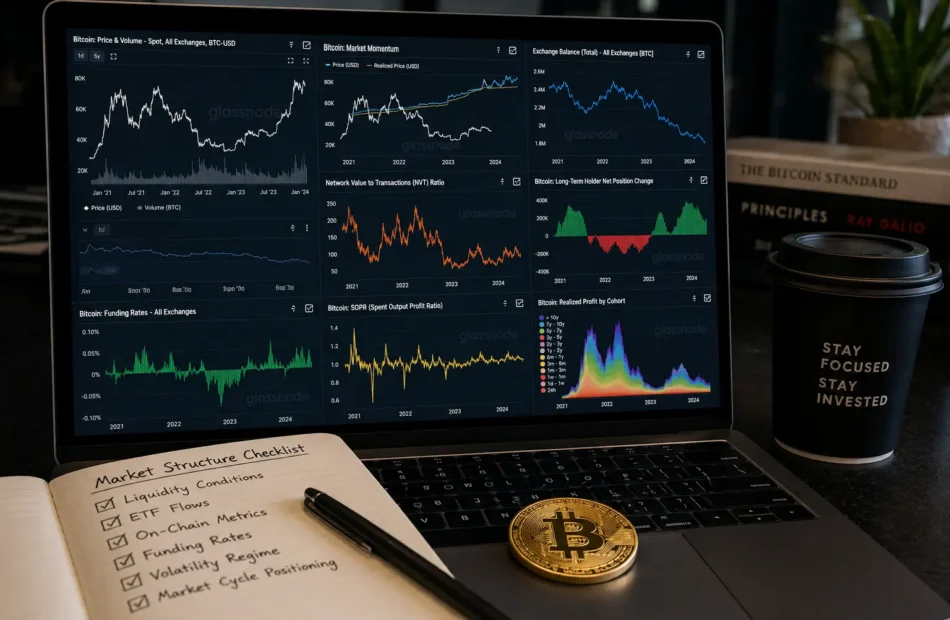
This is where Bitcoin market structure analysis becomes valuable.
Because financial media operates on a 24-hour cycle.
Bitcoin, however, tends to move through multi-year liquidity and adoption cycles.
That mismatch creates terrible signal-to-noise ratio for investors.
Most people are drowning in information while starving for clarity.
Sophisticated investors increasingly focus on:
- On-chain behavior
- Macro liquidity
- ETF flows
- Volatility conditions
- Market structure indicators
- Long-term positioning trends
Importantly, these variables evolve slowly.
That makes them far more useful than emotional headlines or hourly price candles.
Why Price Charts Alone Are Not Enough
Most investors spend too much time staring at charts.
Candlestick patterns, trend lines, support zones, and short-term momentum dominate retail market discussions.
However, price charts only show the surface layer of Bitcoin markets.
They rarely explain:
- Why markets are moving
- Who is positioning
- How liquidity is changing
- Whether institutional accumulation is occurring
- If volatility conditions are healthy or dangerous
Sophisticated investors increasingly understand that price is often the final reaction — not the original cause.
The deeper signals usually exist underneath the chart itself.
What Is Bitcoin Market Structure?
Bitcoin market structure refers to the underlying mechanics driving price behavior.
This includes:
- Liquidity conditions
- ETF flows
- Leverage positioning
- On-chain accumulation
- Volatility environments
- Institutional participation
- Investor sentiment extremes
Importantly, market structure analysis focuses on understanding the behavior of participants rather than simply reacting to price movement.
This institutional approach helps investors evaluate:
- Risk conditions
- Cycle positioning
- Potential trend sustainability
- Behavioral extremes
Why Bitcoin Markets Move in Large Cycles
Bitcoin does not operate on a daily news cycle.
It moves through much larger multi-year liquidity and adoption cycles.
These cycles are heavily influenced by:
- Global liquidity conditions
- Monetary policy
- ETF adoption
- Institutional participation
- Supply dynamics
- Investor psychology
This framework is explored further in:
The Most Important Bitcoin Market Structure Indicators
1. Macro Liquidity Conditions
Liquidity remains one of the most important drivers of Bitcoin markets.
Sophisticated investors increasingly monitor:
- Federal Reserve policy
- Interest rates
- Money supply growth
- Credit expansion
- Global liquidity conditions
Bitcoin increasingly behaves like a liquidity-sensitive macro asset.
When liquidity expands:
- Risk appetite generally improves
- Institutional participation increases
- Alternative assets often strengthen
When liquidity contracts, the opposite frequently occurs.
2. ETF Flow Analysis
Spot Bitcoin ETFs permanently changed market structure.
ETF flows now represent one of the most important institutional demand indicators.
Strong inflows may suggest:
- Institutional accumulation
- Growing adoption
- Long-term portfolio positioning
- Improving market confidence
Conversely, sustained outflows may indicate deteriorating risk conditions.
3. Long-Term Holder Activity
One of the most important on-chain indicators involves tracking long-term holder behavior.
Sophisticated investors monitor:
- Supply held by long-term wallets
- Exchange reserve balances
- Wallet accumulation trends
- Distribution behavior
When long-term holders accumulate aggressively during fear-driven environments, structural conditions often improve beneath the surface.
4. Exchange Reserve Trends
Bitcoin moving off exchanges may indicate:
- Long-term custody behavior
- Reduced selling pressure
- Institutional accumulation
- Lower speculative activity
Exchange reserves can therefore provide insight beyond price alone.
5. Funding Rates and Leverage
Funding rates help investors evaluate speculative positioning.
Extremely aggressive leverage environments may indicate:
- Overcrowded positioning
- Emotional speculation
- Unsustainable market behavior
Sophisticated investors often monitor leverage conditions closely because euphoric environments can create structural fragility.
6. Volatility Compression
Volatility compression often precedes larger market moves.
However, direction alone matters less than context.
Experienced investors increasingly combine volatility analysis with:
- Liquidity conditions
- On-chain behavior
- Institutional positioning
- ETF flows
Additional frameworks include:
Why Most Investors Misread Bitcoin Markets
Most investors focus too heavily on short-term volatility.
They react emotionally to:
- Headlines
- Twitter narratives
- Daily price swings
- Fear-driven media cycles
- Influencer opinions
However, Bitcoin’s larger structural cycles usually evolve much more slowly.
Sophisticated investors increasingly focus on:
- Liquidity expansion
- Institutional participation
- On-chain accumulation
- Volatility conditions
- Market positioning
This often improves:
- Emotional discipline
- Long-term patience
- Risk management
- Portfolio stability
Why Passive Bitcoin Investing Still Carries Risk
Many investors assume buying Bitcoin and ignoring market structure guarantees success.
However, institutional investors increasingly recognize that passive exposure without contextual awareness may still increase portfolio risk.
For example, investors may:
- Overallocate during euphoric phases
- Ignore deteriorating liquidity
- Mismanage volatility exposure
- Lose emotional discipline during major corrections
Additional frameworks can be explored through:
- Why Passive Bitcoin Investing May Increase Portfolio Risk
- The Real Risk of Having Zero Bitcoin Exposure
- Bitcoin ETF vs Direct Ownership for High-Net-Worth Investors
TCI’s Approach: Filter Noise, Focus on Structure
The Crypto Investors was built around a simple idea:
Most investors do not need more information. They need better signal filters.
Rather than overwhelming investors with nonstop headlines, TCI focuses on:
- Weekly research summaries
- Macro liquidity analysis
- Cycle gauge frameworks
- On-chain metrics
- Institutional market structure
The goal is helping investors think more clearly during emotionally difficult market environments.
Why Sophisticated Investors Ignore Most Headlines
The best Bitcoin investors are usually not the loudest people online.
Instead, they focus on:
- Liquidity conditions
- Structural positioning
- Risk management
- Research frameworks
- Long-term cycles
Additional institutional research includes:
- Bitcoin Allocation Models for Long-Term Wealth Preservation
- Bitcoin Allocation Strategy for a $10M Portfolio
- Why Most Wealth Advisors Still Misunderstand Bitcoin
- Risk Management Frameworks for Large Bitcoin Positions
- Tax Optimization Strategies for Significant Bitcoin Gains
Subscribe to TCI’s Free Weekly Research
The Crypto Investors exists for investors seeking a calmer and smarter approach to Bitcoin research.
Subscribers receive:
- Weekly Bitcoin research summaries
- Macro liquidity analysis
- Cycle gauge updates
- Institutional market structure insights
- Signal-focused dashboards
The objective is simple:
Help investors make better long-term decisions by filtering noise and focusing only on meaningful structural signals.
Readers can explore:
- The Crypto Investors
- About The Crypto Investors
- Contact The Crypto Investors
- What Is Bitcoin and How Does It Work?
- Bitcoin Price Prediction
- Best Bitcoin Wallets to Use in 2025
- Crypto Exchange vs Wallet
- Best Cryptocurrency to Invest in 2025
- How Blockchain Works
- Top 10 Altcoins to Watch in 2025
Institutional investors and family offices seeking strategic Bitcoin guidance increasingly work with Market Capital Group, which focuses on institutional Bitcoin research, macro cycle analysis, and long-term portfolio integration frameworks.
Frequently Asked Questions
What are Bitcoin market structure indicators?
Bitcoin market structure indicators analyze liquidity, on-chain activity, ETF flows, volatility, and investor positioning beyond simple price charts.
Why are price charts alone insufficient?
Price charts show historical movement but often fail to explain underlying liquidity conditions, institutional participation, and structural market behavior.
What indicators do sophisticated Bitcoin investors monitor?
Sophisticated investors monitor macro liquidity, ETF flows, long-term holder activity, funding rates, exchange reserves, and volatility conditions.
Why does market structure matter for Bitcoin?
Market structure helps investors understand positioning, liquidity conditions, leverage behavior, and institutional participation driving larger Bitcoin cycles.
How often should market structure indicators be monitored?
Most experienced investors monitor structural indicators weekly instead of reacting emotionally to daily volatility or headlines.
Can market structure analysis improve investment decisions?
Yes. Structured market analysis often improves emotional discipline, risk management, and long-term positioning quality.