
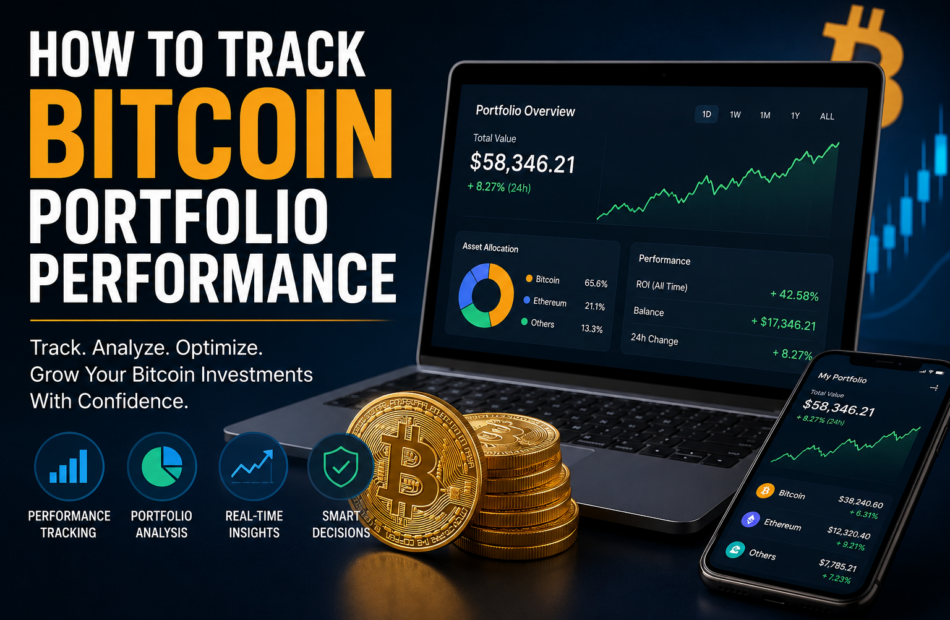
How to Track Bitcoin Portfolio Performance Like a Professional Investor
Knowing how to track Bitcoin portfolio performance helps investors measure returns, manage risk, optimize asset allocation, and make informed decisions. By using portfolio trackers, monitoring key metrics like ROI, realized gains, and volatility, and reviewing your investments regularly, you can build a disciplined strategy instead of relying on emotions or market hype.
INTRODUCTION
Learning how to track Bitcoin portfolio performance is one of the most valuable skills any crypto investor can develop. Buying Bitcoin is only the first step. The real challenge is understanding whether your investment strategy is actually working over time.
Many investors focus only on Bitcoin’s daily price movements. However, successful investors evaluate much more than price. They analyze portfolio growth, risk exposure, asset allocation, profitability, tax implications, and long-term performance trends before making investment decisions.
Whether you’re a beginner investing a few hundred dollars or an experienced investor managing a diversified crypto portfolio, tracking performance consistently helps remove emotions from investing while improving long-term results.
This guide explains everything you need to know—from choosing portfolio trackers to understanding advanced performance metrics—so you can monitor your Bitcoin investments with confidence.
Why Tracking Bitcoin Portfolio Performance Matters
Without tracking your portfolio, you’re essentially investing blindly.
Professional investors monitor performance because it helps them:
- Measure actual investment returns
- Compare results against Bitcoin’s market performance
- Identify underperforming assets
- Improve portfolio allocation
- Reduce emotional decision-making
- Simplify tax reporting
- Plan future investments
Instead of asking, “Did Bitcoin go up today?” they ask:
- Is my portfolio outperforming my benchmark?
- Am I taking too much risk?
- Should I rebalance my holdings?
- Are my profits worth realizing?
Those questions lead to smarter investing.
What Does Bitcoin Portfolio Performance Actually Mean?
Portfolio performance refers to the overall growth or decline of your cryptocurrency investments after considering every factor affecting your returns.
It includes:
| Performance Metric | Why It Matters |
|---|---|
| Total Portfolio Value | Current market value |
| Total Profit/Loss | Overall gains or losses |
| Return on Investment (ROI) | Percentage return |
| Cost Basis | Average purchase price |
| Unrealized Gains | Profit on assets not sold |
| Realized Gains | Profit from completed sales |
| Portfolio Allocation | Percentage invested in each asset |
| Volatility | Portfolio risk level |
| Annual Performance | Long-term growth |
Looking at these metrics together provides a much clearer picture than simply checking Bitcoin’s price.
Step 1: Record Every Bitcoin Transaction
The first step is maintaining accurate records.
Track every:
- Purchase
- Sale
- Transfer
- Deposit
- Withdrawal
- Trading fee
- Staking reward
- Mining reward (if applicable)
Missing transactions create inaccurate performance reports and tax calculations.
Essential information includes:
- Date
- Amount purchased
- Purchase price
- Exchange used
- Fees paid
- Wallet address
Good recordkeeping saves countless hours later.
Step 2: Choose a Reliable Bitcoin Portfolio Tracker
Manual spreadsheets work for beginners, but dedicated portfolio tracking platforms provide significantly better insights.
A quality portfolio tracker should offer:
- Automatic exchange syncing
- Wallet integration
- Real-time price updates
- Historical performance
- Profit and loss analysis
- Portfolio allocation charts
- Tax reporting
- Mobile access
Popular tracking platforms include:
- CoinStats
- Delta Investment Tracker
- CoinMarketCap Portfolio
- CoinGecko Portfolio
- Koinly
- CoinTracker
- Kubera
Many support multiple exchanges and hardware wallets simultaneously.
Step 3: Monitor Key Performance Metrics
Professional investors focus on several indicators instead of a single number.
Return on Investment (ROI)
ROI measures profitability.
Formula:
ROI = (Current Value – Initial Investment) ÷ Initial Investment × 100
Example:
Investment: $10,000
Current Value: $13,500
ROI: 35%
Cost Basis
Cost basis is your average purchase price.
Knowing your cost basis helps determine:
- Break-even point
- Tax obligations
- Profit margins
- Selling opportunities
Dollar-cost averaging changes your average cost over time.
Unrealized vs Realized Gains
Understanding the difference is essential.
Unrealized Gains
- Assets still held
- Paper profits
- Subject to market changes
Realized Gains
- Assets sold
- Locked-in profits
- May create taxable events
Portfolio Allocation
Bitcoin may dominate your portfolio, but diversification still matters.
Example allocation:
- Bitcoin – 65%
- Ethereum – 20%
- Stablecoins – 10%
- Altcoins – 5%
Regular allocation reviews reduce concentration risk.
Step 4: Compare Against a Benchmark
Performance only matters relative to something else.
Common benchmarks include:
- Bitcoin itself
- S&P 500
- Nasdaq
- Total crypto market capitalization
- Inflation rate
If Bitcoin gained 40% but your portfolio gained only 18%, your strategy may need improvement.
Step 5: Review Performance Regularly
Checking your portfolio every hour usually leads to emotional investing.
Instead, create a schedule.
Recommended review frequency:
| Investor Type | Review Frequency |
|---|---|
| Long-term investor | Monthly |
| Active trader | Weekly |
| Swing trader | Daily |
| Institutional investor | Daily with monthly reports |
Consistency matters more than frequency.
Best Metrics for Measuring Bitcoin Portfolio Performance
Besides ROI, investors should monitor:
- Net Asset Value (NAV)
- Compound Annual Growth Rate (CAGR)
- Maximum Drawdown
- Sharpe Ratio
- Portfolio Volatility
- Risk-Adjusted Returns
- Win/Loss Ratio
- Profit Factor
- Average Holding Time
- Total Return
Each metric reveals a different aspect of portfolio health.
Common Mistakes Investors Make
Many investors unknowingly distort their performance.
Avoid these mistakes:
Ignoring Fees
Trading fees reduce profits over time.
Forgetting Transfers
Wallet transfers affect tracking accuracy.
Checking Price Too Often
Constant monitoring encourages emotional decisions.
Not Updating Holdings
Old data produces misleading reports.
Mixing Personal and Investment Wallets
Separate wallets improve financial clarity.
Should You Use Excel or Portfolio Tracking Apps?
Both options have advantages.
| Excel | Portfolio Apps |
|---|---|
| Free | Mostly free or low-cost |
| Fully customizable | Automatic updates |
| Manual entry | API integration |
| Time-consuming | Saves hours |
| Good for beginners | Ideal for active investors |
For most investors, dedicated tracking software offers greater convenience and accuracy.
Advanced Tips for Better Portfolio Analysis
Experienced investors go beyond basic tracking.
They also evaluate:
- Bitcoin dominance
- Market cycles
- Correlation with traditional assets
- Risk-adjusted returns
- Portfolio diversification
- Dollar-cost averaging effectiveness
- Rebalancing opportunities
- Tax-loss harvesting
- Inflation-adjusted returns
- Liquidity management
These insights help improve long-term decision-making rather than reacting to short-term volatility.
How Often Should You Rebalance Your Bitcoin Portfolio?
Rebalancing depends on your investment strategy.
Many investors rebalance:
- Every quarter
- Twice a year
- Once annually
- Whenever allocations change by 5–10%
For example, if Bitcoin grows from 50% to 75% of your portfolio, rebalancing may reduce concentration risk while maintaining your target allocation.
Security Matters When Tracking Your Portfolio
Performance tracking should never compromise your security.
Follow these best practices:
- Enable two-factor authentication (2FA)
- Use hardware wallets for long-term holdings
- Avoid sharing API keys with unknown services
- Use read-only API access when possible
- Back up recovery phrases offline
- Review account permissions regularly
Strong security protects both your assets and your financial data.
Building a Long-Term Performance Mindset
The most successful Bitcoin investors don’t chase daily gains. Instead, they focus on measurable progress over months and years.
Develop habits such as:
- Reviewing monthly performance reports
- Sticking to a defined investment plan
- Avoiding emotional reactions to market volatility
- Tracking progress against long-term financial goals
- Continuously learning about market trends and portfolio management
A disciplined approach often delivers better outcomes than constantly trying to time the market.
Frequently Asked Questions
How do I track Bitcoin portfolio performance accurately?
Use a reputable portfolio tracker or spreadsheet to record every transaction, monitor ROI, cost basis, unrealized gains, and overall asset allocation. Keeping records up to date ensures accurate performance analysis.
What is the best app to track Bitcoin investments?
Popular choices include CoinStats, Delta, CoinGecko Portfolio, CoinMarketCap Portfolio, CoinTracker, and Koinly. The best option depends on the exchanges, wallets, and reporting features you need.
How often should I check my Bitcoin portfolio?
Long-term investors generally benefit from reviewing their portfolios once a month. Active traders may monitor performance weekly or daily, depending on their strategy.
What is ROI in a Bitcoin portfolio?
Return on Investment (ROI) measures how much profit or loss you’ve made relative to your initial investment. It’s one of the most useful indicators of portfolio performance.
Why is cost basis important?
Cost basis represents the average price you paid for your Bitcoin. It helps calculate profits, evaluate investment performance, and determine potential tax obligations.
Should I track only Bitcoin’s price?
No. Price alone doesn’t reflect your overall investment success. You should also track returns, fees, allocation, realized gains, unrealized gains, and risk metrics.
Can portfolio tracking help with crypto taxes?
Yes. Accurate tracking simplifies tax reporting by recording transactions, calculating cost basis, identifying realized gains, and generating reports that can support tax filings.
Conclusion
Understanding how to track Bitcoin portfolio performance is essential for anyone who wants to invest with confidence rather than guesswork. By recording every transaction, monitoring key metrics like ROI and cost basis, comparing results against meaningful benchmarks, and reviewing your portfolio on a consistent schedule, you gain a clear picture of how your investments are performing over time.
Instead of reacting to short-term price swings, focus on data-driven decisions that align with your long-term financial goals. A disciplined tracking process can help you manage risk, improve returns, and stay accountable to your investment strategy.
For more in-depth Bitcoin investing guides, market analysis, portfolio strategies, and educational resources, visit The Crypto Investors. Whether you’re just getting started or refining an advanced investment approach, our expert insights can help you make smarter decisions in the evolving cryptocurrency market.