
Bitcoin Price Cycle History: Understanding Every Major Market Cycle Since 2009
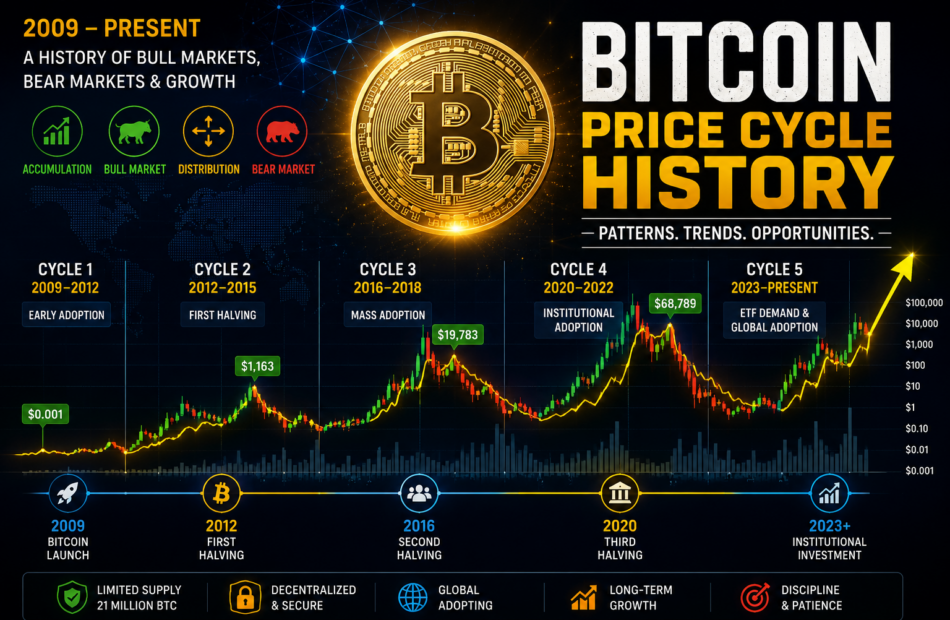
Bitcoin price cycle history refers to the recurring pattern of bull markets, bear markets, accumulation phases, and recoveries that have shaped Bitcoin’s performance since 2009. Although no cycle guarantees future results, understanding previous market trends helps investors identify opportunities, manage risks, and make informed long-term investment decisions.
INTRODUCTION
Bitcoin has experienced some of the most dramatic price movements in financial history. From trading for just a few cents to reaching new all-time highs, its journey has been defined by repeated cycles of rapid growth followed by significant corrections. Understanding bitcoin price cycle history isn’t just interesting—it can help investors recognize market behavior, avoid emotional decisions, and build better long-term strategies.
Unlike traditional assets, Bitcoin operates in a unique environment influenced by supply reductions, investor sentiment, institutional adoption, macroeconomic conditions, and technological innovation. While every cycle has its own characteristics, several repeating patterns have emerged over the past decade.
In this guide, we’ll examine every major Bitcoin market cycle, explore what drives these movements, and discuss how investors can use historical insights without assuming history will repeat exactly.
What Is a Bitcoin Price Cycle?
A Bitcoin price cycle is the recurring sequence of market phases that Bitcoin typically experiences over several years. These phases are influenced by changes in supply and demand, investor psychology, economic conditions, and network growth.
Most Bitcoin cycles include four major stages:
- Accumulation
- Bull Market
- Distribution
- Bear Market
Although timing differs from cycle to cycle, these phases have consistently appeared throughout Bitcoin’s history.
| Market Phase | Typical Characteristics | Investor Behavior |
|---|---|---|
| Accumulation | Low volatility and undervaluation | Long-term buying |
| Bull Market | Strong upward momentum | Growing optimism |
| Distribution | Profit-taking near highs | Mixed sentiment |
| Bear Market | Sharp price declines | Fear and capitulation |
Recognizing these stages helps investors understand where the market may currently stand instead of reacting purely to short-term price fluctuations.
Why Bitcoin Moves in Cycles
Unlike many traditional financial assets, Bitcoin has a fixed maximum supply of 21 million coins. This scarcity plays an important role in its long-term market behavior.
Several factors contribute to recurring cycles:
Supply Reduction Through Halving
Approximately every four years, Bitcoin undergoes a halving event that reduces the number of new coins entering circulation. Lower supply growth has historically coincided with increased upward price momentum when demand remains strong.
Investor Psychology
Financial markets often follow emotional patterns.
Typical emotional stages include:
- Disbelief
- Hope
- Optimism
- Excitement
- Euphoria
- Anxiety
- Fear
- Capitulation
- Recovery
These emotional shifts repeatedly influence buying and selling decisions.
Institutional Adoption
Over the years, institutional investors, publicly traded companies, hedge funds, and investment products have increased Bitcoin exposure. Greater participation often changes market dynamics compared to earlier cycles.
Global Economic Conditions
Interest rates, inflation, liquidity, monetary policy, and geopolitical events also affect investor appetite for risk assets, including Bitcoin.
Bitcoin Price Cycle History (2009–Present)
Let’s explore every major Bitcoin cycle and what made each one unique.
First Cycle (2009–2012): Bitcoin’s Early Growth
The earliest years of Bitcoin were driven almost entirely by technology enthusiasts, developers, and early adopters.
Key characteristics included:
- Extremely low trading volume
- Minimal public awareness
- Limited exchange availability
- High volatility
During this period, Bitcoin transitioned from virtually worthless to several dollars, laying the foundation for future adoption.
Important milestones included:
- Launch of the Bitcoin network
- Early mining community growth
- First cryptocurrency exchanges
- Initial commercial transactions
Although prices were small by today’s standards, percentage gains were extraordinary.
Second Cycle (2012–2015): The First Global Bull Market
Following the first halving, Bitcoin entered one of its earliest explosive bull markets.
Several catalysts supported growth:
- Increased media attention
- More cryptocurrency exchanges
- Growing retail participation
- Rising international interest
Bitcoin climbed from double-digit prices to over $1,000 before experiencing a severe bear market.
The correction that followed exceeded 80%, reminding investors that volatility is an inherent part of Bitcoin investing.
Despite the decline, the network itself continued expanding, demonstrating an important lesson repeated throughout Bitcoin history:
Price and network development don’t always move together over short periods.
Third Cycle (2016–2018): Mainstream Recognition
The 2016 halving marked another turning point.
This cycle introduced Bitcoin to millions of new investors worldwide.
Major developments included:
- Significant retail adoption
- Initial Coin Offering (ICO) boom
- Rapid exchange expansion
- Increased venture capital investment
- Growing global awareness
Bitcoin eventually reached nearly $20,000 in late 2017, attracting unprecedented public attention.
However, excessive speculation eventually led to another prolonged bear market.
The correction eliminated many speculative projects, while Bitcoin itself remained the dominant cryptocurrency by market capitalization.
During this period, experienced investors learned another valuable lesson:
Long-term adoption often survives even when speculative excess disappears.
Fourth Cycle (2020–2022): Institutional Adoption Changes the Market
The fourth Bitcoin cycle was unlike anything seen before. Instead of being driven mainly by retail investors, it was fueled by institutional participation, corporate treasury investments, and growing recognition of Bitcoin as a potential store of value.
Several key developments transformed the market:
- Public companies added Bitcoin to their balance sheets.
- Institutional investors increased crypto allocations.
- Bitcoin exchange-traded products gained popularity in several countries.
- Global monetary stimulus boosted demand for alternative assets.
As confidence grew, Bitcoin climbed from around $3,800 during the 2020 market crash to nearly $69,000 in November 2021.
However, rising inflation, aggressive interest rate hikes, and several high-profile crypto company failures triggered another prolonged bear market. Prices declined by more than 75%, once again demonstrating Bitcoin’s extreme volatility.
Even so, one important trend remained intact—network adoption continued to expand despite falling prices.
Fifth Cycle (2023–Present): A More Mature Bitcoin Market
The current Bitcoin market cycle reflects a more mature asset class than previous years. While volatility remains significant, institutional infrastructure has improved considerably.
Key drivers of the current cycle include:
- Increased institutional demand
- Spot Bitcoin ETF adoption in several markets
- Growing regulatory clarity
- Continued long-term accumulation by investors
- Expanding global acceptance of digital assets
Unlike earlier cycles driven largely by speculation, today’s market includes pension funds, asset managers, family offices, and multinational corporations.
As a result, many analysts believe future cycles may remain volatile but could become progressively more stable over time.
Complete Bitcoin Price Cycle History at a Glance
| Cycle | Approximate Period | Bull Market Peak | Bear Market Decline | Major Catalyst |
|---|---|---|---|---|
| Cycle 1 | 2009–2012 | Early adoption | Moderate | Bitcoin launch |
| Cycle 2 | 2012–2015 | Over $1,000 | Around 85% | First halving |
| Cycle 3 | 2016–2018 | Nearly $20,000 | Around 84% | ICO boom |
| Cycle 4 | 2020–2022 | Nearly $69,000 | Around 77% | Institutional adoption |
| Cycle 5 | 2023–Present | Ongoing | Still developing | ETF demand and institutional investment |
Although no two cycles are identical, each has featured periods of optimism, rapid growth, correction, and eventual recovery.
What Can Investors Learn from Bitcoin Price Cycle History?
Historical performance never guarantees future results. Nevertheless, Bitcoin’s past provides several valuable lessons for long-term investors.
1. Volatility Is Normal
Large corrections have occurred after every major bull market. Investors who understand this are often better prepared emotionally during downturns.
2. Long-Term Trends Matter More Than Daily Prices
Daily price movements can be unpredictable. In contrast, multi-year adoption trends have historically provided a clearer picture of Bitcoin’s overall growth.
3. Market Sentiment Changes Quickly
Fear often dominates near market bottoms, while excessive optimism usually appears close to cycle peaks.
Recognizing these emotional extremes can help investors avoid buying purely because prices are rising or selling simply because prices are falling.
4. Risk Management Remains Essential
Successful investors typically:
- Diversify their portfolios.
- Invest only what they can afford to lose.
- Maintain long-term investment horizons.
- Avoid emotional decision-making.
- Review their strategy periodically.
These principles remain valuable regardless of market conditions.
Does Bitcoin Always Follow a Four-Year Cycle?
Many investors associate Bitcoin with a four-year cycle because of the approximate timing of its halving events. While halvings have historically influenced supply dynamics, modern markets are becoming increasingly complex.
Today, Bitcoin prices are also affected by:
- Global liquidity
- Central bank policies
- Institutional investment flows
- Regulatory developments
- Exchange-traded funds
- Geopolitical uncertainty
- Broader financial market conditions
Consequently, future cycles may differ from historical patterns. Investors should view past cycles as a framework rather than a prediction.
Common Mistakes When Using Bitcoin Cycle History
Studying previous cycles is valuable, but relying on them too heavily can lead to costly mistakes.
Avoid these common pitfalls:
- Assuming history will repeat exactly.
- Ignoring macroeconomic factors.
- Investing solely because of social media hype.
- Trying to perfectly time market tops and bottoms.
- Overlooking proper portfolio diversification.
- Using excessive leverage during volatile periods.
Instead, combine historical analysis with sound risk management and independent research.
Indicators Often Used to Analyze Bitcoin Cycles
Experienced market participants monitor several on-chain and technical indicators alongside price history.
Popular metrics include:
- Bitcoin Halving Schedule
- Market Value to Realized Value (MVRV)
- Realized Price
- Pi Cycle Indicator
- Relative Strength Index (RSI)
- 200-Week Moving Average
- Fear and Greed Index
- Hash Rate Trends
- Long-Term Holder Supply
- Exchange Reserve Balances
No single indicator predicts market movements perfectly. However, using multiple data points together can improve decision-making.
Is Bitcoin Becoming Less Cyclical?
As institutional ownership grows and market liquidity improves, some analysts believe Bitcoin’s future price swings may become less extreme.
Potential reasons include:
- Larger institutional participation
- Greater market efficiency
- Broader global adoption
- Improved regulatory frameworks
- Increasing integration into traditional finance
Nevertheless, Bitcoin remains a relatively young asset compared to stocks, bonds, or gold. Investors should still expect significant volatility during both bull and bear markets.
Key Takeaways from Bitcoin Price Cycle History
Understanding Bitcoin’s historical cycles helps investors develop realistic expectations rather than relying on speculation.
The most consistent patterns include:
- Bull markets have historically followed major accumulation periods.
- Every significant rally has been followed by substantial corrections.
- Long-term adoption has continued despite repeated downturns.
- Investor psychology plays a major role in market movements.
- Risk management is just as important as identifying opportunities.
While the future may not mirror the past perfectly, studying historical cycles provides valuable context for navigating an evolving digital asset market.
Frequently Asked Questions
1. What is the Bitcoin price cycle?
The Bitcoin price cycle is the recurring pattern of accumulation, bull markets, distribution, and bear markets that has characterized Bitcoin’s market behavior since its launch. These cycles are influenced by supply reductions, investor sentiment, adoption trends, and macroeconomic conditions.
2. How long does a typical Bitcoin cycle last?
Historically, Bitcoin has followed cycles lasting approximately four years, largely due to the Bitcoin halving event that reduces new coin issuance every 210,000 blocks. However, future cycles may vary as institutional participation and global economic factors play a larger role.
3. Does Bitcoin always rise after a halving?
Not immediately. While previous halvings have been followed by significant bull markets, there is no guarantee that future price movements will follow the same pattern. Market demand, liquidity, regulations, and investor sentiment also influence Bitcoin’s price.
4. What causes Bitcoin bull and bear markets?
Bitcoin bull markets are generally driven by increasing demand, institutional investment, positive market sentiment, and limited new supply. Bear markets typically occur after periods of excessive speculation, profit-taking, tighter financial conditions, or negative industry events.
5. Can Bitcoin price cycle history predict future prices?
No. Bitcoin price cycle history provides valuable context but cannot accurately predict future prices. Investors should use historical trends alongside technical analysis, on-chain data, and fundamental research rather than relying solely on previous cycles.
6. Is Bitcoin still a good long-term investment?
Many investors view Bitcoin as a long-term digital asset because of its limited supply and growing global adoption. However, Bitcoin remains highly volatile, so every investment decision should align with individual financial goals and risk tolerance.
7. What is the biggest lesson from Bitcoin price cycle history?
The most important lesson is that volatility is a normal part of Bitcoin investing. Every major bull market has been followed by significant corrections, yet Bitcoin has repeatedly recovered and reached new highs over the long term. Patience, disciplined investing, and proper risk management have historically rewarded long-term investors.
Conclusion
Understanding bitcoin price cycle history provides investors with valuable perspective on how the world’s largest cryptocurrency has evolved through multiple market cycles. Although each cycle has been shaped by unique economic conditions, technological developments, and investor sentiment, several consistent patterns have emerged over time.
History shows that Bitcoin has repeatedly moved through accumulation phases, powerful bull markets, sharp corrections, and long recovery periods. While these historical trends can improve market awareness, they should never be viewed as guarantees of future performance. Successful investors combine historical analysis with sound research, disciplined risk management, and a long-term investment mindset.
As Bitcoin continues to mature through institutional adoption, regulatory developments, and increasing global acceptance, future cycles may look different from those of the past. Staying informed and focusing on long-term fundamentals will remain more valuable than attempting to predict short-term price movements.
If you’re looking for expert cryptocurrency insights, in-depth Bitcoin market analysis, educational guides, and data-driven investment strategies, visit TheCryptoInvestors.com. Our mission is to help investors make smarter decisions with reliable, research-backed content that keeps you ahead in the rapidly evolving digital asset market.