

Bitcoin Accumulation Phase Indicators: How to Identify the Best Buying Opportunities
Bitcoin accumulation phase indicators help investors identify periods when long-term holders and institutional buyers quietly accumulate Bitcoin before significant price increases. By analyzing on-chain data, market sentiment, exchange reserves, volume, and technical metrics together, investors can improve entry timing while reducing emotional decision-making. No single indicator is perfect, but combining multiple signals provides stronger confirmation.
INTRODUCTION
Bitcoin has rewarded patient investors more than almost any other asset over the past decade. However, the biggest gains rarely come from buying during media hype or after prices have already surged. Instead, experienced investors often focus on identifying the bitcoin accumulation phase indicators that reveal when smart money is quietly building positions before the next major rally.
Accumulation phases typically occur after significant corrections or extended periods of sideways price action. During these periods, retail interest declines, trading volumes cool, and market sentiment often turns pessimistic. Yet beneath the surface, long-term holders, institutional investors, and sophisticated market participants may steadily accumulate Bitcoin.
Understanding these indicators doesn’t guarantee perfect market timing, but it can significantly improve investment decisions by helping investors recognize favorable risk-to-reward opportunities.
In this guide, you’ll learn how Bitcoin accumulation works, which indicators deserve the most attention, and how to combine multiple signals into a practical investment strategy.
What Is a Bitcoin Accumulation Phase?
A Bitcoin accumulation phase is a market period where investors steadily purchase Bitcoin over time while prices remain relatively stable or recover slowly after a decline.
Unlike explosive bull markets, accumulation is usually quiet and receives little mainstream attention. Price movements remain limited, volatility often decreases, and many market participants lose interest.
During accumulation:
- Long-term investors gradually increase holdings.
- Selling pressure decreases.
- Weak hands exit the market.
- Institutional investors often build positions discreetly.
- Supply available on exchanges gradually shrinks.
Historically, these phases have preceded several of Bitcoin’s strongest long-term rallies.
Why Identifying Accumulation Matters
Recognizing accumulation early offers several advantages.
Better Risk-to-Reward
Buying during accumulation often provides lower downside risk than chasing rapidly rising prices.
Reduced Emotional Investing
Investors who rely on objective market data avoid making decisions based solely on fear or excitement.
Long-Term Wealth Building
Many successful Bitcoin investors focus less on predicting daily price movements and more on identifying high-probability accumulation zones.
Improved Dollar-Cost Averaging
Accumulation indicators can help investors allocate additional capital during periods when Bitcoin appears fundamentally undervalued.
Characteristics of a Bitcoin Accumulation Phase
Several market behaviors tend to appear simultaneously during accumulation.
| Characteristic | What It Suggests |
|---|---|
| Sideways price movement | Market stabilization |
| Lower volatility | Reduced speculative activity |
| Falling exchange balances | Investors moving Bitcoin into long-term storage |
| Increasing wallet activity | Growing accumulation |
| Weak retail sentiment | Contrarian buying opportunities |
| Stable network activity | Healthy long-term adoption |
No single characteristic confirms accumulation. Instead, investors should evaluate the broader market picture.
The Most Reliable Bitcoin Accumulation Phase Indicators
Professional investors rarely rely on only one metric. Instead, they combine several on-chain, technical, and sentiment indicators.
Exchange Reserve Decline
One of the strongest accumulation signals is declining Bitcoin balances held on cryptocurrency exchanges.
When investors withdraw Bitcoin from exchanges into private wallets or cold storage, it often indicates they intend to hold rather than sell.
A sustained decline in exchange reserves may suggest:
- Reduced selling pressure
- Long-term investor confidence
- Institutional custody growth
- Supply becoming less liquid
When supply decreases while demand remains stable or increases, prices may eventually rise.
Long-Term Holder Supply
Long-term holders are investors who have kept their Bitcoin for several months or years without selling.
Historically, these holders tend to accumulate during bear markets and distribute during euphoric bull markets.
Growing long-term holder supply often indicates:
- Investor conviction
- Reduced speculative selling
- Strong confidence in Bitcoin’s future value
Many analysts consider this one of the most valuable on-chain indicators available.
Realized Price
The realized price estimates the average acquisition cost of all Bitcoin currently in circulation.
Historically:
- Bitcoin trading below realized price has often occurred near major market bottoms.
- Trading above realized price generally indicates improving market strength.
Although not a standalone buy signal, realized price provides valuable context for identifying accumulation periods.
MVRV Ratio
The Market Value to Realized Value (MVRV) ratio compares Bitcoin’s market capitalization with its realized capitalization.
Generally:
- High MVRV values may indicate market overheating.
- Low MVRV values can suggest undervaluation.
Historically, lower MVRV readings have frequently aligned with long-term accumulation opportunities.
Investors often combine this metric with price action and holder behavior instead of relying on it alone.
Dormancy Indicators
Dormancy measures how long Bitcoin remains inactive before moving.
When older coins remain untouched, it often indicates experienced investors are holding despite market uncertainty.
Low dormancy levels generally suggest:
- Strong long-term conviction
- Limited profit-taking
- Healthy accumulation behavior
Conversely, spikes in dormancy may indicate long-term holders beginning to sell.
Exchange Netflow
Exchange netflow tracks whether Bitcoin is moving into or out of exchanges.
Negative netflow means:
- More Bitcoin leaves exchanges than enters.
- Investors are transferring assets into self-custody.
- Selling pressure may decline.
Positive netflow can indicate increased willingness to sell, particularly during market rallies.
Monitoring exchange inflows and outflows over time provides valuable insight into investor behavior.
Stablecoin Buying Power
Stablecoins often represent purchasing power waiting to enter the cryptocurrency market.
When stablecoin reserves increase while Bitcoin remains relatively stable, investors may be preparing for future purchases.
This can indicate:
- Growing market liquidity
- Increased institutional readiness
- Potential buying pressure during favorable market conditions
Although indirect, this indicator becomes especially useful when combined with exchange reserve data.
Technical Indicators That Support Bitcoin Accumulation
While on-chain metrics reveal investor behavior, technical analysis helps confirm whether price action supports an accumulation thesis.
Relative Strength Index (RSI)
The Relative Strength Index measures market momentum on a scale from 0 to 100.
During accumulation:
- RSI often remains between 30 and 50.
- Extreme oversold conditions may signal exhausted selling pressure.
- Gradually rising RSI while prices remain stable can indicate strengthening momentum.
Rather than buying solely because RSI is low, investors should seek confirmation from additional indicators.
Moving Averages
Long-term moving averages help filter out short-term market noise.
Key averages commonly monitored include:
- 50-day moving average
- 100-day moving average
- 200-day moving average
When Bitcoin begins reclaiming these long-term averages after an extended decline, it may signal the transition from accumulation to an early uptrend.
In particular, sustained trading above the 200-day moving average has historically coincided with improving long-term market conditions.
Puell Multiple
The Puell Multiple is one of the most respected on-chain valuation metrics because it measures miner revenue relative to its historical average.
Why does this matter? Miners are natural Bitcoin sellers because they need to cover electricity, equipment, and operational expenses. When miner revenue falls significantly below historical norms, selling pressure often decreases, creating favorable conditions for accumulation.
Historically:
- Very low Puell Multiple values have appeared near major market bottoms.
- Extremely high values have often coincided with overheated bull markets.
- Neutral readings typically occur during consolidation periods.
While the Puell Multiple shouldn’t be used alone, it becomes much more powerful when combined with exchange reserves and long-term holder data.
Hash Ribbons
Bitcoin’s security depends on miners, making network hash rate an important market indicator.
Hash Ribbons track miner capitulation and recovery by analyzing hash rate moving averages.
During severe market declines:
- Less profitable miners shut down equipment.
- Hash rate temporarily declines.
- Selling pressure from miners often peaks.
As mining activity stabilizes and hash rate begins recovering, Hash Ribbons may generate a buy signal that has historically aligned with attractive long-term entry points.
Although no indicator predicts every cycle perfectly, Hash Ribbons have earned a strong reputation among long-term Bitcoin investors.
Bitcoin Halving Cycles
One of the most unique bitcoin accumulation phase indicators isn’t an indicator at all—it’s Bitcoin’s programmed monetary policy.
Approximately every four years, the Bitcoin network undergoes a halving event, reducing the number of new coins entering circulation by 50%.
Historically, the market cycle has often followed this pattern:
| Market Stage | Typical Characteristics |
|---|---|
| Bear Market | Heavy corrections and declining sentiment |
| Accumulation | Sideways movement and smart money buying |
| Post-Halving Recovery | Gradual increase in demand |
| Bull Market | Strong upward momentum |
| Distribution | Profit-taking and heightened speculation |
While history doesn’t guarantee future performance, many investors closely monitor halving cycles alongside on-chain metrics.
Whale Wallet Activity
Large Bitcoin holders—commonly called whales—can significantly influence market sentiment.
Monitoring whale activity can reveal whether major investors are:
- Increasing holdings
- Reducing positions
- Moving coins between wallets
- Transferring Bitcoin to exchanges
Growing whale balances during periods of weak retail sentiment often indicate quiet accumulation.
However, investors should avoid reacting to individual transactions. Instead, focus on long-term trends across multiple large wallets.
Volume Analysis
Trading volume provides valuable insight into market conviction.
Healthy accumulation often includes:
- Stable or declining volatility
- Moderate but consistent buying volume
- Reduced panic selling
- Higher lows forming over time
On the other hand, sudden spikes in volume without sustained price improvement may simply reflect short-term speculation.
Volume should always be analyzed alongside price structure rather than in isolation.
Market Sentiment Indicators
Markets are driven by psychology as much as fundamentals.
Extreme fear has historically created some of Bitcoin’s best long-term buying opportunities.
Useful sentiment metrics include:
- Crypto Fear and Greed Index
- Social media engagement
- Google search trends
- News sentiment
- Retail participation
Ironically, accumulation frequently occurs when public confidence is at its lowest.
Experienced investors often take a contrarian approach, recognizing that pessimism can create opportunities for disciplined buyers.
Combining Multiple Indicators for Better Accuracy
No single indicator consistently identifies every accumulation phase.
Instead, experienced investors build a framework that combines several independent signals.
Example Accumulation Checklist
✅ Bitcoin trading near or below realized price
✅ Declining exchange reserves
✅ Increasing long-term holder supply
✅ Low MVRV ratio
✅ Negative exchange netflows
✅ Improving hash rate
✅ Moderate trading volume
✅ Fear dominating market sentiment
The more indicators pointing in the same direction, the stronger the overall investment thesis becomes.
Common Mistakes When Identifying Accumulation
Even with access to advanced data, investors often make avoidable mistakes.
Relying on One Indicator
Every indicator has limitations. Confirmation across multiple metrics reduces false signals.
Ignoring Macroeconomic Conditions
Interest rates, inflation, monetary policy, and global liquidity continue to influence Bitcoin prices.
Accumulation signals are more reliable when broader economic conditions are also supportive.
Chasing Short-Term Price Movements
Accumulation is a long-term process.
Attempting to predict every daily fluctuation usually leads to emotional decision-making rather than disciplined investing.
Confusing Consolidation With Accumulation
Not every sideways market represents genuine accumulation.
Some periods simply reflect uncertainty before another decline.
This is why on-chain confirmation is so important.
A Practical Bitcoin Accumulation Strategy
Instead of trying to buy the exact market bottom, many successful investors follow a systematic approach.
Step 1: Analyze On-Chain Metrics
Review:
- Exchange reserves
- MVRV ratio
- Long-term holder supply
- Realized price
- Exchange netflows
Step 2: Evaluate Technical Structure
Confirm:
- Higher lows
- Strong support levels
- Improving RSI
- Recovery above major moving averages
Step 3: Monitor Sentiment
Periods of excessive fear often provide favorable long-term opportunities.
Step 4: Use Dollar-Cost Averaging (DCA)
Rather than investing all capital at once, spread purchases over weeks or months.
Benefits include:
- Reduced timing risk
- Lower emotional stress
- Consistent portfolio growth
- Better long-term discipline
Step 5: Review Risk Management
Always determine:
- Investment time horizon
- Portfolio allocation
- Cash reserves
- Exit strategy
Successful Bitcoin investing is about managing risk as much as identifying opportunities.
Frequently Asked Questions
What are the best bitcoin accumulation phase indicators?
The most reliable bitcoin accumulation phase indicators include declining exchange reserves, increasing long-term holder supply, the MVRV ratio, realized price, exchange netflows, Hash Ribbons, the Puell Multiple, and market sentiment indicators. Rather than relying on a single metric, combining several indicators provides a more accurate picture of whether Bitcoin is in an accumulation phase.
How do I know if Bitcoin is in an accumulation phase?
Bitcoin may be in an accumulation phase when prices move sideways after a correction, exchange balances decline, long-term holders increase their holdings, market sentiment remains fearful, and on-chain metrics suggest reduced selling pressure. Confirming these signals together is more effective than focusing on price action alone.
Is the accumulation phase the best time to buy Bitcoin?
Historically, accumulation phases have offered attractive long-term entry opportunities because they often occur before major bull markets. However, no indicator guarantees future performance. Many investors reduce timing risk by using Dollar-Cost Averaging (DCA) during periods supported by multiple accumulation signals.
Which on-chain indicator is most accurate for Bitcoin accumulation?
There is no single “most accurate” indicator. Many analysts consider long-term holder supply, exchange reserves, and the MVRV ratio among the most valuable because they reflect investor behavior and market valuation. Combining these metrics with technical analysis improves decision-making.
Why do exchange reserves matter during accumulation?
When Bitcoin leaves exchanges and moves into private wallets or institutional custody, it generally indicates investors intend to hold rather than sell. Declining exchange reserves reduce liquid supply, which can contribute to upward price pressure if demand increases.
Can technical analysis alone identify Bitcoin accumulation?
Technical analysis helps identify support levels, trend changes, and momentum, but it doesn’t reveal investor behavior. Combining technical indicators such as RSI and moving averages with on-chain data provides a more comprehensive view of market conditions.
Should beginners use accumulation indicators before investing?
Yes. Beginners can benefit from understanding accumulation indicators because they encourage data-driven investing instead of emotional decision-making. Learning how to interpret on-chain metrics, market sentiment, and price trends can improve long-term investment discipline and reduce the temptation to chase short-term market moves.
Conclusion
Understanding bitcoin accumulation phase indicators can give investors a significant advantage when navigating Bitcoin’s market cycles. While no indicator can predict the future with certainty, combining on-chain metrics, technical analysis, market sentiment, and macroeconomic context creates a far more informed investment framework than relying on price alone.
The strongest accumulation opportunities often emerge when market sentiment is weak, exchange reserves are falling, long-term holders are increasing their positions, and multiple valuation metrics point toward undervaluation. By focusing on these signals instead of reacting to headlines or short-term volatility, investors can make more disciplined and strategic decisions.
Remember that successful Bitcoin investing is a marathon, not a sprint. Building positions gradually, managing risk carefully, and maintaining a long-term perspective have historically produced better outcomes than attempting to time every market move.
If you’re looking for expert insights, in-depth Bitcoin market analysis, educational resources, and actionable investment strategies, The Crypto Investors is your trusted destination. Explore more guides on thecryptoinvestors.com to stay ahead of market trends, strengthen your crypto knowledge, and make smarter investment decisions with confidence.

How to Track Bitcoin Portfolio Performance Like a Professional Investor
Knowing how to track Bitcoin portfolio performance helps investors measure returns, manage risk, optimize asset allocation, and make informed decisions. By using portfolio trackers, monitoring key metrics like ROI, realized gains, and volatility, and reviewing your investments regularly, you can build a disciplined strategy instead of relying on emotions or market hype.
INTRODUCTION
Learning how to track Bitcoin portfolio performance is one of the most valuable skills any crypto investor can develop. Buying Bitcoin is only the first step. The real challenge is understanding whether your investment strategy is actually working over time.
Many investors focus only on Bitcoin’s daily price movements. However, successful investors evaluate much more than price. They analyze portfolio growth, risk exposure, asset allocation, profitability, tax implications, and long-term performance trends before making investment decisions.
Whether you’re a beginner investing a few hundred dollars or an experienced investor managing a diversified crypto portfolio, tracking performance consistently helps remove emotions from investing while improving long-term results.
This guide explains everything you need to know—from choosing portfolio trackers to understanding advanced performance metrics—so you can monitor your Bitcoin investments with confidence.
Why Tracking Bitcoin Portfolio Performance Matters
Without tracking your portfolio, you’re essentially investing blindly.
Professional investors monitor performance because it helps them:
- Measure actual investment returns
- Compare results against Bitcoin’s market performance
- Identify underperforming assets
- Improve portfolio allocation
- Reduce emotional decision-making
- Simplify tax reporting
- Plan future investments
Instead of asking, “Did Bitcoin go up today?” they ask:
- Is my portfolio outperforming my benchmark?
- Am I taking too much risk?
- Should I rebalance my holdings?
- Are my profits worth realizing?
Those questions lead to smarter investing.
What Does Bitcoin Portfolio Performance Actually Mean?
Portfolio performance refers to the overall growth or decline of your cryptocurrency investments after considering every factor affecting your returns.
It includes:
| Performance Metric | Why It Matters |
|---|---|
| Total Portfolio Value | Current market value |
| Total Profit/Loss | Overall gains or losses |
| Return on Investment (ROI) | Percentage return |
| Cost Basis | Average purchase price |
| Unrealized Gains | Profit on assets not sold |
| Realized Gains | Profit from completed sales |
| Portfolio Allocation | Percentage invested in each asset |
| Volatility | Portfolio risk level |
| Annual Performance | Long-term growth |
Looking at these metrics together provides a much clearer picture than simply checking Bitcoin’s price.
Step 1: Record Every Bitcoin Transaction
The first step is maintaining accurate records.
Track every:
- Purchase
- Sale
- Transfer
- Deposit
- Withdrawal
- Trading fee
- Staking reward
- Mining reward (if applicable)
Missing transactions create inaccurate performance reports and tax calculations.
Essential information includes:
- Date
- Amount purchased
- Purchase price
- Exchange used
- Fees paid
- Wallet address
Good recordkeeping saves countless hours later.
Step 2: Choose a Reliable Bitcoin Portfolio Tracker
Manual spreadsheets work for beginners, but dedicated portfolio tracking platforms provide significantly better insights.
A quality portfolio tracker should offer:
- Automatic exchange syncing
- Wallet integration
- Real-time price updates
- Historical performance
- Profit and loss analysis
- Portfolio allocation charts
- Tax reporting
- Mobile access
Popular tracking platforms include:
- CoinStats
- Delta Investment Tracker
- CoinMarketCap Portfolio
- CoinGecko Portfolio
- Koinly
- CoinTracker
- Kubera
Many support multiple exchanges and hardware wallets simultaneously.
Step 3: Monitor Key Performance Metrics
Professional investors focus on several indicators instead of a single number.
Return on Investment (ROI)
ROI measures profitability.
Formula:
ROI = (Current Value – Initial Investment) ÷ Initial Investment × 100
Example:
Investment: $10,000
Current Value: $13,500
ROI: 35%
Cost Basis
Cost basis is your average purchase price.
Knowing your cost basis helps determine:
- Break-even point
- Tax obligations
- Profit margins
- Selling opportunities
Dollar-cost averaging changes your average cost over time.
Unrealized vs Realized Gains
Understanding the difference is essential.
Unrealized Gains
- Assets still held
- Paper profits
- Subject to market changes
Realized Gains
- Assets sold
- Locked-in profits
- May create taxable events
Portfolio Allocation
Bitcoin may dominate your portfolio, but diversification still matters.
Example allocation:
- Bitcoin – 65%
- Ethereum – 20%
- Stablecoins – 10%
- Altcoins – 5%
Regular allocation reviews reduce concentration risk.
Step 4: Compare Against a Benchmark
Performance only matters relative to something else.
Common benchmarks include:
- Bitcoin itself
- S&P 500
- Nasdaq
- Total crypto market capitalization
- Inflation rate
If Bitcoin gained 40% but your portfolio gained only 18%, your strategy may need improvement.
Step 5: Review Performance Regularly
Checking your portfolio every hour usually leads to emotional investing.
Instead, create a schedule.
Recommended review frequency:
| Investor Type | Review Frequency |
|---|---|
| Long-term investor | Monthly |
| Active trader | Weekly |
| Swing trader | Daily |
| Institutional investor | Daily with monthly reports |
Consistency matters more than frequency.
Best Metrics for Measuring Bitcoin Portfolio Performance
Besides ROI, investors should monitor:
- Net Asset Value (NAV)
- Compound Annual Growth Rate (CAGR)
- Maximum Drawdown
- Sharpe Ratio
- Portfolio Volatility
- Risk-Adjusted Returns
- Win/Loss Ratio
- Profit Factor
- Average Holding Time
- Total Return
Each metric reveals a different aspect of portfolio health.
Common Mistakes Investors Make
Many investors unknowingly distort their performance.
Avoid these mistakes:
Ignoring Fees
Trading fees reduce profits over time.
Forgetting Transfers
Wallet transfers affect tracking accuracy.
Checking Price Too Often
Constant monitoring encourages emotional decisions.
Not Updating Holdings
Old data produces misleading reports.
Mixing Personal and Investment Wallets
Separate wallets improve financial clarity.
Should You Use Excel or Portfolio Tracking Apps?
Both options have advantages.
| Excel | Portfolio Apps |
|---|---|
| Free | Mostly free or low-cost |
| Fully customizable | Automatic updates |
| Manual entry | API integration |
| Time-consuming | Saves hours |
| Good for beginners | Ideal for active investors |
For most investors, dedicated tracking software offers greater convenience and accuracy.
Advanced Tips for Better Portfolio Analysis
Experienced investors go beyond basic tracking.
They also evaluate:
- Bitcoin dominance
- Market cycles
- Correlation with traditional assets
- Risk-adjusted returns
- Portfolio diversification
- Dollar-cost averaging effectiveness
- Rebalancing opportunities
- Tax-loss harvesting
- Inflation-adjusted returns
- Liquidity management
These insights help improve long-term decision-making rather than reacting to short-term volatility.
How Often Should You Rebalance Your Bitcoin Portfolio?
Rebalancing depends on your investment strategy.
Many investors rebalance:
- Every quarter
- Twice a year
- Once annually
- Whenever allocations change by 5–10%
For example, if Bitcoin grows from 50% to 75% of your portfolio, rebalancing may reduce concentration risk while maintaining your target allocation.
Security Matters When Tracking Your Portfolio
Performance tracking should never compromise your security.
Follow these best practices:
- Enable two-factor authentication (2FA)
- Use hardware wallets for long-term holdings
- Avoid sharing API keys with unknown services
- Use read-only API access when possible
- Back up recovery phrases offline
- Review account permissions regularly
Strong security protects both your assets and your financial data.
Building a Long-Term Performance Mindset
The most successful Bitcoin investors don’t chase daily gains. Instead, they focus on measurable progress over months and years.
Develop habits such as:
- Reviewing monthly performance reports
- Sticking to a defined investment plan
- Avoiding emotional reactions to market volatility
- Tracking progress against long-term financial goals
- Continuously learning about market trends and portfolio management
A disciplined approach often delivers better outcomes than constantly trying to time the market.
Frequently Asked Questions
How do I track Bitcoin portfolio performance accurately?
Use a reputable portfolio tracker or spreadsheet to record every transaction, monitor ROI, cost basis, unrealized gains, and overall asset allocation. Keeping records up to date ensures accurate performance analysis.
What is the best app to track Bitcoin investments?
Popular choices include CoinStats, Delta, CoinGecko Portfolio, CoinMarketCap Portfolio, CoinTracker, and Koinly. The best option depends on the exchanges, wallets, and reporting features you need.
How often should I check my Bitcoin portfolio?
Long-term investors generally benefit from reviewing their portfolios once a month. Active traders may monitor performance weekly or daily, depending on their strategy.
What is ROI in a Bitcoin portfolio?
Return on Investment (ROI) measures how much profit or loss you’ve made relative to your initial investment. It’s one of the most useful indicators of portfolio performance.
Why is cost basis important?
Cost basis represents the average price you paid for your Bitcoin. It helps calculate profits, evaluate investment performance, and determine potential tax obligations.
Should I track only Bitcoin’s price?
No. Price alone doesn’t reflect your overall investment success. You should also track returns, fees, allocation, realized gains, unrealized gains, and risk metrics.
Can portfolio tracking help with crypto taxes?
Yes. Accurate tracking simplifies tax reporting by recording transactions, calculating cost basis, identifying realized gains, and generating reports that can support tax filings.
Conclusion
Understanding how to track Bitcoin portfolio performance is essential for anyone who wants to invest with confidence rather than guesswork. By recording every transaction, monitoring key metrics like ROI and cost basis, comparing results against meaningful benchmarks, and reviewing your portfolio on a consistent schedule, you gain a clear picture of how your investments are performing over time.
Instead of reacting to short-term price swings, focus on data-driven decisions that align with your long-term financial goals. A disciplined tracking process can help you manage risk, improve returns, and stay accountable to your investment strategy.
For more in-depth Bitcoin investing guides, market analysis, portfolio strategies, and educational resources, visit The Crypto Investors. Whether you’re just getting started or refining an advanced investment approach, our expert insights can help you make smarter decisions in the evolving cryptocurrency market.
Bitcoin Fundamentals for New Investors: The Complete Beginner’s Guide
Bitcoin fundamentals for new investors begin with understanding what Bitcoin is, how blockchain technology works, why Bitcoin has value, and how to buy, store, and protect it safely. Learning these core concepts before investing helps reduce risk, avoid common mistakes, and build long-term confidence in the cryptocurrency market.
INTRODUCTION
Bitcoin has transformed from a niche digital experiment into one of the world’s most recognized financial assets. Whether you’re hearing about it from friends, social media, or financial news, one question keeps coming up: Should I invest in Bitcoin?
The answer isn’t simply yes or no. Instead, every beginner should first understand the bitcoin fundamentals for new investors before investing even a single dollar. Learning the basics helps you separate facts from hype, make informed decisions, and avoid costly mistakes.
This guide explains everything you need to know—from how Bitcoin works to why it has value, how blockchain technology secures transactions, and the best practices for getting started responsibly.
What Is Bitcoin?
Bitcoin is a decentralized digital currency that allows people to send and receive money over the internet without relying on banks or governments to process transactions.
Unlike traditional currencies, Bitcoin isn’t printed or controlled by a central authority. Instead, it operates on a distributed network maintained by thousands of computers worldwide.
Key characteristics include:
- Decentralized network
- Limited supply of 21 million coins
- Borderless transactions
- Transparent blockchain ledger
- Highly secure cryptographic technology
- Peer-to-peer payments
These unique features make Bitcoin both a payment network and a store of value.
Why Understanding Bitcoin Fundamentals Matters
Many new investors enter the crypto market because they fear missing out on future gains. Unfortunately, investing without understanding the fundamentals often leads to emotional decisions.
Learning the basics helps you:
- Evaluate Bitcoin objectively
- Understand price volatility
- Protect your investments
- Avoid scams
- Build long-term investment confidence
- Develop realistic expectations
Knowledge is one of the most valuable assets an investor can own.
How Bitcoin Works
At its core, Bitcoin is powered by blockchain technology.
Every transaction is verified by computers around the world and permanently recorded in a public digital ledger called the blockchain. Once confirmed, these records cannot easily be changed, making the network extremely secure.
The process works like this:
- A user sends Bitcoin.
- The transaction is broadcast across the network.
- Nodes verify the transaction.
- Miners package verified transactions into a block.
- The block is added to the blockchain.
- The transaction becomes permanent.
Because thousands of independent computers validate transactions simultaneously, no single organization controls the network.
Understanding Blockchain Technology
Blockchain is often confused with Bitcoin, but they’re not the same thing.
Bitcoin is the digital currency.
Blockchain is the technology that makes Bitcoin possible.
Think of blockchain as a digital accounting book shared across thousands of computers. Every new transaction creates another entry that everyone can verify but nobody can secretly modify.
Benefits of Blockchain
| Feature | Benefit |
|---|---|
| Transparency | Every transaction can be verified |
| Security | Protected using cryptography |
| Immutability | Records cannot easily be altered |
| Decentralization | No central authority controls the ledger |
| Reliability | Operates continuously worldwide |
Understanding blockchain is one of the most important bitcoin fundamentals for new investors because it explains why Bitcoin can function without banks.
Why Does Bitcoin Have Value?
One of the biggest questions beginners ask is:
“If Bitcoin isn’t backed by gold or a government, why is it valuable?”
Bitcoin derives its value from several factors.
Scarcity
Only 21 million Bitcoins will ever exist.
Unlike traditional currencies that governments can print, Bitcoin’s supply is permanently limited by its programming.
Scarcity has historically been one of the strongest drivers of value for assets like gold and precious metals.
Demand
Millions of individuals, companies, institutional investors, and even governments now own Bitcoin.
As adoption grows while supply remains fixed, demand has the potential to increase long-term value.
Security
Bitcoin has operated continuously for more than 15 years without its core network being compromised.
This reliability has strengthened investor confidence over time.
Utility
Bitcoin can be used to:
- Transfer money internationally
- Store wealth digitally
- Diversify investment portfolios
- Hedge against currency inflation in some regions
- Make peer-to-peer transactions without intermediaries
Its combination of scarcity, security, and utility contributes to its market value.
Bitcoin Mining Explained
Mining is the process that keeps the Bitcoin network secure while creating new bitcoins.
Specialized computers solve complex mathematical problems to verify transactions.
Successful miners receive:
- Newly created Bitcoin
- Transaction fees paid by network users
Mining serves two essential purposes:
- It secures the blockchain.
- It introduces new Bitcoin into circulation according to a fixed schedule.
Approximately every four years, the Bitcoin network undergoes a halving, reducing mining rewards by 50%. This mechanism slows the rate of new supply entering the market and is a key part of Bitcoin’s long-term economic design.
Essential Terms Every Beginner Should Know
Understanding common Bitcoin terminology makes it much easier to follow market discussions and investment guides.
| Term | Meaning |
|---|---|
| Blockchain | Public ledger of transactions |
| Wallet | Stores your Bitcoin keys |
| Private Key | Secret code that gives access to your Bitcoin |
| Public Address | Address used to receive Bitcoin |
| Mining | Process of verifying transactions |
| Node | Computer maintaining the Bitcoin network |
| Halving | Reduction in mining rewards every four years |
| Satoshi | Smallest unit of one Bitcoin |
| Market Cap | Total value of all Bitcoin in circulation |
| Cold Wallet | Offline storage for enhanced security |
Choosing the Right Bitcoin Wallet
One of the most important bitcoin fundamentals for new investors is learning how to store Bitcoin securely. Unlike a traditional bank account, you are responsible for protecting your digital assets.
There are two main types of wallets:
Hot Wallets
Hot wallets remain connected to the internet, making them convenient for everyday transactions.
Advantages
- Easy to access
- Quick transfers
- User-friendly interfaces
- Suitable for beginners
Disadvantages
- More vulnerable to hacking
- Internet exposure increases security risks
Cold Wallets
Cold wallets store Bitcoin offline, providing much stronger protection against cyber threats.
Advantages
- Maximum security
- Ideal for long-term investors
- Protection from online attacks
Disadvantages
- Less convenient for frequent trading
- Requires careful backup management
Wallet Comparison
| Wallet Type | Best For | Security | Convenience |
|---|---|---|---|
| Hot Wallet | Daily use | Medium | High |
| Mobile Wallet | Beginners | Medium | Very High |
| Desktop Wallet | Personal use | Medium-High | High |
| Hardware Wallet | Long-term investors | Very High | Medium |
| Paper Backup | Emergency recovery | High | Low |
For most new investors, a combination of a trusted mobile wallet for small amounts and a hardware wallet for larger holdings provides an excellent balance between convenience and security.
How to Buy Bitcoin Safely
Buying Bitcoin has become easier than ever, but safety should always come first.
Before purchasing Bitcoin:
- Choose a reputable cryptocurrency exchange.
- Complete identity verification if required.
- Enable two-factor authentication (2FA).
- Deposit funds using a secure payment method.
- Purchase the desired amount of Bitcoin.
- Transfer larger holdings to your personal wallet.
Avoid leaving significant amounts of Bitcoin on an exchange for extended periods, as exchanges can become targets for cyberattacks.
Understanding Bitcoin Price Volatility
One characteristic every beginner should expect is volatility.
Bitcoin’s price can rise or fall dramatically within short periods. These movements are influenced by numerous factors, including:
- Investor sentiment
- Institutional adoption
- Government regulations
- Interest rates
- Inflation expectations
- Market liquidity
- Global economic events
- Supply and demand dynamics
While volatility may seem intimidating, experienced investors often view it as a normal part of Bitcoin’s long-term growth cycle.
Common Mistakes New Bitcoin Investors Make
Many beginners lose money not because Bitcoin fails, but because they make avoidable mistakes.
Buying During Market Hype
Purchasing solely because everyone else is buying often leads to poor entry prices.
Investing More Than You Can Afford
Bitcoin remains a volatile asset. Only invest money you can comfortably leave invested for several years.
Ignoring Security
Weak passwords, missing backups, and storing large balances on exchanges increase risk significantly.
Chasing Quick Profits
Bitcoin is not a guaranteed path to overnight wealth. Successful investors usually focus on patience rather than speculation.
Panic Selling
Temporary price declines are common. Emotional selling during corrections often locks in unnecessary losses.
A Beginner-Friendly Bitcoin Investment Strategy
Instead of trying to predict market highs and lows, many investors follow a disciplined strategy called Dollar-Cost Averaging (DCA).
With DCA, you invest a fixed amount at regular intervals regardless of the current price.
Example
| Month | Investment | Bitcoin Price | BTC Purchased |
|---|---|---|---|
| January | $100 | $100,000 | 0.0010 BTC |
| February | $100 | $90,000 | 0.0011 BTC |
| March | $100 | $110,000 | 0.0009 BTC |
This approach reduces emotional investing and smooths out market volatility over time.
How to Evaluate Bitcoin Beyond Price
New investors often focus exclusively on price charts. However, long-term success comes from understanding the network itself.
Important indicators include:
- Network security
- Hash rate growth
- Active wallet addresses
- Institutional adoption
- Developer activity
- Regulatory developments
- Lightning Network adoption
- On-chain transaction volume
These metrics provide a deeper understanding of Bitcoin’s overall health.
Risk Management Tips for Beginners
Every investment carries risk, including Bitcoin.
To reduce unnecessary exposure:
- Diversify your investment portfolio.
- Keep an emergency fund separate.
- Never borrow money to buy Bitcoin.
- Review your investment goals regularly.
- Ignore unrealistic profit promises.
- Stay informed through reliable educational sources.
Successful investing is about managing risk—not eliminating it.
Bitcoin vs Traditional Investments
Many beginners wonder how Bitcoin compares with more familiar assets.
| Feature | Bitcoin | Stocks | Gold |
|---|---|---|---|
| Supply | Fixed | Unlimited | Limited |
| Trading Hours | 24/7 | Market hours | Market hours |
| Volatility | High | Medium | Low |
| Inflation Protection | Potential | Moderate | Strong |
| Global Accessibility | Excellent | Moderate | Moderate |
| Ownership Transfer | Instant | Broker required | Physical delivery |
Each asset serves a different purpose. Bitcoin is increasingly viewed as a digital asset that can complement, rather than replace, a diversified investment portfolio.
The Importance of Long-Term Thinking
History shows that Bitcoin has experienced multiple market cycles, including sharp declines followed by periods of significant recovery. While past performance never guarantees future results, many experienced investors focus on long-term adoption rather than short-term price fluctuations.
If you’re building wealth over several years instead of chasing daily gains, patience and consistency are often more valuable than perfect market timing.
Key Takeaways for New Investors
Before investing, remember these core principles:
- Learn how Bitcoin works before buying.
- Understand blockchain technology.
- Protect your private keys.
- Use secure wallets.
- Invest gradually instead of emotionally.
- Diversify your investments.
- Focus on long-term education rather than short-term speculation.
- Continue learning as the cryptocurrency ecosystem evolves.
These habits can help you become a more informed and confident Bitcoin investor.
Frequently Asked Questions
Is Bitcoin a good investment for beginners?
Bitcoin can be a suitable investment for beginners who first understand its fundamentals, accept its volatility, and invest responsibly. Rather than trying to make quick profits, new investors should focus on long-term goals, proper risk management, and continuous learning.
How much money do I need to start investing in Bitcoin?
You don’t need to buy an entire Bitcoin. Most exchanges allow you to purchase a small fraction, often starting with as little as $10 to $20. Investing small amounts regularly can be an effective way to gain exposure while managing risk.
What is the safest way to store Bitcoin?
The safest option is a hardware (cold) wallet, which keeps your private keys offline and protected from most online threats. For smaller balances used in everyday transactions, a reputable hot wallet may be sufficient, but always enable two-factor authentication and securely back up your recovery phrase.
Why is Bitcoin so volatile?
Bitcoin’s price changes rapidly because it is influenced by supply and demand, investor sentiment, macroeconomic conditions, institutional adoption, regulatory developments, and global market events. While volatility can create opportunities, it also increases investment risk.
Can I lose all my money investing in Bitcoin?
Yes. Like any investment, Bitcoin carries risk. Prices can decline significantly, especially over short periods. That’s why financial experts recommend investing only what you can afford to lose and maintaining a diversified portfolio.
Is Bitcoin legal?
Bitcoin is legal in many countries, but regulations differ around the world. Before buying or trading Bitcoin, check the cryptocurrency laws and tax requirements in your country to ensure compliance.
Should beginners trade Bitcoin or hold it?
For most beginners, a long-term investment strategy is generally less stressful and more effective than frequent trading. Long-term investors can avoid emotional decisions while benefiting from consistent investing habits such as Dollar-Cost Averaging (DCA).
Final Thoughts
Understanding bitcoin fundamentals for new investors is the first step toward becoming a confident and informed cryptocurrency investor. Instead of focusing solely on price predictions or market hype, take time to learn how Bitcoin works, why blockchain technology matters, how to protect your assets, and how to manage investment risk effectively.
Successful Bitcoin investing isn’t about timing every market move—it’s about building knowledge, staying disciplined, and making informed decisions over the long term. As the cryptocurrency industry continues to evolve, investors who prioritize education are often better equipped to navigate changing market conditions.
Whether you’re buying your first fraction of Bitcoin or planning a long-term digital asset strategy, remember that patience, security, and continuous learning are your greatest advantages.
At The Crypto Investors.com, we’re committed to helping you make smarter crypto investment decisions through in-depth guides, market insights, educational resources, and practical strategies designed for both beginners and experienced investors. Explore our latest articles to deepen your understanding of Bitcoin, blockchain technology, cryptocurrency investing, and the rapidly evolving digital asset ecosystem.
Bitcoin Price Cycle History: Understanding Every Major Market Cycle Since 2009
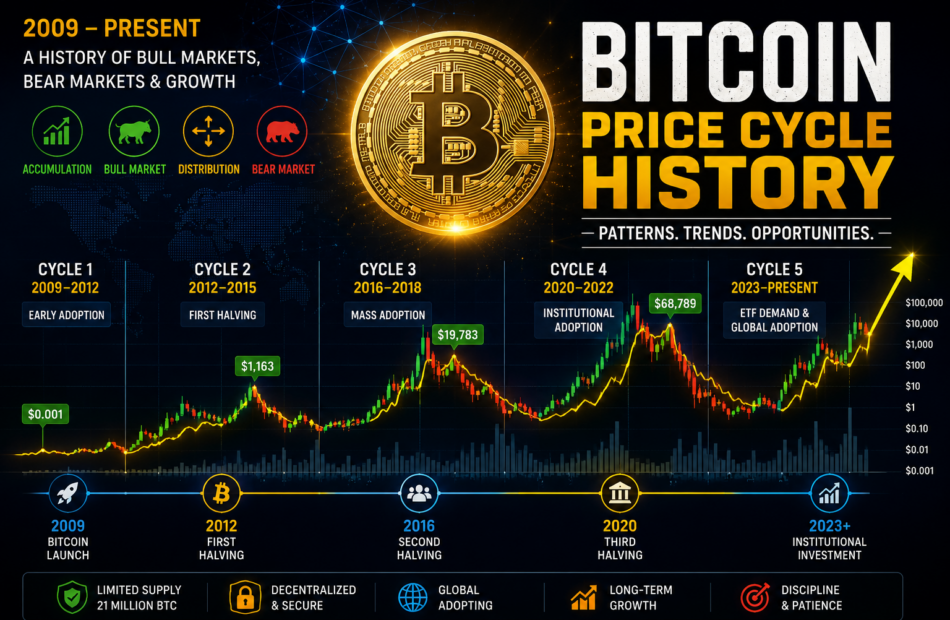
Bitcoin price cycle history refers to the recurring pattern of bull markets, bear markets, accumulation phases, and recoveries that have shaped Bitcoin’s performance since 2009. Although no cycle guarantees future results, understanding previous market trends helps investors identify opportunities, manage risks, and make informed long-term investment decisions.
INTRODUCTION
Bitcoin has experienced some of the most dramatic price movements in financial history. From trading for just a few cents to reaching new all-time highs, its journey has been defined by repeated cycles of rapid growth followed by significant corrections. Understanding bitcoin price cycle history isn’t just interesting—it can help investors recognize market behavior, avoid emotional decisions, and build better long-term strategies.
Unlike traditional assets, Bitcoin operates in a unique environment influenced by supply reductions, investor sentiment, institutional adoption, macroeconomic conditions, and technological innovation. While every cycle has its own characteristics, several repeating patterns have emerged over the past decade.
In this guide, we’ll examine every major Bitcoin market cycle, explore what drives these movements, and discuss how investors can use historical insights without assuming history will repeat exactly.
What Is a Bitcoin Price Cycle?
A Bitcoin price cycle is the recurring sequence of market phases that Bitcoin typically experiences over several years. These phases are influenced by changes in supply and demand, investor psychology, economic conditions, and network growth.
Most Bitcoin cycles include four major stages:
- Accumulation
- Bull Market
- Distribution
- Bear Market
Although timing differs from cycle to cycle, these phases have consistently appeared throughout Bitcoin’s history.
| Market Phase | Typical Characteristics | Investor Behavior |
|---|---|---|
| Accumulation | Low volatility and undervaluation | Long-term buying |
| Bull Market | Strong upward momentum | Growing optimism |
| Distribution | Profit-taking near highs | Mixed sentiment |
| Bear Market | Sharp price declines | Fear and capitulation |
Recognizing these stages helps investors understand where the market may currently stand instead of reacting purely to short-term price fluctuations.
Why Bitcoin Moves in Cycles
Unlike many traditional financial assets, Bitcoin has a fixed maximum supply of 21 million coins. This scarcity plays an important role in its long-term market behavior.
Several factors contribute to recurring cycles:
Supply Reduction Through Halving
Approximately every four years, Bitcoin undergoes a halving event that reduces the number of new coins entering circulation. Lower supply growth has historically coincided with increased upward price momentum when demand remains strong.
Investor Psychology
Financial markets often follow emotional patterns.
Typical emotional stages include:
- Disbelief
- Hope
- Optimism
- Excitement
- Euphoria
- Anxiety
- Fear
- Capitulation
- Recovery
These emotional shifts repeatedly influence buying and selling decisions.
Institutional Adoption
Over the years, institutional investors, publicly traded companies, hedge funds, and investment products have increased Bitcoin exposure. Greater participation often changes market dynamics compared to earlier cycles.
Global Economic Conditions
Interest rates, inflation, liquidity, monetary policy, and geopolitical events also affect investor appetite for risk assets, including Bitcoin.
Bitcoin Price Cycle History (2009–Present)
Let’s explore every major Bitcoin cycle and what made each one unique.
First Cycle (2009–2012): Bitcoin’s Early Growth
The earliest years of Bitcoin were driven almost entirely by technology enthusiasts, developers, and early adopters.
Key characteristics included:
- Extremely low trading volume
- Minimal public awareness
- Limited exchange availability
- High volatility
During this period, Bitcoin transitioned from virtually worthless to several dollars, laying the foundation for future adoption.
Important milestones included:
- Launch of the Bitcoin network
- Early mining community growth
- First cryptocurrency exchanges
- Initial commercial transactions
Although prices were small by today’s standards, percentage gains were extraordinary.
Second Cycle (2012–2015): The First Global Bull Market
Following the first halving, Bitcoin entered one of its earliest explosive bull markets.
Several catalysts supported growth:
- Increased media attention
- More cryptocurrency exchanges
- Growing retail participation
- Rising international interest
Bitcoin climbed from double-digit prices to over $1,000 before experiencing a severe bear market.
The correction that followed exceeded 80%, reminding investors that volatility is an inherent part of Bitcoin investing.
Despite the decline, the network itself continued expanding, demonstrating an important lesson repeated throughout Bitcoin history:
Price and network development don’t always move together over short periods.
Third Cycle (2016–2018): Mainstream Recognition
The 2016 halving marked another turning point.
This cycle introduced Bitcoin to millions of new investors worldwide.
Major developments included:
- Significant retail adoption
- Initial Coin Offering (ICO) boom
- Rapid exchange expansion
- Increased venture capital investment
- Growing global awareness
Bitcoin eventually reached nearly $20,000 in late 2017, attracting unprecedented public attention.
However, excessive speculation eventually led to another prolonged bear market.
The correction eliminated many speculative projects, while Bitcoin itself remained the dominant cryptocurrency by market capitalization.
During this period, experienced investors learned another valuable lesson:
Long-term adoption often survives even when speculative excess disappears.
Fourth Cycle (2020–2022): Institutional Adoption Changes the Market
The fourth Bitcoin cycle was unlike anything seen before. Instead of being driven mainly by retail investors, it was fueled by institutional participation, corporate treasury investments, and growing recognition of Bitcoin as a potential store of value.
Several key developments transformed the market:
- Public companies added Bitcoin to their balance sheets.
- Institutional investors increased crypto allocations.
- Bitcoin exchange-traded products gained popularity in several countries.
- Global monetary stimulus boosted demand for alternative assets.
As confidence grew, Bitcoin climbed from around $3,800 during the 2020 market crash to nearly $69,000 in November 2021.
However, rising inflation, aggressive interest rate hikes, and several high-profile crypto company failures triggered another prolonged bear market. Prices declined by more than 75%, once again demonstrating Bitcoin’s extreme volatility.
Even so, one important trend remained intact—network adoption continued to expand despite falling prices.
Fifth Cycle (2023–Present): A More Mature Bitcoin Market
The current Bitcoin market cycle reflects a more mature asset class than previous years. While volatility remains significant, institutional infrastructure has improved considerably.
Key drivers of the current cycle include:
- Increased institutional demand
- Spot Bitcoin ETF adoption in several markets
- Growing regulatory clarity
- Continued long-term accumulation by investors
- Expanding global acceptance of digital assets
Unlike earlier cycles driven largely by speculation, today’s market includes pension funds, asset managers, family offices, and multinational corporations.
As a result, many analysts believe future cycles may remain volatile but could become progressively more stable over time.
Complete Bitcoin Price Cycle History at a Glance
| Cycle | Approximate Period | Bull Market Peak | Bear Market Decline | Major Catalyst |
|---|---|---|---|---|
| Cycle 1 | 2009–2012 | Early adoption | Moderate | Bitcoin launch |
| Cycle 2 | 2012–2015 | Over $1,000 | Around 85% | First halving |
| Cycle 3 | 2016–2018 | Nearly $20,000 | Around 84% | ICO boom |
| Cycle 4 | 2020–2022 | Nearly $69,000 | Around 77% | Institutional adoption |
| Cycle 5 | 2023–Present | Ongoing | Still developing | ETF demand and institutional investment |
Although no two cycles are identical, each has featured periods of optimism, rapid growth, correction, and eventual recovery.
What Can Investors Learn from Bitcoin Price Cycle History?
Historical performance never guarantees future results. Nevertheless, Bitcoin’s past provides several valuable lessons for long-term investors.
1. Volatility Is Normal
Large corrections have occurred after every major bull market. Investors who understand this are often better prepared emotionally during downturns.
2. Long-Term Trends Matter More Than Daily Prices
Daily price movements can be unpredictable. In contrast, multi-year adoption trends have historically provided a clearer picture of Bitcoin’s overall growth.
3. Market Sentiment Changes Quickly
Fear often dominates near market bottoms, while excessive optimism usually appears close to cycle peaks.
Recognizing these emotional extremes can help investors avoid buying purely because prices are rising or selling simply because prices are falling.
4. Risk Management Remains Essential
Successful investors typically:
- Diversify their portfolios.
- Invest only what they can afford to lose.
- Maintain long-term investment horizons.
- Avoid emotional decision-making.
- Review their strategy periodically.
These principles remain valuable regardless of market conditions.
Does Bitcoin Always Follow a Four-Year Cycle?
Many investors associate Bitcoin with a four-year cycle because of the approximate timing of its halving events. While halvings have historically influenced supply dynamics, modern markets are becoming increasingly complex.
Today, Bitcoin prices are also affected by:
- Global liquidity
- Central bank policies
- Institutional investment flows
- Regulatory developments
- Exchange-traded funds
- Geopolitical uncertainty
- Broader financial market conditions
Consequently, future cycles may differ from historical patterns. Investors should view past cycles as a framework rather than a prediction.
Common Mistakes When Using Bitcoin Cycle History
Studying previous cycles is valuable, but relying on them too heavily can lead to costly mistakes.
Avoid these common pitfalls:
- Assuming history will repeat exactly.
- Ignoring macroeconomic factors.
- Investing solely because of social media hype.
- Trying to perfectly time market tops and bottoms.
- Overlooking proper portfolio diversification.
- Using excessive leverage during volatile periods.
Instead, combine historical analysis with sound risk management and independent research.
Indicators Often Used to Analyze Bitcoin Cycles
Experienced market participants monitor several on-chain and technical indicators alongside price history.
Popular metrics include:
- Bitcoin Halving Schedule
- Market Value to Realized Value (MVRV)
- Realized Price
- Pi Cycle Indicator
- Relative Strength Index (RSI)
- 200-Week Moving Average
- Fear and Greed Index
- Hash Rate Trends
- Long-Term Holder Supply
- Exchange Reserve Balances
No single indicator predicts market movements perfectly. However, using multiple data points together can improve decision-making.
Is Bitcoin Becoming Less Cyclical?
As institutional ownership grows and market liquidity improves, some analysts believe Bitcoin’s future price swings may become less extreme.
Potential reasons include:
- Larger institutional participation
- Greater market efficiency
- Broader global adoption
- Improved regulatory frameworks
- Increasing integration into traditional finance
Nevertheless, Bitcoin remains a relatively young asset compared to stocks, bonds, or gold. Investors should still expect significant volatility during both bull and bear markets.
Key Takeaways from Bitcoin Price Cycle History
Understanding Bitcoin’s historical cycles helps investors develop realistic expectations rather than relying on speculation.
The most consistent patterns include:
- Bull markets have historically followed major accumulation periods.
- Every significant rally has been followed by substantial corrections.
- Long-term adoption has continued despite repeated downturns.
- Investor psychology plays a major role in market movements.
- Risk management is just as important as identifying opportunities.
While the future may not mirror the past perfectly, studying historical cycles provides valuable context for navigating an evolving digital asset market.
Frequently Asked Questions
1. What is the Bitcoin price cycle?
The Bitcoin price cycle is the recurring pattern of accumulation, bull markets, distribution, and bear markets that has characterized Bitcoin’s market behavior since its launch. These cycles are influenced by supply reductions, investor sentiment, adoption trends, and macroeconomic conditions.
2. How long does a typical Bitcoin cycle last?
Historically, Bitcoin has followed cycles lasting approximately four years, largely due to the Bitcoin halving event that reduces new coin issuance every 210,000 blocks. However, future cycles may vary as institutional participation and global economic factors play a larger role.
3. Does Bitcoin always rise after a halving?
Not immediately. While previous halvings have been followed by significant bull markets, there is no guarantee that future price movements will follow the same pattern. Market demand, liquidity, regulations, and investor sentiment also influence Bitcoin’s price.
4. What causes Bitcoin bull and bear markets?
Bitcoin bull markets are generally driven by increasing demand, institutional investment, positive market sentiment, and limited new supply. Bear markets typically occur after periods of excessive speculation, profit-taking, tighter financial conditions, or negative industry events.
5. Can Bitcoin price cycle history predict future prices?
No. Bitcoin price cycle history provides valuable context but cannot accurately predict future prices. Investors should use historical trends alongside technical analysis, on-chain data, and fundamental research rather than relying solely on previous cycles.
6. Is Bitcoin still a good long-term investment?
Many investors view Bitcoin as a long-term digital asset because of its limited supply and growing global adoption. However, Bitcoin remains highly volatile, so every investment decision should align with individual financial goals and risk tolerance.
7. What is the biggest lesson from Bitcoin price cycle history?
The most important lesson is that volatility is a normal part of Bitcoin investing. Every major bull market has been followed by significant corrections, yet Bitcoin has repeatedly recovered and reached new highs over the long term. Patience, disciplined investing, and proper risk management have historically rewarded long-term investors.
Conclusion
Understanding bitcoin price cycle history provides investors with valuable perspective on how the world’s largest cryptocurrency has evolved through multiple market cycles. Although each cycle has been shaped by unique economic conditions, technological developments, and investor sentiment, several consistent patterns have emerged over time.
History shows that Bitcoin has repeatedly moved through accumulation phases, powerful bull markets, sharp corrections, and long recovery periods. While these historical trends can improve market awareness, they should never be viewed as guarantees of future performance. Successful investors combine historical analysis with sound research, disciplined risk management, and a long-term investment mindset.
As Bitcoin continues to mature through institutional adoption, regulatory developments, and increasing global acceptance, future cycles may look different from those of the past. Staying informed and focusing on long-term fundamentals will remain more valuable than attempting to predict short-term price movements.
If you’re looking for expert cryptocurrency insights, in-depth Bitcoin market analysis, educational guides, and data-driven investment strategies, visit TheCryptoInvestors.com. Our mission is to help investors make smarter decisions with reliable, research-backed content that keeps you ahead in the rapidly evolving digital asset market.

Is Bitcoin in a Bull Market 2025? Complete Investor Guide
Is Bitcoin in a bull market 2025? The evidence suggests Bitcoin remains in a long-term bullish trend, supported by institutional adoption, ETF demand, favorable macroeconomic conditions, and strong on-chain metrics. However, investors should also expect significant volatility and periodic corrections. Understanding market indicators rather than relying solely on price action can help make better long-term investment decisions.
INTRODUCTION
Bitcoin has once again captured global attention, leaving many investors asking one important question: is bitcoin in a bull market 2025?
The answer isn’t as simple as looking at today’s price. A true Bitcoin bull market is driven by a combination of price momentum, investor psychology, institutional capital, on-chain activity, macroeconomic trends, and long-term adoption. While headlines often focus on new all-time highs, experienced investors know that sustainable bull markets are built on much stronger foundations.
In 2025, Bitcoin continues to benefit from growing institutional participation, increased adoption by businesses, expanding ETF investments, and improving regulatory clarity in several regions. At the same time, market volatility remains a defining characteristic, making it essential for investors to understand what separates a healthy bull market from short-lived price rallies.
This guide examines the latest market signals, explains the indicators professionals monitor, and helps you evaluate whether Bitcoin’s current momentum represents a genuine bull market or simply another temporary surge.
What Is a Bitcoin Bull Market?
A Bitcoin bull market is a prolonged period during which prices trend higher while investor confidence, trading activity, and adoption continue to grow.
Unlike short-term rallies, bull markets are supported by multiple positive fundamentals that reinforce one another over time.
Typical characteristics include:
- Consistently higher highs and higher lows
- Rising institutional investment
- Increased trading volume
- Strong long-term holder confidence
- Growing network activity
- Positive macroeconomic sentiment
- Expanding cryptocurrency adoption
Historically, Bitcoin bull markets have lasted several months and, in some cases, more than a year before entering a major correction.
Why Are Investors Asking “Is Bitcoin in a Bull Market 2025?”
Several major developments have strengthened Bitcoin’s outlook throughout 2025.
These include:
- Continued institutional accumulation
- Strong demand through Bitcoin ETFs
- Increased corporate treasury allocations
- Growing retail participation
- Improving blockchain infrastructure
- Wider acceptance of Bitcoin as a long-term store of value
Together, these developments have created optimism that the current cycle is more mature than previous bull markets.
However, experienced investors understand that optimism alone does not confirm a sustainable trend. Instead, they evaluate multiple market indicators before reaching a conclusion.
Key Signs Bitcoin Is in a Bull Market
Professional investors rarely rely on price alone. Instead, they combine technical analysis, on-chain metrics, market sentiment, and macroeconomic factors.
Higher Highs and Higher Lows
One of the strongest bullish signals is a consistent pattern of higher highs followed by higher lows.
This indicates buyers continue entering the market even after temporary pullbacks.
When this structure remains intact over several months, analysts generally consider the long-term trend bullish.
Institutional Demand Continues to Grow
Institutional participation has become one of the biggest differences between previous Bitcoin cycles and 2025.
Large financial institutions now view Bitcoin as a legitimate alternative asset rather than a speculative experiment.
Institutional demand contributes to:
- Greater market liquidity
- Reduced selling pressure
- Improved price stability
- Increased investor confidence
- Long-term capital inflows
As more professional investors enter the market, Bitcoin’s price movements increasingly reflect broader financial trends rather than purely retail speculation.
Bitcoin ETF Inflows Support Long-Term Growth
One of the most significant catalysts during this market cycle has been sustained inflows into spot Bitcoin exchange-traded funds.
These investment products have made Bitcoin more accessible to:
- Pension funds
- Wealth managers
- Family offices
- Institutional investors
- Traditional brokerage clients
Steady ETF demand removes substantial amounts of Bitcoin from circulation, reducing available supply while supporting long-term price appreciation.
On-Chain Indicators That Support a Bullish Outlook
Unlike traditional financial assets, Bitcoin allows investors to analyze blockchain data directly.
These on-chain metrics often provide valuable insight into market health before price changes become obvious.
Long-Term Holders Continue Accumulating
One of the strongest bullish indicators occurs when long-term holders choose to keep their Bitcoin instead of selling during rallies.
This behavior suggests:
- Strong investor conviction
- Reduced selling pressure
- Confidence in future price appreciation
- Healthy market structure
Historically, periods of sustained long-term holding have often preceded major upward price movements.
Exchange Balances Continue Declining
When investors withdraw Bitcoin from exchanges into personal wallets or cold storage, it often signals long-term confidence.
Lower exchange balances generally mean:
- Fewer coins available for immediate selling
- Reduced market supply
- Increased scarcity
- Potential upward pressure on price
Although this metric should never be viewed in isolation, declining exchange reserves have frequently aligned with previous bull market phases.
Market Sentiment Is Improving
Investor psychology plays a significant role in every Bitcoin cycle.
Positive sentiment often leads to:
- Higher trading activity
- Increased media attention
- Greater retail participation
- Rising search interest
- Stronger overall market momentum
Nevertheless, excessive optimism can also signal overheating. For this reason, successful investors balance sentiment analysis with technical and fundamental research instead of relying solely on market excitement.
Why Volatility Still Exists During Bull Markets
Many new investors mistakenly believe that bull markets move upward without interruption.
In reality, Bitcoin has experienced numerous corrections of 10% to 30% even during its strongest historical bull runs.
These pullbacks often occur because of:
- Profit-taking by traders
- Macroeconomic uncertainty
- Regulatory news
- Leveraged liquidations
- Short-term market sentiment shifts
Rather than viewing every correction as the end of the cycle, experienced investors evaluate whether the broader bullish structure remains intact.
As long as long-term fundamentals continue improving, temporary declines are often considered a normal part of Bitcoin’s market cycle.
Market Indicators Every Bitcoin Investor Should Watch in 2025
Answering the question “is bitcoin in a bull market 2025“ requires more than watching the daily price chart. Professional investors monitor several indicators together because no single metric can accurately predict market direction.
The following indicators provide a clearer picture of Bitcoin’s overall health.
Relative Strength Index (RSI)
The Relative Strength Index (RSI) measures the speed and strength of price movements.
General interpretation:
| RSI Range | Market Signal |
|---|---|
| Below 30 | Potentially oversold |
| 30–70 | Healthy trading range |
| Above 70 | Potentially overbought |
During strong bull markets, Bitcoin can remain above an RSI of 70 for extended periods. Therefore, investors should avoid treating an overbought reading as an automatic sell signal.
Moving Averages Continue Showing Strength
Moving averages help identify the long-term trend while filtering out short-term price fluctuations.
The most commonly watched averages include:
- 50-Day Moving Average
- 100-Day Moving Average
- 200-Day Moving Average
When Bitcoin trades above all three averages, it generally reflects strong bullish momentum.
Many analysts also monitor the relationship between the 50-day and 200-day moving averages. A bullish crossover often signals growing long-term strength, while the opposite may indicate weakening momentum.
Trading Volume Matters More Than Price Alone
A price increase supported by rising trading volume is generally healthier than a rally driven by weak participation.
Strong volume suggests:
- Genuine buyer interest
- Institutional participation
- Sustainable momentum
- Better market liquidity
Conversely, sharp price increases on low volume may indicate speculative buying rather than lasting demand.
Bitcoin Dominance Remains an Important Signal
Bitcoin dominance measures Bitcoin’s share of the overall cryptocurrency market.
A rising dominance percentage often indicates:
- Investors prefer Bitcoin over riskier altcoins.
- Institutional money is flowing into Bitcoin first.
- Market confidence is strengthening.
On the other hand, falling dominance may suggest that investors are rotating profits into alternative cryptocurrencies later in the market cycle.
How the Bitcoin Halving Influences the 2025 Bull Market
One of Bitcoin’s most unique characteristics is its fixed supply schedule.
Approximately every four years, the Bitcoin halving reduces the reward miners receive for validating transactions.
This event decreases the rate at which new Bitcoin enters circulation.
Historically, halvings have been followed by periods of increased demand and higher prices because supply growth slows while demand often continues rising.
Although history never guarantees future performance, many investors believe the current market cycle is still benefiting from this reduced supply environment.
Institutional Adoption Is Changing the Market
The Bitcoin market today looks very different from previous cycles.
Instead of relying mostly on retail investors, today’s market includes participation from:
- Asset management firms
- Hedge funds
- Family offices
- Public companies
- Pension funds
- Wealth advisors
Institutional investors typically invest with longer time horizons.
As a result, they often reduce market volatility compared to short-term speculative traders while increasing overall market maturity.
Macroeconomic Factors Supporting Bitcoin
Bitcoin no longer trades independently of global financial markets.
Instead, several macroeconomic factors influence investor sentiment.
These include:
Lower Interest Rate Expectations
When borrowing becomes cheaper, investors often move capital toward growth assets such as Bitcoin.
Lower interest rates can increase liquidity across financial markets and encourage higher-risk investments.
Inflation Concerns
Many investors view Bitcoin as a potential hedge against long-term currency debasement because its supply is capped at 21 million coins.
Although Bitcoin can remain volatile in the short term, scarcity continues attracting investors seeking alternative stores of value.
Global Liquidity
Historically, Bitcoin has performed well during periods when liquidity expands across global markets.
Higher liquidity generally supports increased investment into technology stocks, digital assets, and other growth-oriented investments.
Risks That Could Slow the Bull Market
Even during strong uptrends, investors should remain aware of potential risks.
Regulatory Changes
Government regulations continue evolving worldwide.
Unexpected policy changes regarding taxation, cryptocurrency exchanges, or digital asset reporting can temporarily affect investor confidence.
Economic Slowdowns
Recession fears or tightening monetary policy can reduce investor appetite for risk assets.
Although Bitcoin has matured considerably, macroeconomic uncertainty still influences short-term price movements.
Market Overheating
Rapid price appreciation often attracts speculative investors.
Signs of excessive speculation include:
- Extremely high leverage
- Sudden spikes in funding rates
- Social media hype
- Retail FOMO buying
- Unrealistic price expectations
Healthy bull markets usually experience periodic corrections that remove excessive speculation before continuing higher.
Bull Market vs Bear Market: Quick Comparison
| Feature | Bull Market | Bear Market |
|---|---|---|
| Price Trend | Higher highs and higher lows | Lower highs and lower lows |
| Investor Sentiment | Optimistic | Fearful |
| Institutional Activity | Buying | Reducing exposure |
| Trading Volume | Generally increasing | Often declining |
| Market Confidence | Strong | Weak |
| Long-Term Holder Activity | Accumulating | Distribution or caution |
Recognizing these differences helps investors avoid emotional decisions during periods of market volatility.
Should You Invest During a Bitcoin Bull Market?
There is no universal answer because every investor has different financial goals, risk tolerance, and investment horizon.
However, many experienced investors follow a disciplined approach rather than chasing short-term price movements.
Common strategies include:
- Dollar-cost averaging (DCA)
- Long-term holding
- Portfolio diversification
- Setting realistic profit targets
- Maintaining an emergency cash reserve
Trying to time the exact top or bottom of the market is extremely difficult, even for professional traders.
Instead, consistent investing combined with sound risk management has historically produced better long-term results than emotional decision-making.
Expert Take: Is Bitcoin in a Bull Market 2025?
When evaluating price action alongside institutional demand, ETF inflows, on-chain data, adoption trends, and macroeconomic conditions, the evidence points toward Bitcoin remaining in a broader bullish phase during 2025.
That said, no bull market moves in a straight line.
Corrections are normal, sentiment can change quickly, and unexpected global events may create temporary volatility. Investors who focus on long-term fundamentals instead of daily headlines are generally better positioned to navigate these market swings.
Rather than asking only whether Bitcoin is in a bull market, a more useful question is whether the underlying drivers of adoption, demand, and network growth continue to strengthen. If those fundamentals remain intact, the long-term outlook stays constructive despite short-term fluctuations.
Frequently Asked Questions
1. Is Bitcoin really in a bull market in 2025?
Current market conditions indicate that Bitcoin is experiencing a broader bullish trend. Strong institutional investment, steady ETF inflows, healthy on-chain metrics, and continued adoption support this outlook. However, investors should expect periods of volatility and price corrections along the way.
2. What are the biggest signs of a Bitcoin bull market?
Some of the strongest indicators include:
- Higher highs and higher lows
- Rising institutional demand
- Strong Bitcoin ETF inflows
- Declining exchange reserves
- Long-term holder accumulation
- Increasing trading volume
- Positive market sentiment
No single indicator confirms a bull market, so it’s best to evaluate several metrics together.
3. Can Bitcoin still experience major corrections during a bull market?
Yes. Bitcoin has historically experienced corrections of 10% to 30% even during its strongest bull markets. These pullbacks are normal and often help remove excessive speculation before the market resumes its upward trend.
4. Is it too late to invest in Bitcoin in 2025?
Not necessarily. The right time to invest depends on your financial goals, investment horizon, and risk tolerance. Many long-term investors prefer Dollar-Cost Averaging (DCA), which involves investing fixed amounts at regular intervals instead of trying to predict short-term market movements.
5. How do Bitcoin ETFs affect the bull market?
Spot Bitcoin ETFs have made Bitcoin more accessible to institutional and retail investors. As money flows into these funds, they purchase Bitcoin on behalf of investors, increasing demand and potentially reducing the available supply in the market.
6. What risks could end the Bitcoin bull market?
Several factors could weaken market momentum, including:
- Stricter cryptocurrency regulations
- Global economic uncertainty
- Higher interest rates
- Large-scale profit-taking
- Security incidents or exchange failures
- Unexpected geopolitical events
Investors should monitor these risks while maintaining a long-term perspective.
7. What is the best strategy during a Bitcoin bull market?
A disciplined investment approach often performs better than emotional trading. Consider these best practices:
- Invest only what you can afford to lose.
- Use Dollar-Cost Averaging (DCA).
- Diversify your investment portfolio.
- Avoid buying solely because of social media hype.
- Review your portfolio periodically and rebalance when necessary.
- Focus on long-term goals instead of daily price fluctuations.
Conclusion
So, is bitcoin in a bull market 2025? Based on current market indicators, institutional participation, ETF demand, blockchain activity, and long-term adoption trends, the evidence points toward a continuing bullish environment. Nevertheless, every market cycle includes corrections, uncertainty, and changing investor sentiment.
Instead of making decisions based on headlines or short-term price swings, successful investors evaluate the broader picture. Monitoring technical indicators, on-chain data, macroeconomic developments, and market psychology can provide a more balanced understanding of where Bitcoin may be headed next.
Whether you’re investing for the first time or expanding an existing portfolio, patience and disciplined risk management remain your greatest advantages. Remember that no market moves upward forever, but long-term investors who stay informed are often better equipped to navigate both opportunities and challenges.
If you’re looking for reliable Bitcoin insights, in-depth market analysis, educational guides, and practical investment strategies, The Crypto Investors is here to help. Visit our website regularly for expert content designed to help you make smarter, more confident crypto investment decisions.

Bitcoin Newsletter for Serious Investors: How to Choose One That Actually Improves Your Investment Decisions
A bitcoin newsletter for serious investors delivers curated market analysis, on-chain insights, macroeconomic trends, regulatory updates, and long-term investment strategies. Unlike general crypto news, premium investor-focused newsletters help readers filter market noise, identify emerging opportunities, manage risk effectively, and make data-driven decisions based on credible research rather than speculation.
Introduction
If you’ve ever felt overwhelmed by the nonstop flow of crypto headlines, you’re not alone. Finding a reliable bitcoin newsletter for serious investors can save hours of research while helping you focus on what truly matters. Instead of chasing every market rumor or social media trend, a quality newsletter provides carefully researched insights, on-chain metrics, macroeconomic analysis, and practical investment ideas.
However, not every newsletter deserves a place in your inbox. Some simply recycle breaking news, while others offer little more than personal opinions. Serious investors need trusted analysis backed by data, transparent reasoning, and a long-term perspective.
This guide explains what separates an exceptional Bitcoin newsletter from average crypto emails, the features that matter most, and how to choose one that supports your investment goals with confidence.
Why Serious Bitcoin Investors Need a Dedicated Newsletter
The Bitcoin market operates 24/7, making it impossible to follow every development in real time. New regulations, institutional investments, ETF inflows, mining trends, and global economic events can influence price movements within hours.
Rather than spending several hours reading dozens of websites every day, investors can receive carefully filtered research directly in their inbox.
A high-quality Bitcoin newsletter helps you:
- Stay informed without information overload.
- Understand market cycles instead of reacting emotionally.
- Follow institutional and macroeconomic developments.
- Learn from experienced market analysts.
- Discover long-term investment opportunities.
- Improve portfolio risk management.
- Save valuable research time.
Most importantly, it transforms scattered information into structured analysis that supports better investment decisions.
What Makes a Bitcoin Newsletter Valuable?
Not every crypto email offers meaningful value. The best newsletters prioritize education, evidence, and consistency over sensational headlines.
Look for newsletters that consistently include:
| Feature | Why It Matters |
|---|---|
| On-chain analytics | Reveals blockchain activity and investor behavior. |
| Market analysis | Explains price movements using data instead of speculation. |
| Macroeconomic coverage | Connects Bitcoin with inflation, interest rates, and global markets. |
| Institutional updates | Tracks adoption by companies, ETFs, and large investors. |
| Risk management guidance | Helps investors protect capital during volatile markets. |
| Educational content | Improves long-term investing knowledge. |
| Portfolio insights | Supports balanced allocation decisions. |
When these elements appear consistently, a newsletter becomes more than a news source—it becomes an educational investment resource.
Key Features Every Serious Investor Should Look For
Before subscribing, evaluate whether the newsletter provides genuine research rather than recycled headlines.
Independent Research
Reliable newsletters perform original analysis instead of summarizing trending stories. Independent research often uncovers market developments before they become mainstream.
On-Chain Data Interpretation
Raw blockchain metrics can be confusing. Strong newsletters explain indicators such as wallet activity, exchange reserves, long-term holder behavior, and network growth in simple language.
Macro Perspective
Bitcoin no longer moves independently of the global economy. Inflation data, central bank policies, liquidity conditions, and interest rates increasingly influence market sentiment.
A professional newsletter connects these broader economic factors with Bitcoin’s long-term outlook.
Long-Term Investment Focus
Daily price predictions rarely help serious investors. Instead, look for newsletters that emphasize:
- Portfolio discipline
- Dollar-cost averaging (DCA)
- Risk-adjusted investing
- Market cycle analysis
- Capital preservation
- Long-term wealth creation
This approach encourages informed decision-making rather than emotional trading.
Free vs Premium Bitcoin Newsletters
Many investors wonder whether paying for a newsletter is worthwhile.
The answer depends on your investing goals.
| Free Newsletters | Premium Newsletters |
| Daily crypto news | Deep institutional research |
| Basic market updates | Exclusive on-chain analysis |
| Limited educational content | Detailed portfolio frameworks |
| Advertising-supported | Independent research-driven insights |
| Suitable for beginners | Better for experienced investors |
Free newsletters are an excellent starting point for learning the basics. Meanwhile, premium services often provide deeper analysis, proprietary research, and comprehensive market reports that can justify the subscription cost for active investors.
Common Mistakes When Choosing a Bitcoin Newsletter
A polished website or a large subscriber count doesn’t always indicate quality. Before subscribing, avoid these common mistakes:
- Choosing newsletters based solely on price.
- Trusting unrealistic return claims.
- Following newsletters that promote hype over evidence.
- Ignoring the author’s experience and transparency.
- Overlooking the consistency of published research.
- Subscribing without reviewing past editions.
- Depending on a single information source for investment decisions.
Diversifying your research sources can provide a more balanced perspective and reduce confirmation bias.
Why Research Quality Matters More Than Market Predictions
Many newsletters attract readers with bold predictions about Bitcoin’s next price target. While forecasts can be interesting, they shouldn’t be the primary reason for subscribing.
Instead, focus on newsletters that explain:
- Why market conditions are changing.
- Which indicators support their conclusions.
- What risks investors should monitor.
- How different scenarios could unfold.
- What long-term trends deserve attention.
Understanding the reasoning behind market movements is far more valuable than following short-term predictions.
How a High-Quality Bitcoin Newsletter Supports Better Investment Decisions
Successful Bitcoin investing isn’t about reacting to every price swing. Instead, it’s about making informed decisions based on reliable data and a clear strategy. A well-researched newsletter helps bridge the gap between raw information and practical action.
For example, instead of simply reporting that Bitcoin’s price has fallen, a quality newsletter might explain:
- Whether long-term holders are accumulating.
- How exchange balances are changing.
- What institutional investors are doing.
- How macroeconomic events are affecting market sentiment.
- Whether the current movement aligns with historical market cycles.
This deeper context helps investors avoid emotional decisions and focus on long-term objectives.
Essential Topics Every Serious Bitcoin Newsletter Should Cover
The most valuable newsletters consistently address multiple aspects of the Bitcoin ecosystem rather than focusing only on price action.
Market Cycle Analysis
Understanding where Bitcoin sits within its market cycle can improve timing and expectations. Strong newsletters discuss historical trends, investor sentiment, and cycle indicators without guaranteeing future outcomes.
On-Chain Metrics
Blockchain data provides valuable insight into network health and investor behavior. Common metrics include:
- Active wallet addresses
- Exchange inflows and outflows
- Long-term holder supply
- Miner reserves
- Realized price
- Dormancy indicators
- Supply distribution
These metrics often provide context that traditional price charts cannot.
Institutional Adoption
Large organizations continue to influence Bitcoin markets through treasury allocations, investment products, and infrastructure development.
A serious newsletter should monitor developments such as:
- Corporate Bitcoin holdings
- Institutional fund activity
- Exchange-Traded Fund (ETF) flows
- Custody solutions
- Banking integrations
- Government policy changes
Understanding institutional participation helps investors assess long-term market maturity.
Macroeconomic Trends
Bitcoin no longer exists in isolation. Global financial conditions increasingly shape investor behavior.
Topics worth following include:
- Inflation reports
- Interest rate decisions
- Central bank policy
- Liquidity conditions
- Currency strength
- Recession risks
- Employment data
Connecting these broader economic trends with Bitcoin provides a more complete investment perspective.
Building Your Own Bitcoin Research Routine
Even the best newsletter should complement—not replace—your own research. Developing a consistent routine can help you stay informed while avoiding information overload.
A practical weekly workflow might look like this:
| Day | Activity |
|---|---|
| Monday | Read your preferred Bitcoin newsletter. |
| Tuesday | Review on-chain metrics and network activity. |
| Wednesday | Follow macroeconomic developments. |
| Thursday | Evaluate portfolio allocation and risk exposure. |
| Friday | Read industry reports or educational resources. |
| Weekend | Reflect on long-term goals instead of short-term price movements. |
Following a structured routine encourages disciplined investing and reduces impulsive decision-making.
Red Flags That Suggest a Newsletter Isn’t Worth Following
Not every publication provides trustworthy information. Some prioritize clicks over credibility, making it important to recognize warning signs.
Be cautious if a newsletter:
- Promises guaranteed profits.
- Predicts exact future prices with certainty.
- Relies heavily on fear or hype.
- Promotes unknown investment schemes.
- Frequently changes its investment philosophy.
- Lacks transparent research methods.
- Doesn’t disclose potential conflicts of interest.
Credible publishers explain both opportunities and risks, allowing readers to make informed decisions rather than pressuring them into action.
Characteristics of the Best Bitcoin Newsletters
While every investor has different preferences, the strongest newsletters tend to share several qualities.
They are:
- Consistent in publication.
- Written by experienced market researchers.
- Transparent about methodologies.
- Supported by verifiable data.
- Focused on education as well as analysis.
- Balanced rather than sensational.
- Updated as market conditions evolve.
These characteristics build trust over time and help readers develop a deeper understanding of Bitcoin investing.
Practical Tips for Getting the Most Value from Your Newsletter
Simply subscribing isn’t enough. To maximize the benefits, approach each edition with a clear process.
Consider these best practices:
- Read each issue carefully instead of skimming headlines.
- Compare insights with multiple reputable sources.
- Keep notes on recurring market themes.
- Track predictions against actual outcomes.
- Review educational sections regularly.
- Focus on long-term trends rather than daily volatility.
- Apply insights within your personal investment strategy and risk tolerance.
This disciplined approach turns information into actionable knowledge.
Is a Bitcoin Newsletter Worth It?
For casual observers, free crypto news websites may provide enough information. However, investors managing significant capital or pursuing long-term wealth creation often benefit from curated research.
A professional Bitcoin newsletter can help you:
- Reduce time spent searching for reliable information.
- Understand complex market developments.
- Identify emerging trends earlier.
- Strengthen portfolio decision-making.
- Stay focused during periods of high market volatility.
- Continue learning as the Bitcoin ecosystem evolves.
The real value isn’t in receiving more information—it’s in receiving better information that supports thoughtful investment decisions.
Final Thoughts Before You Subscribe
Choosing the right bitcoin newsletter for serious investors is ultimately about finding a trusted source that aligns with your investment philosophy. Look beyond bold headlines and focus on publications that consistently provide research-backed insights, educational value, and transparent analysis.
The best newsletters don’t tell you what to think—they equip you with the knowledge to make confident decisions on your own. Over time, this habit of consuming high-quality research can become one of the most valuable parts of your overall investment strategy.
Frequently Asked Questions
What is a bitcoin newsletter for serious investors?
A bitcoin newsletter for serious investors is a curated publication that provides in-depth market analysis, on-chain data, macroeconomic insights, regulatory updates, and long-term investment strategies. Unlike general crypto news, it focuses on helping investors make informed, evidence-based decisions.
Are free Bitcoin newsletters good enough?
Free newsletters are a great way to stay informed about major Bitcoin developments and learn the basics. However, premium newsletters often provide deeper research, exclusive reports, advanced on-chain analysis, and portfolio insights that experienced investors may find more valuable.
How often should I read a Bitcoin newsletter?
Most investors benefit from reading one or two high-quality newsletters each week. This keeps you updated on important market developments without becoming overwhelmed by daily price fluctuations or unnecessary market noise.
What should I look for before subscribing?
Choose a newsletter that offers original research, transparent analysis, educational content, consistent publishing, and experienced authors. Avoid newsletters that rely on hype, unrealistic price predictions, or guaranteed investment returns.
Can a Bitcoin newsletter improve my investment performance?
A quality newsletter cannot guarantee profits. However, it can improve your understanding of market trends, risk management, on-chain metrics, and macroeconomic factors, helping you make more informed investment decisions over time.
Should beginners use investor-focused newsletters?
Yes. Beginners can benefit from investor-focused newsletters that explain complex topics in simple language. Educational newsletters help build confidence while teaching fundamental concepts such as market cycles, portfolio management, and long-term investing.
Is it better to rely on one newsletter or multiple sources?
Using multiple trusted sources is generally the better approach. Comparing different viewpoints reduces confirmation bias and gives you a broader understanding of Bitcoin, the crypto market, and the global economy.
Conclusion
Finding the right bitcoin newsletter for serious investors is about more than receiving regular emails—it’s about gaining reliable knowledge that supports smarter investment decisions. The best newsletters combine market research, on-chain analytics, macroeconomic insights, and practical education to help investors navigate Bitcoin with greater confidence.
Rather than chasing headlines or reacting to short-term volatility, build a habit of following trusted research and maintaining a long-term perspective. Consistent learning often becomes one of the strongest advantages any investor can develop.
At TheCryptoInvestors.com, we’re committed to helping readers cut through the noise with practical guides, educational resources, and expert insights designed for both new and experienced Bitcoin investors. Explore more of our in-depth articles to strengthen your knowledge, refine your investment strategy, and stay ahead in the rapidly evolving world of digital assets.

Bitcoin Investor Psychology Explained: Understanding the Emotions Behind Market Cycles
Bitcoin Investor Psychology Explained: Understanding the Emotions Behind Market Cycles
Bitcoin investor psychology explained refers to understanding how emotions, cognitive biases, and market sentiment influence Bitcoin investment decisions. Fear, greed, FOMO, panic selling, and overconfidence often drive price movements more than fundamentals. Investors who recognize these psychological patterns can improve risk management, avoid emotional mistakes, and make more disciplined long-term investment decisions.
Introduction
Bitcoin is often described as a revolutionary digital asset, yet many investors discover that the biggest challenge isn’t technology, market analysis, or price volatility. Instead, the real challenge lies in controlling emotions. Understanding bitcoin investor psychology explained can help investors make rational decisions during both bull and bear markets.
While charts, indicators, and economic data matter, emotions frequently drive market behavior. Fear can trigger panic selling, while greed can push investors into buying at market tops. Consequently, mastering investor psychology often becomes the difference between long-term success and costly mistakes.
This guide explores the psychological forces behind Bitcoin investing, common behavioral patterns, and practical strategies for building emotional discipline in the cryptocurrency market.
Why Investor Psychology Matters in Bitcoin
Bitcoin is one of the most volatile financial assets in the world. Price swings of 10%, 20%, or even 50% can occur within relatively short periods.
Because of this volatility, investor emotions become amplified. Unlike traditional markets, cryptocurrency markets operate 24/7, creating constant exposure to price movements and emotional decision-making.
Investor psychology affects:
- Buying decisions
- Selling behavior
- Risk management
- Portfolio allocation
- Long-term investment success
- Market sentiment
In many cases, market participants react emotionally rather than logically, creating opportunities and risks for everyone involved.
The Core Emotions Driving Bitcoin Investors
Fear
Fear is one of the strongest market forces.
When Bitcoin prices decline sharply, investors often worry about:
- Losing money
- Missing opportunities elsewhere
- Market crashes
- Regulatory changes
- Economic uncertainty
As a result, many investors sell during downturns, locking in losses that may have been temporary.
Greed
Greed appears during strong bull markets.
Investors become increasingly confident as prices rise. Many begin to believe gains will continue indefinitely.
Signs of greed include:
- Excessive leverage
- Ignoring risk management
- Overexposure to Bitcoin
- Chasing unrealistic returns
- Buying without research
Although optimism can be beneficial, unchecked greed often leads to poor investment decisions.
Hope
Hope keeps investors holding losing positions longer than they should.
Instead of evaluating facts objectively, investors may convince themselves that prices will recover simply because they want them to.
This emotional attachment can delay necessary portfolio adjustments.
Regret
Regret frequently follows missed opportunities.
For example, investors who failed to buy Bitcoin during a previous rally may rush into the market later at much higher prices.
Unfortunately, decisions driven by regret often result in buying near market peaks.
Understanding FOMO in Bitcoin Investing
What Is FOMO?
FOMO stands for Fear of Missing Out.
In cryptocurrency markets, FOMO occurs when investors see others making profits and feel pressured to participate immediately.
Typical FOMO behavior includes:
- Buying after major price increases
- Ignoring valuation concerns
- Following social media hype
- Investing without a clear strategy
How FOMO Impacts Bitcoin Prices
During bull markets, FOMO can create rapid price acceleration.
A typical cycle looks like this:
| Stage | Investor Behavior |
|---|---|
| Early Adoption | Research-driven buying |
| Rising Prices | Increased optimism |
| Media Attention | Public interest grows |
| FOMO Buying | Mass participation |
| Euphoria | Extreme confidence |
| Correction | Sharp decline |
Understanding this cycle helps investors avoid emotional entries during overheated markets.
The Role of Fear and Panic Selling
Panic selling occurs when investors exit positions solely because prices are falling.
Several factors contribute to panic:
- Negative news headlines
- Market uncertainty
- Social media fear
- Portfolio losses
- Short-term volatility
Historically, many investors sell near market bottoms due to emotional pressure.
Meanwhile, experienced investors often view periods of fear as potential opportunities for accumulation.
Cognitive Biases That Affect Bitcoin Investors
Investor psychology extends beyond emotions. Cognitive biases also influence decision-making.
Confirmation Bias
Investors naturally seek information that supports their existing beliefs.
For example, a Bitcoin enthusiast may only read bullish news while ignoring legitimate risks.
This creates an incomplete view of market conditions.
Recency Bias
People often assume recent trends will continue indefinitely.
When Bitcoin rises for several months, investors may expect further gains without considering historical cycles.
Similarly, during downturns, many assume prices will never recover.
Herd Mentality
Humans are social creatures.
As a result, investors frequently follow the crowd instead of conducting independent analysis.
Herd behavior can amplify both market rallies and market crashes.
Overconfidence Bias
Successful trades sometimes create excessive confidence.
Investors may begin believing they can consistently predict market movements, leading to larger risks and poor decisions.
Bitcoin Market Psychology Cycle
Market psychology tends to follow predictable stages.
Accumulation
Smart investors begin buying while public interest remains low.
Characteristics include:
- Low media coverage
- Limited excitement
- Attractive valuations
- Strong long-term conviction
Optimism
Prices start rising steadily.
Investor confidence improves, and market participation increases.
Excitement
Positive sentiment spreads rapidly.
New investors enter the market as momentum strengthens.
Euphoria
This is often the most dangerous stage.
Common signs include:
- Extreme price predictions
- Social media hype
- Excessive leverage
- Belief that prices can only rise
Anxiety
Prices begin showing weakness.
Many investors remain optimistic despite warning signs.
Fear
Selling pressure increases.
Investors become concerned about protecting capital.
Capitulation
Panic reaches its peak.
Many investors exit positions at substantial losses.
Recovery
Market sentiment gradually improves, beginning a new cycle.
How Social Media Influences Bitcoin Psychology
Social media platforms have transformed cryptocurrency investing.
Information spreads instantly, influencing market sentiment worldwide.
Benefits include:
- Faster news distribution
- Educational content
- Community engagement
- Market transparency
However, risks also exist:
- Misinformation
- Hype-driven investing
- Emotional decision-making
- Market manipulation
Therefore, investors should verify information before acting on social media narratives.
The Psychology of Long-Term Bitcoin Holders
Long-term Bitcoin investors often display different psychological traits.
These include:
- Patience
- Emotional discipline
- Strong conviction
- Risk awareness
- Focus on fundamentals
Rather than reacting to daily price fluctuations, long-term investors prioritize:
- Adoption trends
- Network growth
- Institutional interest
- Macroeconomic developments
- Long-term value creation
This mindset helps reduce emotional stress and impulsive decisions.
Practical Strategies to Control Investment Emotions
Create a Clear Investment Plan
Before investing, define:
- Investment goals
- Risk tolerance
- Time horizon
- Exit strategy
- Position size
A written plan reduces emotional reactions during market volatility.
Use Dollar-Cost Averaging
Dollar-cost averaging involves investing fixed amounts regularly.
Benefits include:
- Reduced emotional timing decisions
- Lower impact of volatility
- Consistent accumulation
- Better long-term discipline
Limit Portfolio Exposure
Avoid allocating more capital than you can comfortably tolerate losing.
Proper diversification helps reduce emotional pressure.
Focus on Data, Not Headlines
Market headlines often exaggerate fear or excitement.
Instead, evaluate:
- On-chain metrics
- Adoption trends
- Market structure
- Economic conditions
- Fundamental developments
Maintain a Long-Term Perspective
Bitcoin has historically experienced multiple major corrections while continuing to attract investors over time.
A long-term perspective helps investors remain focused during temporary market turbulence.
Key Lessons from Historical Bitcoin Cycles
Several lessons emerge from past Bitcoin market cycles:
- Fear often creates opportunities.
- Greed frequently appears near market tops.
- FOMO can lead to poor entry points.
- Emotional decisions rarely outperform disciplined strategies.
- Risk management is essential.
- Market sentiment changes faster than fundamentals.
- Long-term discipline often outperforms short-term speculation.
Investors who understand these patterns gain an important advantage in navigating cryptocurrency markets.
Building Emotional Resilience as a Bitcoin Investor
Emotional resilience is not developed overnight.
Successful investors typically:
- Accept volatility as normal
- Focus on process over outcomes
- Learn from mistakes
- Avoid emotional trading
- Follow predefined strategies
Over time, this disciplined approach can improve both investment performance and peace of mind.
Frequently Asked Questions
What is bitcoin investor psychology?
Bitcoin investor psychology refers to the emotions, behaviors, and cognitive biases that influence how investors buy, hold, and sell Bitcoin during different market conditions.
Why is psychology important in Bitcoin investing?
Psychology is important because emotions like fear and greed often drive investment decisions, impacting profitability more than technical analysis alone.
What causes FOMO in Bitcoin markets?
FOMO occurs when investors fear missing potential gains and buy Bitcoin after significant price increases, often without proper research.
How does fear affect Bitcoin investors?
Fear can trigger panic selling during market declines, causing investors to realize losses and miss future recoveries.
What is the Bitcoin market psychology cycle?
The cycle includes accumulation, optimism, excitement, euphoria, anxiety, fear, capitulation, and recovery, reflecting changing investor emotions throughout market movements.
How can investors avoid emotional trading?
Investors can avoid emotional trading by creating a plan, using dollar-cost averaging, managing risk, and focusing on long-term objectives.
Do successful Bitcoin investors control emotions better?
In many cases, yes. Successful investors often demonstrate patience, discipline, and consistency while avoiding impulsive decisions driven by short-term market fluctuations.
Conclusion
Understanding bitcoin investor psychology explained is essential for anyone looking to navigate cryptocurrency markets successfully. Although Bitcoin’s technology, adoption, and fundamentals remain important, investor emotions frequently influence short-term price movements.
Fear, greed, FOMO, herd mentality, and cognitive biases can all impact investment outcomes. However, investors who recognize these psychological patterns can make better decisions, manage risk effectively, and maintain discipline throughout market cycles.
At The Crypto Investors, we help investors understand market behavior, develop smarter strategies, and stay informed about the evolving Bitcoin ecosystem. Explore more expert guides, market insights, and cryptocurrency education to strengthen your investing journey and make more confident financial decisions.

Bitcoin Treasury Strategy for Companies: The Complete Corporate Guide
Bitcoin Treasury Strategy for Companies: The Complete Corporate Guide
A bitcoin treasury strategy for companies involves allocating a portion of corporate cash reserves into Bitcoin as a long-term treasury asset. Businesses use this approach to diversify holdings, hedge against inflation, and potentially improve shareholder value. Successful implementation requires strong governance, risk management, secure custody solutions, and a clearly defined treasury policy.
Introduction
The idea of holding Bitcoin on a corporate balance sheet has moved from a niche concept to a serious treasury management discussion. As inflation concerns, currency depreciation, and changing economic conditions affect businesses worldwide, many organizations are exploring alternative reserve assets beyond traditional cash holdings.
A bitcoin treasury strategy for companies allows businesses to allocate a portion of their reserves into Bitcoin while maintaining liquidity and operational stability. While some executives view Bitcoin as digital gold, others see it as a strategic asset capable of enhancing long-term shareholder value.
This guide explains how corporate Bitcoin treasury strategies work, why companies are adopting them, the benefits and risks involved, and the practical steps needed for implementation.
What Is a Bitcoin Treasury Strategy for Companies?
A bitcoin treasury strategy is the practice of holding Bitcoin as part of a company’s treasury reserves. Instead of keeping all excess cash in traditional instruments such as bank deposits, treasury bills, or money market funds, businesses allocate a percentage of capital into Bitcoin.
Traditional Treasury Management
Historically, corporate treasury teams focused on preserving capital through:
- Cash reserves
- Government bonds
- Treasury bills
- Money market accounts
- Corporate debt securities
These assets typically provide stability and liquidity but often deliver limited returns during inflationary periods.
Bitcoin as a Treasury Asset
Bitcoin introduces a new category of treasury asset. Its fixed supply and decentralized structure make it attractive to companies seeking diversification and long-term growth opportunities. Rather than replacing traditional reserves, Bitcoin often serves as a complementary allocation within a broader treasury strategy.
Why Are Companies Adopting Bitcoin Treasury Strategies?
Corporate interest in Bitcoin has increased significantly over the last several years. Businesses are searching for ways to preserve purchasing power and improve capital efficiency.
Protection Against Inflation
One major reason companies consider Bitcoin is inflation protection. When inflation rises, cash reserves gradually lose purchasing power. Bitcoin’s limited supply of 21 million coins has led many investors to view it as a potential hedge against monetary expansion.
Balance Sheet Diversification
Diversification remains a core principle of treasury management. By adding Bitcoin to reserve holdings, companies can reduce dependence on traditional financial assets and gain exposure to a different asset class.
Long-Term Growth Potential
Although Bitcoin experiences significant volatility, its long-term performance has attracted attention from corporate decision-makers seeking growth-oriented treasury assets.
Institutional Adoption Momentum
The growing involvement of institutional investors has increased confidence in Bitcoin. As financial infrastructure improves, more businesses feel comfortable evaluating Bitcoin for treasury purposes.
Key Benefits of a Bitcoin Treasury Strategy
Businesses considering Bitcoin treasury adoption often focus on several potential advantages.
Enhanced Capital Appreciation Potential
Traditional treasury assets are designed primarily for capital preservation. Bitcoin offers the possibility of substantial appreciation over the long term, making it attractive for companies with excess reserves.
Improved Treasury Diversification
Diversification helps companies spread risk across multiple asset classes. Bitcoin’s unique market behavior can complement traditional treasury holdings.
Global Liquidity
Bitcoin trades continuously across global markets. This provides companies with access to a highly liquid asset that can be bought or sold at any time.
Strategic Brand Positioning
For technology-focused businesses, adopting Bitcoin may reinforce an innovative corporate image and demonstrate forward-thinking leadership.
Risks Companies Must Understand Before Investing
Despite its advantages, Bitcoin introduces risks that must be carefully managed.
Market Volatility
Bitcoin’s price can fluctuate dramatically over short periods. Companies should prepare for significant changes in portfolio value.
Regulatory Uncertainty
Digital asset regulations continue evolving worldwide. Organizations must stay informed about tax rules, reporting obligations, and compliance requirements.
Cybersecurity Risks
Protecting digital assets requires robust security procedures. Weak custody practices can expose organizations to theft or loss.
Liquidity Management Concerns
Treasury reserves support operational requirements. Companies should avoid allocating funds that may be needed for payroll, debt servicing, or day-to-day expenses.
How Much Bitcoin Should a Company Allocate?
There is no universal allocation model. The appropriate percentage depends on a company’s risk tolerance, financial health, and strategic objectives.
Factors Influencing Allocation
Consider the following before determining allocation size:
- Available cash reserves
- Operating expenses
- Debt obligations
- Industry risk profile
- Growth objectives
- Shareholder expectations
Sample Treasury Allocation Model
| Asset Type | Example Allocation |
|---|---|
| Cash Reserves | 50% |
| Government Bonds | 20% |
| Money Market Funds | 20% |
| Bitcoin | 10% |
Many organizations begin with a small allocation and increase exposure gradually as they gain experience.
Building a Corporate Bitcoin Treasury Policy
A successful treasury strategy requires clear governance and documented procedures.
Establish Governance Frameworks
Board approval and executive oversight are critical. Treasury policies should define investment objectives, allocation limits, and reporting requirements.
Implement Secure Custody
Companies should choose secure custody options such as institutional custodians, cold storage solutions, or multi-signature wallets.
Create Risk Management Procedures
Effective risk management includes:
- Position limits
- Rebalancing policies
- Liquidity requirements
- Portfolio monitoring
Ensure Regulatory Compliance
Organizations must address legal, tax, accounting, and disclosure requirements before implementing a Bitcoin treasury strategy.
How to Implement a Bitcoin Treasury Strategy
Define Strategic Objectives
Determine whether the goal is inflation protection, diversification, capital appreciation, or a combination of these objectives.
Assess Financial Readiness
Evaluate available reserves and ensure sufficient liquidity remains for business operations.
Develop Internal Policies
Create detailed procedures covering asset acquisition, custody, accounting, and reporting.
Select a Trusted Custody Provider
Security should remain a top priority when storing corporate Bitcoin holdings.
Execute Purchases Gradually
Many companies prefer phased purchases rather than investing a large amount at once.
Monitor Performance Regularly
Treasury strategies should be reviewed periodically to ensure alignment with corporate goals.
Frequently Asked Questions
What is a bitcoin treasury strategy for companies?
It is the practice of holding Bitcoin as part of corporate treasury reserves to diversify assets and potentially improve long-term returns.
Why do companies put Bitcoin on their balance sheet?
Companies may use Bitcoin to hedge against inflation, diversify reserves, and gain exposure to a scarce digital asset.
Is Bitcoin safe for corporate treasuries?
Bitcoin can be held securely through proper custody and governance, but it remains a volatile asset with investment risks.
How much Bitcoin should a company own?
There is no standard percentage. Allocation depends on business objectives, liquidity needs, and risk tolerance.
What are the main risks of corporate Bitcoin ownership?
Key risks include volatility, cybersecurity threats, regulatory changes, and liquidity challenges.
Can small businesses use a Bitcoin treasury strategy?
Yes, but they should prioritize operational liquidity before allocating funds to Bitcoin.
Does Bitcoin replace cash reserves?
Most companies treat Bitcoin as a complement to cash reserves rather than a complete replacement.
Conclusion
A bitcoin treasury strategy for companies has become an increasingly important topic in modern corporate finance. Businesses seeking diversification, inflation protection, and long-term growth opportunities are evaluating Bitcoin alongside traditional treasury assets.
However, successful implementation requires thoughtful planning, disciplined risk management, strong governance, and secure custody solutions. Companies that approach Bitcoin strategically rather than speculatively are more likely to benefit from its potential advantages while managing associated risks.
For more expert cryptocurrency insights, institutional investing strategies, and market analysis, visit TheCryptoInvestors.com and stay informed about the future of digital asset investing.

Best Bitcoin Indicators to Watch for Smarter Trading Decisions
The best bitcoin indicators to watch include RSI, Moving Averages, MACD, Bollinger Bands, On-Balance Volume, Funding Rates, and Bitcoin-specific on-chain metrics. These indicators help traders identify trends, momentum, market sentiment, support and resistance levels, and potential reversals. Using multiple indicators together can improve decision-making and reduce the risk of false signals in volatile cryptocurrency markets.
INTRODUCTION
Bitcoin remains the most closely watched asset in the cryptocurrency market. However, its price can move rapidly, making it difficult for traders and investors to identify the right entry and exit points. This is why understanding the best bitcoin indicators to watch is essential for anyone looking to navigate market volatility with greater confidence.
Technical indicators and on-chain metrics provide valuable insights into market trends, momentum, sentiment, and potential price reversals. While no indicator guarantees success, combining several reliable tools can significantly improve your decision-making process.
This guide covers the most effective Bitcoin indicators, explains how they work, and shows how traders use them to analyze the market from both short-term and long-term perspectives.
Why Bitcoin Indicators Matter
Bitcoin trades 24/7 and is influenced by multiple factors, including:
- Market sentiment
- Institutional adoption
- Macroeconomic conditions
- Regulatory developments
- Supply and demand dynamics
- Blockchain activity
Because of these factors, traders rely on indicators to:
- Identify trends
- Measure momentum
- Spot potential reversals
- Manage risk
- Confirm trading signals
Instead of relying on emotions, indicators help traders make more objective decisions.
Quick Comparison of the Best Bitcoin Indicators
| Indicator | Purpose | Best For |
|---|---|---|
| RSI | Momentum measurement | Overbought and oversold conditions |
| Moving Averages | Trend identification | Trend-following strategies |
| MACD | Trend and momentum | Entry and exit signals |
| Bollinger Bands | Volatility analysis | Breakouts and reversals |
| Volume Indicator | Market participation | Trend confirmation |
| OBV | Volume flow tracking | Price movement validation |
| Funding Rates | Market sentiment | Futures analysis |
| MVRV Ratio | On-chain valuation | Long-term Bitcoin cycles |
| Puell Multiple | Miner behavior | Market tops and bottoms |
| Hash Ribbon | Miner capitulation | Long-term accumulation zones |
Relative Strength Index (RSI)
The Relative Strength Index is one of the most popular momentum indicators in cryptocurrency trading.
RSI measures the speed and magnitude of price movements on a scale from 0 to 100.
How RSI Works
- Above 70 = Potentially overbought
- Below 30 = Potentially oversold
- Around 50 = Neutral momentum
Example
If Bitcoin’s RSI rises above 70 after a strong rally, it may indicate that buyers are becoming exhausted. Conversely, an RSI below 30 could suggest a potential buying opportunity.
Why Traders Use RSI
- Easy to understand
- Effective for spotting momentum shifts
- Useful in both bull and bear markets
Moving Averages (MA)
Moving averages remain among the best bitcoin indicators to watch because they help identify overall market direction.
Common Moving Averages
- 50-Day Moving Average
- 100-Day Moving Average
- 200-Day Moving Average
Key Signals
Golden Cross
Occurs when the 50-day moving average crosses above the 200-day moving average.
This is generally considered bullish.
Death Cross
Occurs when the 50-day moving average falls below the 200-day moving average.
This is often considered bearish.
Benefits
- Filters market noise
- Highlights long-term trends
- Widely used by institutional traders
Moving Average Convergence Divergence (MACD)
MACD combines trend and momentum analysis into one indicator.
It consists of:
- MACD line
- Signal line
- Histogram
Bullish Signal
When the MACD line crosses above the signal line.
Bearish Signal
When the MACD line crosses below the signal line.
Why MACD Is Valuable
MACD helps traders identify trend changes before they become obvious on the price chart.
As a result, many Bitcoin traders use MACD alongside RSI for confirmation.
Bollinger Bands
Bollinger Bands measure market volatility.
The indicator includes:
- Middle moving average
- Upper band
- Lower band
What It Shows
When the bands widen:
- Volatility is increasing
When the bands contract:
- Volatility is decreasing
Trading Insights
A breakout above the upper band can indicate strong bullish momentum.
Meanwhile, a move below the lower band may signal increased selling pressure.
Because Bitcoin often experiences explosive price moves, Bollinger Bands can be especially useful for spotting breakout opportunities.
Trading Volume
Volume is one of the simplest yet most important indicators.
It measures how much Bitcoin is being bought and sold during a specific period.
Why Volume Matters
Price movements backed by strong volume are generally considered more reliable.
For example:
- Rising price + rising volume = Strong trend
- Rising price + weak volume = Potential weakness
Practical Use
Before entering a trade, experienced traders often check whether volume confirms the move.
On-Balance Volume (OBV)
OBV combines price action and trading volume.
The indicator adds volume on up days and subtracts volume on down days.
What OBV Reveals
OBV helps identify whether money is flowing into or out of Bitcoin.
Bullish Signal
If Bitcoin’s price remains flat while OBV rises, accumulation may be occurring behind the scenes.
Bearish Signal
If price rises while OBV falls, the rally may lack strong support.
Funding Rates
Funding rates are crucial for traders participating in Bitcoin futures markets.
Positive Funding Rate
Long traders pay short traders.
This often indicates bullish sentiment.
Negative Funding Rate
Short traders pay long traders.
This can indicate bearish sentiment.
Why It Matters
Extremely high funding rates may signal excessive optimism.
Likewise, extremely negative funding rates can indicate fear and potential market bottoms.
Funding rates are often used as contrarian indicators.
MVRV Ratio
The Market Value to Realized Value (MVRV) Ratio is one of the most respected Bitcoin on-chain indicators.
What It Measures
MVRV compares:
- Current market value
- Realized value of all Bitcoin in circulation
Interpretation
High MVRV values:
- Potential market overheating
- Possible cycle top
Low MVRV values:
- Potential undervaluation
- Historical accumulation zones
Long-term investors frequently monitor this metric when evaluating Bitcoin’s position within larger market cycles.
Puell Multiple
The Puell Multiple focuses on Bitcoin miner revenue.
Why Miners Matter
Miners are responsible for securing the Bitcoin network.
Their behavior often influences market dynamics.
Bull Market Warning
When miner revenues become exceptionally high, market tops may be approaching.
Bear Market Opportunity
Historically low miner revenues have often coincided with attractive accumulation periods.
Hash Ribbon Indicator
Hash Ribbon tracks changes in Bitcoin mining activity.
Core Concept
The indicator identifies periods of miner capitulation.
Miner capitulation occurs when mining becomes unprofitable and some miners shut down operations.
Why Investors Watch It
Historically, Hash Ribbon buy signals have appeared near major Bitcoin market bottoms.
As a result, long-term investors often use this indicator to identify accumulation opportunities.
Fear and Greed Index
Although technically not a chart indicator, the Crypto Fear and Greed Index provides valuable sentiment analysis.
Fear
- Panic selling
- Market uncertainty
- Potential buying opportunities
Greed
- Excessive optimism
- Increased speculation
- Potential correction risk
This indicator helps investors understand emotional extremes in the market.
Combining Indicators for Better Accuracy
No single indicator works perfectly.
Successful traders typically combine multiple tools.
Example Strategy
Trend Analysis:
- 200-Day Moving Average
Momentum:
- RSI
- MACD
Confirmation:
- Volume
- OBV
Sentiment:
- Funding Rates
- Fear and Greed Index
On-Chain Analysis:
- MVRV Ratio
- Hash Ribbon
This multi-layered approach reduces false signals and improves confidence.
Common Mistakes When Using Bitcoin Indicators
Using Only One Indicator
Relying on a single metric can lead to poor decisions.
Ignoring Market Context
Indicators should be combined with broader market analysis.
Overtrading
Not every signal deserves action.
Patience remains one of the most important trading skills.
Chasing Lagging Signals
Many indicators are based on historical data.
Therefore, traders should use them as guidance rather than guarantees.
Which Bitcoin Indicator Is Best for Beginners?
For beginners, the most practical indicators include:
- RSI
- Moving Averages
- MACD
- Volume Analysis
These indicators are widely available, easy to understand, and effective for learning market behavior.
As experience grows, traders can incorporate advanced on-chain metrics such as MVRV, Puell Multiple, and Hash Ribbon.
Related Bitcoin Indicators and Metrics Worth Monitoring
Beyond the major indicators discussed above, traders often track:
- Bitcoin dominance
- Open interest
- Exchange inflows and outflows
- Stablecoin reserves
- Realized price
- Stock-to-flow model
- Network value to transactions ratio (NVT)
- Active wallet addresses
- Long-term holder supply
- Short-term holder supply
Together, these metrics provide a deeper understanding of Bitcoin’s market structure.
Frequently Asked Questions
What are the best bitcoin indicators to watch for beginners?
RSI, Moving Averages, MACD, and Volume Analysis are generally considered the best starting indicators because they are easy to understand and widely used.
Which indicator predicts Bitcoin price most accurately?
No indicator predicts Bitcoin prices perfectly. Combining RSI, MACD, Moving Averages, and on-chain metrics typically produces better results than relying on one indicator.
Is RSI good for Bitcoin trading?
Yes. RSI helps identify overbought and oversold conditions, making it useful for spotting potential reversals and momentum changes.
What is the best on-chain Bitcoin indicator?
Many analysts consider the MVRV Ratio and Hash Ribbon among the most reliable on-chain indicators for identifying long-term market cycles.
How many indicators should I use?
Most traders use between three and five complementary indicators to avoid information overload while still gaining multiple perspectives.
Do professional traders use Bitcoin indicators?
Yes. Professional traders, hedge funds, and institutional investors frequently use technical indicators alongside macroeconomic and on-chain analysis.
Can indicators guarantee profits?
No. Indicators are analytical tools that improve decision-making, but they cannot eliminate risk or guarantee successful trades.
Conclusion
Understanding the best bitcoin indicators to watch can dramatically improve your ability to analyze market conditions, identify trends, and manage risk effectively. Indicators such as RSI, Moving Averages, MACD, Bollinger Bands, Volume, MVRV Ratio, and Hash Ribbon each provide unique insights into Bitcoin’s behavior.
The most successful investors do not rely on a single signal. Instead, they combine technical analysis, market sentiment, and on-chain data to build a more complete view of the market.
At The Crypto Investors, we provide in-depth Bitcoin analysis, educational resources, market insights, and expert guidance to help investors make informed decisions in an evolving crypto landscape. Explore more of our Bitcoin strategy guides and stay ahead of the market with research-driven insights.

Bitcoin Weekly Market Analysis: Key Trends, Price Action, and Market Outlook
Bitcoin weekly market analysis provides a snapshot of the cryptocurrency market by examining price action, trading volume, investor sentiment, on-chain metrics, and macroeconomic developments. A consistent weekly review helps traders identify trends, assess risks, and uncover opportunities. By combining technical indicators with blockchain data, investors can better understand Bitcoin’s direction and make informed decisions in a rapidly changing market.
Introduction
Bitcoin continues to dominate the cryptocurrency market, making its weekly performance an important indicator for traders and investors alike. As the largest digital asset by market capitalization, Bitcoin often sets the tone for the broader crypto ecosystem.
Instead of focusing solely on daily price fluctuations, many investors prefer conducting a bitcoin weekly market analysis to gain a clearer perspective on market direction. Moreover, weekly analysis helps separate meaningful trends from short-term volatility. As a result, decision-making becomes more data-driven and less emotional.
Throughout each week, several factors influence Bitcoin’s price movement. These include technical indicators, on-chain activity, institutional demand, macroeconomic developments, and overall market sentiment. Consequently, understanding these elements can provide valuable insights into potential opportunities and risks.
Whether you’re a beginner entering the crypto space or an experienced investor managing a portfolio, reviewing Bitcoin’s weekly performance can significantly improve your market understanding.
Understanding Bitcoin Weekly Market Analysis
A bitcoin weekly market analysis involves evaluating Bitcoin’s performance over the previous seven days using various metrics and indicators. Rather than relying on a single data point, analysts combine multiple sources of information to build a comprehensive market outlook.
Typically, weekly analysis includes:
- Price action review
- Trading volume analysis
- Technical indicator assessment
- On-chain data evaluation
- Institutional activity tracking
- Market sentiment monitoring
- Macroeconomic event analysis
By examining these components together, investors can identify trends that might otherwise go unnoticed. Furthermore, a broader perspective often leads to better investment decisions.
Why Weekly Analysis Matters More Than Daily Noise
Short-term price swings frequently create confusion among market participants. While daily charts can be useful for active traders, they often contain excessive noise that makes trend identification difficult.
In contrast, weekly analysis provides a more reliable picture of market conditions. Additionally, longer timeframes reduce the impact of temporary market reactions and speculative trading activity.
Several benefits make weekly analysis valuable:
- Stronger trend confirmation
- Better risk management
- Reduced emotional decision-making
- Improved portfolio planning
- Clearer support and resistance levels
Consequently, many professional investors rely heavily on weekly charts when evaluating Bitcoin’s long-term direction.
Key Trends to Monitor Every Week
Successful market analysis begins with understanding the most important trends influencing Bitcoin’s performance.
Price Structure
Price structure reveals whether buyers or sellers currently control the market. Generally, bullish conditions are characterized by higher highs and higher lows. On the other hand, bearish environments often produce lower highs and lower lows.
When Bitcoin consistently forms higher lows, investor confidence tends to strengthen. Conversely, repeated failures to maintain support levels may indicate weakening momentum.
Trading Volume
Volume serves as confirmation for price movement. Without sufficient volume, even strong-looking breakouts can fail.
For example:
| Volume Behavior | Market Signal |
|---|---|
| Rising price + rising volume | Strong bullish momentum |
| Falling price + rising volume | Strong bearish pressure |
| Rising price + falling volume | Weak trend strength |
| Sideways price + low volume | Market consolidation |
Therefore, volume should always be analyzed alongside price action rather than in isolation.
Technical Indicators That Shape Weekly Bitcoin Analysis
Technical indicators help investors measure momentum, trend strength, and potential reversal points.
Moving Averages
Moving averages remain among the most trusted tools in technical analysis. Because they smooth price fluctuations, underlying trends become easier to identify.
Popular moving averages include:
- 20-week Moving Average
- 50-week Moving Average
- 100-week Moving Average
- 200-week Moving Average
When Bitcoin trades above major moving averages, market sentiment is generally considered positive. However, sustained trading below these levels may indicate growing weakness.
Relative Strength Index (RSI)
The RSI measures market momentum and identifies overbought or oversold conditions.
Common RSI interpretations include:
- Above 70 = Overbought
- Below 30 = Oversold
- Between 40 and 60 = Neutral
Furthermore, weekly RSI readings often carry greater significance than daily readings because they reflect broader market conditions.
On-Chain Metrics That Investors Should Monitor
One of Bitcoin’s biggest advantages is transparency. Unlike traditional financial markets, blockchain data allows investors to observe network activity in real time. Consequently, on-chain analysis has become an essential component of every bitcoin weekly market analysis.
Active Addresses
Active addresses measure how many users are interacting with the Bitcoin network. Generally, an increase in active addresses indicates growing participation and stronger demand.
Higher network activity may suggest:
- Increasing adoption
- Greater investor interest
- Improved network utility
- Rising transaction volume
Moreover, sustained growth in active addresses often supports long-term bullish sentiment.
Exchange Reserves
Bitcoin held on cryptocurrency exchanges can provide important clues about investor behavior. When exchange reserves decline, it often suggests that investors are moving coins into private wallets for long-term storage.
As a result, selling pressure may decrease.
On the other hand, rising exchange balances can indicate that investors are preparing to sell. Therefore, analysts frequently monitor exchange reserve trends when assessing market direction.
Hash Rate
Hash rate reflects the computational power securing the Bitcoin network. Because miners invest significant resources into their operations, hash rate growth often signals confidence in Bitcoin’s future.
A rising hash rate may indicate:
- Strong network security
- Miner confidence
- Long-term ecosystem growth
- Healthy blockchain activity
Historically, periods of increasing hash rate have often coincided with strong market fundamentals.
Institutional Activity and Market Influence
Institutional participation continues to reshape the Bitcoin market. Over the past few years, large financial institutions have entered the cryptocurrency space through investment funds, ETFs, and direct Bitcoin purchases.
Consequently, institutional activity has become an important indicator of market sentiment.
Several factors deserve attention:
- Spot Bitcoin ETF inflows
- Corporate treasury allocations
- Hedge fund exposure
- Asset manager holdings
- Pension fund investments
Notably, large-scale institutional buying can reduce available supply while increasing overall market confidence.
Signs of Institutional Accumulation
Investors frequently search for evidence of accumulation before major market moves occur.
Common signs include:
- Consistent ETF inflows
- Growth in large wallet balances
- Increased OTC trading activity
- Strong buying during market corrections
Furthermore, accumulation periods often occur quietly before substantial price appreciation becomes visible.
Macroeconomic Factors Affecting Bitcoin
Although Bitcoin was originally viewed as an independent asset, global economic conditions now play a significant role in price movements.
Therefore, every bitcoin weekly market analysis should include a review of macroeconomic developments.
Interest Rates
Central bank decisions influence liquidity throughout financial markets. When interest rates remain low, borrowing becomes more attractive and investment activity tends to increase.
As a result, risk assets such as Bitcoin may benefit.
Conversely, rising interest rates often reduce liquidity and encourage more conservative investment behavior.
Inflation Data
Inflation remains one of the most closely watched economic indicators.
For example, investors regularly monitor:
- Consumer Price Index (CPI)
- Producer Price Index (PPI)
- Inflation expectations
- Central bank inflation targets
Because inflation affects purchasing power, many investors consider Bitcoin a potential hedge against currency debasement.
US Dollar Strength
Movements in the US Dollar Index frequently influence Bitcoin’s performance. Generally, a weaker dollar supports demand for alternative assets. Meanwhile, a stronger dollar can create headwinds for risk markets.
Although this relationship is not always perfect, it remains an important factor for analysts to monitor.
Market Sentiment Analysis
Market sentiment often drives short-term price movements. While technical indicators reveal what the market is doing, sentiment indicators help explain why investors may be behaving in a certain way.
Therefore, sentiment analysis provides valuable context.
Fear and Greed Index
The Fear and Greed Index measures investor emotions.
| Score | Market Sentiment |
|---|---|
| 0-24 | Extreme Fear |
| 25-49 | Fear |
| 50-74 | Greed |
| 75-100 | Extreme Greed |
Extreme fear can sometimes create buying opportunities because investors become overly pessimistic. In contrast, extreme greed may signal excessive optimism and increased correction risk.
Social Media and Search Trends
Investor discussions often reveal changing market narratives before they appear in price action.
Analysts commonly track:
- Google search trends
- Social media engagement
- Crypto community discussions
- Market-related news coverage
Additionally, shifts in online sentiment can provide early warning signs of changing market conditions.
Building a Weekly Bitcoin Analysis Framework
Consistency is one of the most important characteristics of successful investors. Rather than making decisions based on emotions, experienced traders follow a structured analysis process.
A practical weekly framework may include:
- Review weekly candlestick patterns.
- Identify major support levels.
- Identify major resistance levels.
- Analyze trading volume.
- Examine RSI readings.
- Review moving averages.
- Evaluate on-chain metrics.
- Monitor institutional activity.
- Assess macroeconomic developments.
- Update risk management plans.
By following the same process each week, investors can improve discipline and maintain objectivity regardless of market conditions.
Common Mistakes Investors Make During Weekly Analysis
Even the most accurate market analysis can become ineffective when investors make emotional decisions. Consequently, understanding common mistakes can improve both risk management and long-term performance.
Several errors repeatedly appear among market participants:
Ignoring Risk Management
Many traders focus exclusively on potential profits while overlooking downside risks. However, preserving capital should always remain a priority.
Effective risk management includes:
- Setting stop-loss levels
- Limiting position size
- Avoiding excessive leverage
- Maintaining portfolio diversification
As a result, investors can survive periods of market volatility without significant damage to their portfolios.
Chasing Market Momentum
Rapid price increases often create excitement among investors. Nevertheless, buying solely because prices are rising can lead to poor entry points.
Instead, traders should wait for confirmation signals and evaluate broader market conditions before entering positions.
Relying on a Single Indicator
No technical indicator is perfect. Therefore, successful analysts combine multiple data sources before making decisions.
For example, traders may use:
- Price action analysis
- Trading volume
- RSI
- Moving averages
- On-chain metrics
- Market sentiment indicators
By combining several tools, investors gain a more complete market perspective.
Bitcoin Weekly Market Outlook: Bullish, Bearish, and Neutral Scenarios
Every bitcoin weekly market analysis should consider multiple outcomes rather than focusing on a single prediction.
Bullish Scenario
A bullish market environment typically includes:
- Higher highs and higher lows
- Increasing trading volume
- Positive institutional flows
- Strong on-chain activity
- Improving investor sentiment
Under these conditions, Bitcoin may continue its upward trend and potentially challenge key resistance levels.
Bearish Scenario
A bearish outlook often develops when:
- Lower highs begin forming
- Selling pressure increases
- Exchange balances rise
- Macroeconomic conditions weaken
- Market sentiment deteriorates
Consequently, Bitcoin may test lower support zones before establishing a new trend.
Neutral Scenario
At times, neither buyers nor sellers maintain clear control.
During consolidation periods:
- Price moves sideways
- Volume declines
- Volatility decreases
- Market participants wait for new catalysts
Although consolidation can appear boring, it frequently precedes significant market movements.
Key Takeaways
Before making investment decisions each week, investors should remember several important principles:
- Weekly analysis provides a broader market perspective.
- Technical indicators should be used alongside on-chain data.
- Trading volume helps confirm price trends.
- Institutional activity can influence market direction.
- Macroeconomic developments impact investor behavior.
- Market sentiment often drives short-term volatility.
- Risk management remains essential regardless of market conditions.
Most importantly, consistency matters more than perfection. Investors who follow a structured process are often better positioned to navigate changing market environments.
Frequently Asked Questions
What is a bitcoin weekly market analysis?
A bitcoin weekly market analysis is a detailed review of Bitcoin’s performance over a seven-day period. It typically includes price action, technical indicators, trading volume, on-chain metrics, investor sentiment, and macroeconomic factors.
Why is weekly analysis important for Bitcoin investors?
Weekly analysis reduces short-term market noise and provides a clearer understanding of broader trends. As a result, investors can make more informed decisions.
Which technical indicators are most useful for Bitcoin analysis?
Popular indicators include moving averages, RSI, MACD, support and resistance levels, and trading volume. Together, these tools help identify momentum and potential trend changes.
How does institutional investment affect Bitcoin prices?
Institutional demand can increase buying pressure and reduce available supply. Consequently, large inflows from ETFs and investment funds often influence market direction.
Can on-chain data predict Bitcoin’s future price?
On-chain data cannot guarantee future outcomes. However, it can provide valuable insights into network activity, investor behavior, and supply-demand dynamics.
How often should traders perform market analysis?
Most investors benefit from conducting a comprehensive weekly review while also monitoring major developments throughout the week.
What is the biggest mistake new Bitcoin investors make?
One of the most common mistakes is making emotional decisions during periods of volatility. Therefore, following a structured analysis framework can help improve consistency.
Conclusion
A comprehensive bitcoin weekly market analysis provides valuable insights into the forces shaping Bitcoin’s price movements. Rather than relying on speculation or social media narratives, successful investors use data-driven research to evaluate trends, identify opportunities, and manage risk effectively.
Throughout each week, technical indicators, trading volume, institutional participation, on-chain activity, and macroeconomic developments interact to influence market behavior. Therefore, understanding these factors can help investors make more confident decisions.
Furthermore, a structured analysis process encourages discipline and reduces emotional reactions during periods of uncertainty. Whether market conditions appear bullish, bearish, or neutral, maintaining a consistent approach remains essential for long-term success.
As Bitcoin continues to evolve as a global financial asset, staying informed becomes increasingly important. By conducting a regular bitcoin weekly market analysis, investors can better understand market trends, anticipate potential risks, and position themselves for future opportunities.
For more expert cryptocurrency insights, educational resources, investment strategies, and in-depth market research, visit The Crypto Investors and stay ahead in the rapidly evolving world of digital assets.