
Bitcoin vs Gold Store of Value Comparison: Which Asset Protects Wealth Better?
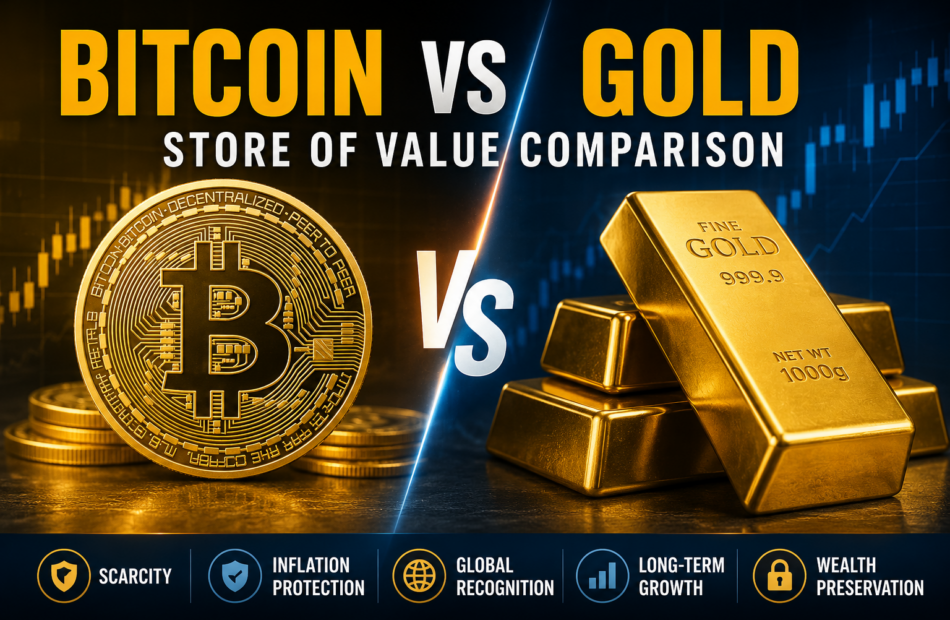
When comparing Bitcoin vs gold as a store of value, both assets serve different purposes. Gold has a centuries-long history of preserving wealth during economic uncertainty, while Bitcoin offers scarcity, portability, and higher long-term growth potential. The better choice depends on your investment goals, risk tolerance, and time horizon, with many investors choosing to own both for diversification.
INTRODUCTION
For decades, investors have relied on gold to preserve purchasing power during inflation, recessions, and financial crises. However, over the past decade, Bitcoin has emerged as a modern alternative that many call “digital gold.” This has sparked one of the biggest debates in investing today: bitcoin vs gold store of value comparison.
Is Bitcoin truly replacing gold, or is gold still the safest asset for protecting wealth?
The answer isn’t as simple as choosing one over the other. Each asset has unique strengths, weaknesses, and roles within a diversified investment portfolio. Understanding these differences can help you make smarter long-term investment decisions.
In this guide, we’ll compare Bitcoin and gold across multiple factors, including scarcity, inflation protection, volatility, liquidity, historical performance, institutional adoption, and long-term investment potential.
What Is a Store of Value?
A store of value is an asset that maintains or increases its purchasing power over time. It allows investors to preserve wealth instead of watching it erode because of inflation or currency depreciation.
A strong store of value generally has several characteristics:
- Limited supply
- High durability
- Strong market demand
- Easy transferability
- Long-term stability
- Global acceptance
- Resistance to inflation
Both Bitcoin and gold meet many of these requirements, but they achieve them in very different ways.
Why Investors Compare Bitcoin and Gold
Bitcoin and gold are often compared because both are scarce assets that operate independently of government-issued currencies.
Common reasons investors evaluate both include:
- Hedging against inflation
- Protecting wealth during economic uncertainty
- Diversifying investment portfolios
- Reducing exposure to fiat currency depreciation
- Preserving long-term purchasing power
While gold has thousands of years of history supporting its value, Bitcoin relies on mathematical scarcity, blockchain technology, and increasing global adoption.
Bitcoin vs Gold at a Glance
| Feature | Bitcoin | Gold |
|---|---|---|
| Supply | Fixed at 21 million coins | Limited but continually mined |
| Age | Since 2009 | Thousands of years |
| Portability | Digital and global | Physical transportation required |
| Divisibility | Up to 100 million satoshis | Limited practical divisibility |
| Storage | Digital wallets | Vaults, banks, home safes |
| Volatility | High | Relatively low |
| Growth Potential | High | Moderate |
| Historical Trust | Emerging | Extremely high |
| Accessibility | 24/7 global trading | Market hours vary |
This comparison shows why Bitcoin is often viewed as an innovative alternative rather than a direct replacement for gold.
Scarcity: Which Asset Is Truly Limited?
Scarcity plays a major role in determining whether an asset can retain value over time.
Bitcoin’s Fixed Supply
Bitcoin has one of the most transparent monetary policies ever created.
Key facts include:
- Maximum supply of 21 million BTC
- Supply cannot be increased
- New coins are issued through mining
- Block rewards decrease approximately every four years through Bitcoin halving
- Every transaction is publicly verifiable on the blockchain
This predictable issuance makes Bitcoin resistant to inflation caused by excessive money printing.
Gold’s Natural Scarcity
Gold is naturally scarce because mining new deposits requires significant exploration, equipment, and labor.
However:
- New gold continues entering circulation every year.
- New discoveries may increase supply.
- Recycling also contributes to market availability.
Although gold remains scarce, its total supply is not fixed like Bitcoin’s.
Winner for Scarcity: Bitcoin
Inflation Protection
One of the biggest reasons investors buy either asset is protection against inflation.
Gold During Inflation
Historically, gold has performed well during periods of:
- Rising inflation
- Currency weakness
- Banking crises
- Geopolitical uncertainty
Gold has served as a reliable hedge for generations because investors trust its intrinsic value.
Bitcoin as an Inflation Hedge
Bitcoin was introduced after the 2008 financial crisis with the goal of creating a decentralized monetary system immune to central bank money creation.
Many investors believe Bitcoin protects purchasing power because:
- Supply cannot be manipulated.
- It operates outside government control.
- Increasing adoption may strengthen long-term demand.
Although Bitcoin’s inflation-hedging record is much shorter than gold’s, institutional interest has significantly increased confidence in its long-term role.
Historical Performance Comparison
When evaluating investments, historical returns provide useful perspective.
Gold has delivered relatively stable long-term appreciation while preserving purchasing power across generations.
Bitcoin, however, has produced extraordinary long-term returns despite experiencing several severe market corrections.
Bitcoin
Advantages:
- Exceptional long-term capital appreciation
- Rapid adoption worldwide
- Increasing institutional participation
- Strong network effects
Challenges:
- High volatility
- Significant price swings
- Regulatory uncertainty in some countries
Gold
Advantages:
- Lower volatility
- Reliable wealth preservation
- Established global market
- Safe-haven reputation
Challenges:
- Slower capital growth
- Storage costs
- Lower upside potential during strong economic expansions
For investors seeking aggressive long-term growth, Bitcoin has historically outperformed gold. For investors prioritizing stability, gold continues to play an important defensive role.
Portability and Accessibility
Transporting and storing wealth has become increasingly important in today’s digital economy.
Bitcoin offers several advantages:
- Can be transferred globally within minutes
- Easily stored in hardware wallets
- Divisible into tiny fractions
- Accessible 24 hours a day
- No physical transportation required
Gold remains valuable but involves additional considerations:
- Requires secure storage
- Transportation can be expensive
- Insurance costs may apply
- Cross-border movement can be complicated
For modern investors who value mobility and convenience, Bitcoin offers significant practical advantages.
Volatility: Stability vs Growth
Volatility is one of the biggest differences in the bitcoin vs gold store of value comparison.
Gold has historically experienced relatively moderate price fluctuations, making it a preferred safe-haven asset during market uncertainty.
Bitcoin, meanwhile, is known for significant short-term price swings. While these fluctuations can be intimidating, they have also created opportunities for substantial long-term gains.
Gold Volatility
Pros:
- Stable price movements
- Lower investment risk
- Widely trusted during financial crises
- Lower correlation with stock markets
Cons:
- Slower wealth creation
- Limited upside during bull markets
Bitcoin Volatility
Pros:
- Higher return potential
- Strong long-term appreciation
- Growing institutional demand
Cons:
- Large market corrections
- Emotional investing can lead to poor decisions
- Higher short-term risk
Investors with a longer investment horizon often view Bitcoin’s volatility as the price paid for potentially higher returns.
Institutional Adoption
Institutional interest has transformed Bitcoin from a niche digital asset into a globally recognized investment.
Gold’s Institutional Position
Gold remains a cornerstone asset for:
- Central banks
- Sovereign wealth funds
- Pension funds
- Insurance companies
- Large investment firms
Its reputation has been built over centuries.
Bitcoin’s Growing Acceptance
Bitcoin has seen increasing adoption among:
- Publicly traded companies
- Asset managers
- Hedge funds
- Financial institutions
- Exchange-Traded Funds (ETFs)
Institutional participation has improved Bitcoin’s credibility and expanded access for traditional investors.
Liquidity and Market Accessibility
Liquidity determines how easily an asset can be bought or sold without significantly affecting its price.
Gold
Gold is highly liquid through:
- Bullion dealers
- Banks
- Commodity exchanges
- Gold ETFs
- Jewelry markets
However, physical gold transactions can involve premiums, storage fees, and transportation costs.
Bitcoin
Bitcoin trades continuously across global cryptocurrency exchanges.
Advantages include:
- 24/7 trading
- Instant international transfers
- Fractional ownership
- Digital custody options
- Increasing exchange liquidity
For investors seeking flexibility, Bitcoin offers greater accessibility in today’s digital economy.
Security and Ownership
Security is another major consideration when preserving wealth.
Gold Storage
Owners typically store gold in:
- Bank vaults
- Private vaults
- Home safes
While physical ownership provides reassurance, it also introduces risks such as theft, insurance expenses, and storage costs.
Bitcoin Storage
Bitcoin ownership depends on private keys.
Storage options include:
- Hardware wallets
- Software wallets
- Multi-signature wallets
- Institutional custodians
Although digital security requires careful management, Bitcoin eliminates many of the physical risks associated with storing precious metals.
Which Performs Better During Economic Crises?
Historically, gold has been the preferred safe-haven asset during:
- Banking failures
- Recessions
- Wars
- Currency crises
- High inflation
Investors often shift capital into gold because of its long-established reputation.
Bitcoin’s behavior during crises has been more mixed.
Some periods have shown:
- Strong recovery after market crashes
- Increased demand following monetary stimulus
- Growing adoption during currency instability
However, Bitcoin’s relatively short history means it has not yet experienced every type of economic cycle that gold has survived.
Tax Considerations
Tax treatment varies depending on the country.
Generally:
Gold
- Capital gains taxes may apply upon sale.
- Physical ownership can involve additional reporting requirements.
Bitcoin
- Usually taxed as a digital asset or property.
- Transactions, trading, and capital gains may be taxable.
- Regulations continue to evolve globally.
Investors should always consult a qualified tax professional before making investment decisions.
Who Should Choose Bitcoin?
Bitcoin may be more suitable for investors who:
- Have a long investment horizon
- Can tolerate higher volatility
- Believe in blockchain technology
- Want exposure to digital assets
- Seek higher potential returns
- Prefer easily transferable investments
It is particularly attractive to younger investors building long-term portfolios.
Who Should Choose Gold?
Gold remains an excellent choice for investors who:
- Prioritize wealth preservation
- Prefer lower volatility
- Need portfolio stability
- Value centuries of historical performance
- Want protection during geopolitical uncertainty
- Already own growth-oriented investments
Gold continues to serve as an important defensive asset.
Is Owning Both the Best Strategy?
For many investors, the answer is yes.
Rather than choosing between Bitcoin and gold, combining both assets can provide diversification.
A balanced allocation may offer:
- Inflation protection
- Reduced portfolio risk
- Exposure to digital innovation
- Stability during market downturns
- Long-term capital appreciation
- Better risk-adjusted returns
Many financial advisors now view Bitcoin as a complementary asset rather than a replacement for gold.
Expert Takeaway
The debate surrounding bitcoin vs gold store of value comparison isn’t about declaring one asset the absolute winner.
Gold offers stability, trust, and centuries of proven wealth preservation.
Bitcoin offers scarcity, technological innovation, portability, and exceptional long-term growth potential.
Investors should evaluate factors such as:
- Financial goals
- Investment horizon
- Risk tolerance
- Portfolio diversification
- Inflation expectations
- Liquidity needs
The strongest portfolios often include multiple asset classes instead of relying entirely on one investment.
Key Differences Summary
| Factor | Bitcoin | Gold |
|---|---|---|
| Supply | Fixed (21 million) | Limited but expanding |
| Inflation Hedge | Strong long-term potential | Historically proven |
| Volatility | High | Low |
| Growth Potential | Very High | Moderate |
| Safe Haven | Emerging | Established |
| Portability | Excellent | Moderate |
| Storage | Digital wallets | Physical vaults |
| Divisibility | Extremely high | Limited |
| Trading Hours | 24/7 | Market hours |
| Institutional Adoption | Rapidly increasing | Mature and widespread |
Frequently Asked Questions
Is Bitcoin a better store of value than gold?
Bitcoin has higher long-term growth potential due to its fixed supply of 21 million coins and increasing global adoption. Gold, however, has a much longer history of preserving wealth and typically experiences lower volatility. Investors seeking growth may prefer Bitcoin, while those prioritizing stability often choose gold.
Why do people call Bitcoin “digital gold”?
Bitcoin is called “digital gold” because it shares many characteristics with gold, including scarcity, limited supply, and resistance to inflation. Unlike physical gold, Bitcoin is digital, highly portable, easily divisible, and can be transferred globally within minutes.
Which asset performs better during inflation?
Gold has historically been one of the most reliable inflation hedges over centuries. Bitcoin is increasingly viewed as an inflation-resistant asset because of its fixed supply, but its shorter history means it has yet to prove itself across as many economic cycles as gold.
Is Bitcoin riskier than gold?
Yes. Bitcoin is significantly more volatile than gold and can experience large price swings over short periods. Gold generally provides greater price stability, making it a preferred option for conservative investors.
Should beginners invest in Bitcoin or gold?
The best choice depends on individual financial goals and risk tolerance. Beginners seeking long-term capital growth may allocate a small percentage of their portfolio to Bitcoin, while those looking for stability and wealth preservation may start with gold. Many investors choose to hold both for diversification.
Can Bitcoin replace gold in the future?
Bitcoin is increasingly being adopted as a digital store of value, but it is unlikely to completely replace gold in the near future. Gold remains deeply embedded in global financial systems, central bank reserves, and investment portfolios. Instead, Bitcoin is more likely to complement gold rather than replace it.
Is it smart to own both Bitcoin and gold?
Yes. Holding both assets can create a more balanced portfolio by combining gold’s stability with Bitcoin’s growth potential. This diversified approach may help reduce overall investment risk while providing exposure to different market opportunities.
Conclusion
The bitcoin vs gold store of value comparison highlights that there is no universal winner. Instead, each asset serves a distinct purpose within a well-rounded investment strategy.
Gold has earned its reputation over thousands of years as a dependable store of value, offering stability during inflation, recessions, and geopolitical uncertainty. Bitcoin, on the other hand, represents a new generation of digital assets with verifiable scarcity, unmatched portability, and significant long-term growth potential.
For investors seeking capital preservation, gold remains a trusted choice. For those willing to accept higher volatility in exchange for potentially greater returns, Bitcoin offers compelling opportunities. Many experienced investors find that combining both assets provides the ideal balance between security and growth.
As digital finance continues to evolve, understanding the strengths and limitations of each asset will help you make informed investment decisions aligned with your financial goals.
If you’re looking for expert cryptocurrency insights, in-depth Bitcoin guides, market analysis, and practical investment strategies, visit TheCryptoInvestors.com. Our team provides research-driven content designed to help beginners and experienced investors navigate the rapidly changing crypto landscape with confidence. Stay informed, build a smarter portfolio, and make better long-term investment decisions with trusted resources from TheCryptoInvestors.com.